
TL;DR:
- Mechanical testing provides valuable data early in development, improving design and quality decisions.
- Selecting the right test method depends on material, product stage, and regulatory requirements.
- Integrating automation and data analytics enhances efficiency, reproducibility, and material insight.
Mechanical testing is often treated as a final checkpoint before regulatory submission, a box to check before a product ships. That framing undersells it significantly. When integrated early and strategically, mechanical testing becomes one of the most powerful tools in your R&D and quality assurance toolkit. It informs material selection, flags failure modes before they reach the field, and generates the quantitative evidence that regulators, partners, and end users all rely on. This article covers the fundamentals, key methods, technology integration, compliance best practices, and real-world applications across biomedical, pharmaceutical, aerospace, and energy sectors.
Table of Contents
- The fundamentals of mechanical testing: What every lab manager should know
- Types of mechanical testing: Methods, applications, and selection criteria
- Integrating advanced technologies: Automation, data analytics, and modern mechanical testing
- Standards, compliance, and best practices in mechanical testing
- Real-world application: Mechanical testing in critical industries
- Why conventional mechanical testing mindsets leave innovation on the table
- Advance your materials testing with expert support
- Frequently asked questions
Key Takeaways
| Point | Details |
|---|---|
| Mechanical testing unlocks value | It delivers insights that drive compliance, innovation, and product reliability in critical industries. |
| Method selection is strategic | Choosing the right mechanical test depends on your material, product, and regulatory needs. |
| Technology fuels better results | Automation and analytics are revolutionizing mechanical testing accuracy and efficiency. |
| Standards are essential | Adhering to ISO and ASTM standards is crucial for product safety and successful audits. |
| Shift mindset for innovation | Seeing mechanical testing as an enabler, not a chore, helps organizations lead in their field. |
The fundamentals of mechanical testing: What every lab manager should know
Mechanical testing is the systematic evaluation of how materials and components respond to applied forces, whether tension, compression, shear, bending, or impact. The core objective is to characterize a material’s behavior under conditions that mirror real-world use, so that design teams, QA managers, and regulatory affairs professionals can make decisions grounded in data rather than assumptions.
At its most basic level, core mechanical test types verify durability, safety, and performance across the product lifecycle. But the value extends well beyond compliance. Mechanical data feeds directly into design optimization, supplier qualification, failure analysis, and post-market surveillance. Without it, you are essentially estimating risk rather than measuring it.
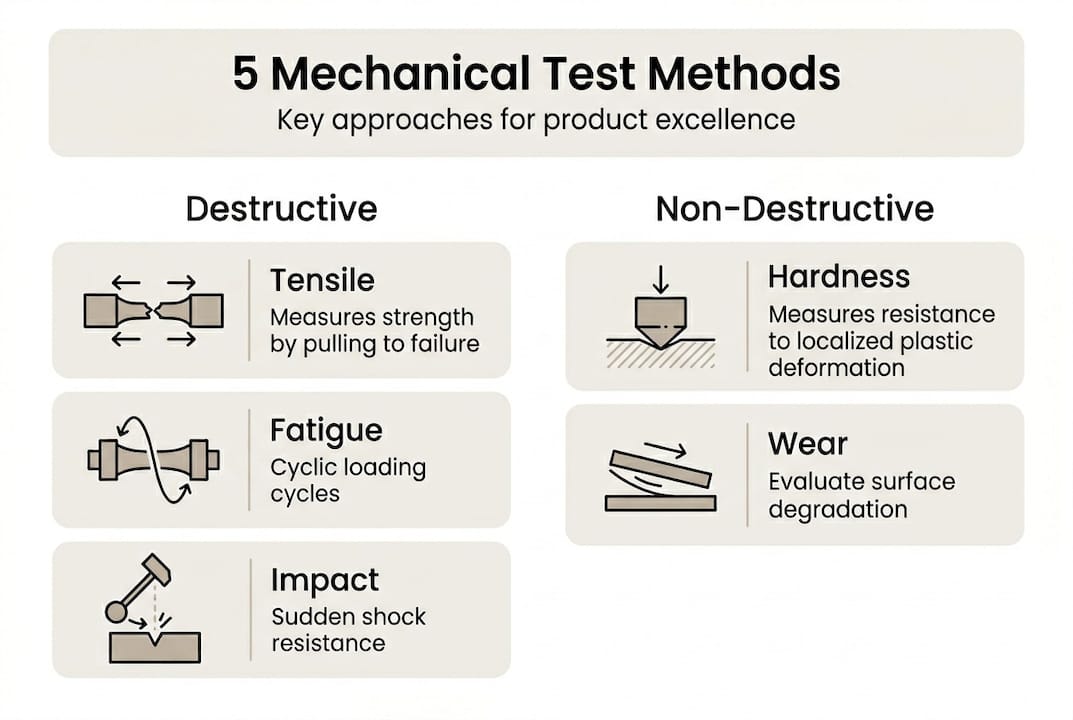
A common misconception is that mechanical testing only matters at the end of development. In reality, early-stage testing catches design flaws when they are least expensive to fix. Another misconception is that a single test type covers all material behavior. Different loading modes reveal different failure mechanisms, and selecting the wrong test can leave critical vulnerabilities undetected.
Here is what robust mechanical testing delivers for QA and R&D teams:
- Objective, quantitative data on tensile strength, yield point, elongation, and modulus
- Evidence for regulatory submissions under ISO, ASTM, and FDA frameworks
- Benchmarks for supplier qualification and incoming material inspection
- Early detection of batch-to-batch variability that laboratory quality control protocols depend on
- Performance data that supports design iteration and risk assessment
“Mechanical data is not just a compliance artifact. It is a living dataset that should inform every stage of your product’s development and post-market life.”
Treating mechanical testing as a strategic input rather than a final gate changes how your lab prioritizes resources and how your R&D team makes decisions.
Types of mechanical testing: Methods, applications, and selection criteria
Not all mechanical tests are created equal, and selecting the wrong method for your material or product context can produce misleading results. The first major distinction is between destructive and non-destructive testing.
Destructive tests push a sample to its limit, measuring properties like ultimate tensile strength, fracture toughness, or fatigue life. Non-destructive testing methods assess structural integrity and surface properties without altering the sample, which is essential when every unit has high value or when you need to test finished assemblies. Specific testing methods address different material and regulatory needs, so matching the method to the context is not optional.
Here is a summary of common methods, their applications, and trade-offs:
| Method | Typical application | Advantage | Limitation |
|---|---|---|---|
| Tensile testing | Polymers, metals, biologics | Direct strength data | Destroys sample |
| Compression testing | Implants, packaging, foams | Simulates in-use loading | Limited to compressive loads |
| Fatigue testing | Aerospace components, implants | Predicts cyclic failure | Time-intensive |
| Hardness testing | Coatings, alloys | Fast, minimal prep | Surface-level only |
| Nanoindentation | Thin films, micro-devices | Sub-micron resolution | Requires skilled interpretation |
| Ultrasonic NDT | Welds, composites | Non-destructive | Operator-dependent |
Industry context shapes the selection further. Biomedical device teams prioritize tests that align with ISO 10993 and simulate physiological loading. Aerospace engineers focus on fatigue and fracture under thermal cycling. Pharmaceutical packaging teams need compression and seal-integrity data. Energy sector applications often demand high-temperature creep and corrosion-fatigue testing.
Selection factors to evaluate before choosing a method:
- Material class: metal, polymer, ceramic, composite, or biological
- Product lifecycle stage: prototype, pre-clinical, or production
- Regulatory framework governing your market
- Whether the sample must be preserved for further analysis
- Required lab standards for method validation and traceability
Pro Tip: When in doubt, run a small exploratory panel using two or three complementary methods. The overlap in data often reveals failure modes that a single test would miss entirely.
Integrating advanced technologies: Automation, data analytics, and modern mechanical testing
Modern mechanical testing labs are no longer defined solely by their load frames and grips. Automation, digital data acquisition, and AI-assisted analysis are reshaping what is possible, and the labs that adopt these tools gain a measurable edge in throughput, reproducibility, and insight depth.
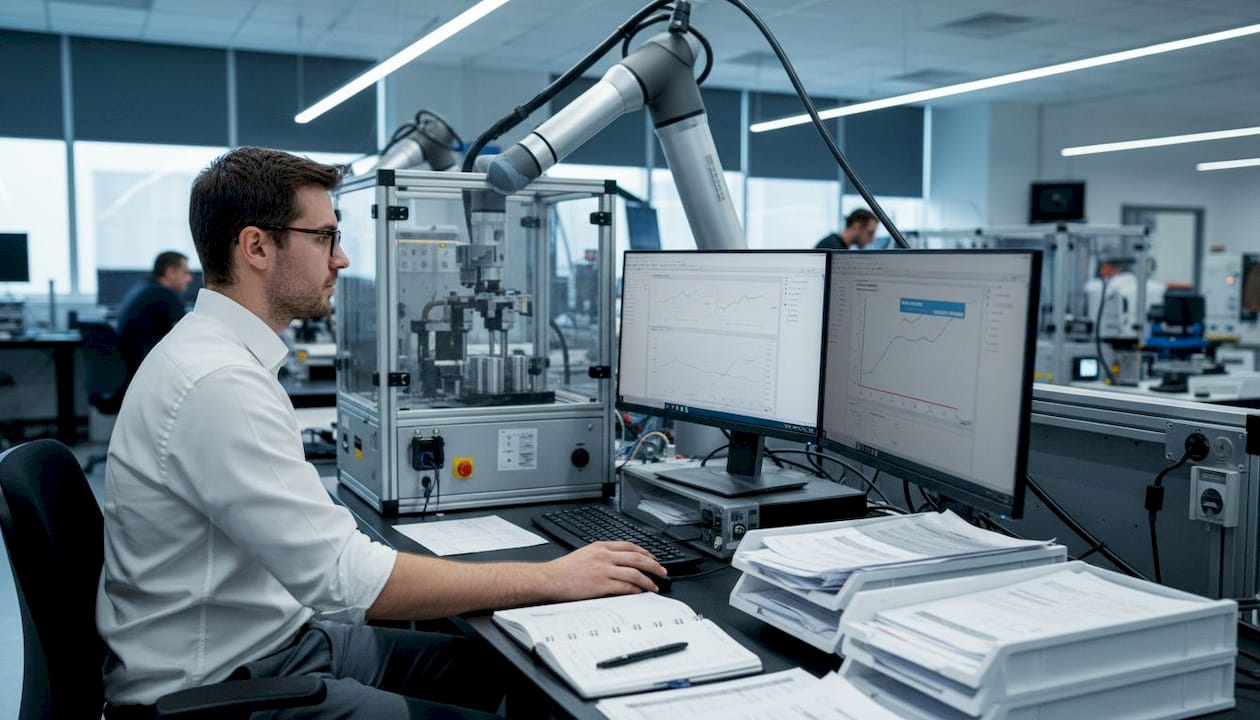
Automated systems increase throughput and reduce operator error, enabling more reliable results across high-volume testing campaigns. When you remove manual steps from sample loading, force application, and data recording, you also remove a significant source of variability. That matters enormously when your data feeds into regulatory submissions or comparative studies.
Here is how technology integration translates into lab-level impact:
| Technology | Impact area | Measurable benefit |
|---|---|---|
| Robotic sample handling | Throughput | 30 to 50% faster cycle times |
| Real-time data acquisition | Reproducibility | Reduced inter-operator variability |
| AI-based failure prediction | Insight depth | Earlier detection of fatigue onset |
| Digital twin modeling | Design iteration | Fewer physical prototypes needed |
| 3D scanning integration | Dimensional accuracy | Precise pre-test geometry capture |
Steps to begin integrating automation and analytics into your mechanical testing program:
- Audit your current workflow to identify the highest-variability manual steps.
- Prioritize automation for repetitive, high-volume tests where operator fatigue is a real risk.
- Implement a centralized data management system before adding more instruments.
- Pilot AI-assisted analysis on a well-characterized material to validate model outputs.
- Train operators on interpreting automated outputs, not just running the equipment.
Biomechanical testing innovations are also pushing boundaries in how we simulate complex, multi-axial loading that better replicates physiological or operational environments. Pairing these capabilities with streamlined lab workflows ensures that technology investments translate into real efficiency gains rather than added complexity.
Pro Tip: Before investing in automation hardware, map your data pipeline end-to-end. The bottleneck is often in data handling and reporting, not in the testing itself.
Standards, compliance, and best practices in mechanical testing
Regulatory compliance in mechanical testing is not simply about knowing which standard applies. It is about building a quality system that makes compliance a natural outcome of how your lab operates every day.
ISO and ASTM standards guide rigorous, reproducible mechanical test results essential for compliance across global markets. ISO 10993 governs biocompatibility and mechanical performance for medical devices. ASTM E8 covers tensile testing of metallic materials. ASTM D638 addresses plastics. Each standard defines not just the test procedure but also specimen geometry, loading rate, environmental conditions, and reporting requirements.
Practical steps to build audit-ready compliance into your mechanical testing program:
- Map every test method to its governing standard and document the rationale for any deviations
- Establish a calibration schedule for all load cells, extensometers, and environmental chambers
- Maintain complete chain-of-custody records for every sample tested
- Implement a formal operator training and competency verification program
- Review reagent standards for compliance when chemical environments are part of the test protocol
- Conduct internal audits at least annually, using the same criteria an external auditor would apply
“Audit readiness is not a sprint before an inspection. It is the result of consistent, well-documented lab practice built over time.”
Documentation quality is often the differentiator between a lab that passes an audit and one that struggles. Every test record should be traceable to a specific instrument, operator, calibration certificate, and standard version. When you build that traceability into your daily workflow rather than reconstructing it before an audit, compliance becomes far less stressful and far more reliable.
Real-world application: Mechanical testing in critical industries
All these best practices come to life in varied industries, and the results speak clearly. Industry-specific case studies highlight how mechanical testing in R&D drives better outcomes when applied with precision and intent.
Consider these four industry examples:
-
Biomedical devices: A spinal implant manufacturer used fatigue testing under simulated physiological loading to identify a stress concentration in the implant geometry. Redesigning that feature before clinical trials avoided a potential field failure and accelerated regulatory clearance.
-
Pharmaceutical packaging: A pharma company used compression and seal-integrity testing on blister packs to qualify a new supplier. The data revealed that one material variant failed under humidity cycling, preventing a costly packaging recall.
-
Aerospace materials: High-temperature tensile and creep testing on a new nickel superalloy confirmed its suitability for turbine blade applications, providing the performance envelope data needed for certification submissions.
-
Energy sector: A wind turbine blade manufacturer used fatigue and fracture toughness testing on composite laminates to extend the certified service life of existing blade designs, reducing replacement costs significantly.
A stepwise framework for applying mechanical testing results to R&D decisions:
- Define the failure mode you are trying to prevent or characterize.
- Select the test method that best replicates the loading condition in service.
- Run tests at statistically meaningful sample sizes.
- Interpret results in the context of your material specification and regulatory requirement.
- Feed findings back into the design or process, and retest to confirm the improvement.
Pro Tip: Cross-industry knowledge transfer is underused. Solutions developed for aerospace fatigue testing, for example, have direct applicability to orthopedic implant durability. Explore advanced materials testing industries to see where methods overlap and accelerate your problem-solving.
Why conventional mechanical testing mindsets leave innovation on the table
We see it regularly. A lab runs the required tests, generates the compliance data, and files the report. The product moves forward. But the deeper question, what did that data tell us about the material’s behavior that we did not already know, often goes unasked.
That gap is where innovation stalls. When mechanical testing is framed purely as a compliance exercise, the data is used to confirm rather than to discover. The missed opportunity is significant. A fatigue curve that shows unexpected early-stage crack initiation is not just a compliance flag. It is a signal to revisit your material selection, surface treatment, or geometry. A stress-strain curve with an anomalous yield point might reveal a processing inconsistency that, once corrected, improves batch-to-batch consistency across your entire production line.
The mindset shift we advocate is treating every mechanical test as a source of material intelligence. Pair your physical test data with computational modeling to predict behavior under conditions you have not yet tested. Use the results to build a material knowledge base that informs future projects, not just the current one. QA and R&D leaders who make this shift find that their testing programs generate compounding value over time, rather than isolated data points that expire with each project.
Advance your materials testing with expert support
Ready to put advanced mechanical testing to work for your next project? At Materials Metric, we support QA managers and R&D teams across biomedical, pharmaceutical, aerospace, and energy sectors with testing solutions that go beyond compliance checkboxes.
Our capabilities span tensile, compression, fatigue, wear, nanoindentation, and biomechanical testing, all supported by expert interpretation and regulatory consulting. We integrate advanced characterization techniques with your existing development workflows to accelerate timelines and strengthen your data packages. Whether you need method validation, custom test protocol development, or analytical testing solutions aligned with ISO or ASTM requirements, our team is ready to act as an extension of your research team. Contact us to discuss your testing goals.
Frequently asked questions
What is the difference between destructive and non-destructive mechanical testing?
Destructive tests damage or alter the sample to measure its limits, while non-destructive methods assess properties without causing harm, preserving the sample for further use or deployment.
Why is mechanical testing important for regulated industries like biomedical and pharmaceuticals?
Mechanical testing ensures that products meet strict safety, durability, and regulatory standards. Testing addresses both product quality and compliance needs required by national and international authorities.
How does automation impact mechanical testing?
Automated solutions maximize reliability and efficiency in testing by increasing throughput and consistency while reducing operator error and turnaround times.
Which standards are most commonly referenced in mechanical testing?
ISO and ASTM standards are widely used to define procedures and acceptance criteria. ISO 10993 and ASTM frameworks drive global mechanical testing practices across multiple industries.
What is the first step for a lab looking to upgrade its mechanical testing?
Start with a gap assessment of your current capabilities and prioritize investments in technology and training that align with your main quality and innovation goals.
Recommended
- Tensile, Compression and Shear Testing | Materials Metric | CRO
- Essential Non-Destructive Material Testing Methods | Testing Lab
- Method Development & Validation Services | Materials Metric
- Analytical testing explained: methods, compliance, and impact
- Quality Control in Production Utah: Cut Defects 90% with AI