
Analytical testing is often misunderstood as a back-end quality check, something you run after development is done. In reality, it is a strategic function embedded throughout product development, regulatory submission, and post-market surveillance. Across pharma, biomedical, aerospace, and energy sectors, the stakes for getting this right have never been higher. Regulatory agencies are demanding more rigorous data packages, and the cost of a failed submission or a product recall far outweighs the investment in a well-designed testing program. This guide covers the core definitions, key methodologies, validation standards, sector-specific applications, and the best practices that separate reliable programs from costly ones.
Table of Contents
- What is analytical testing? Scope and fundamentals
- Key methods and validation standards in analytical testing
- Sector perspectives: How analytical testing drives value in pharma, aerospace, and energy
- Nuances, challenges, and best practices for analytical testing success
- Why most analytical testing failures stem not from technology, but process design
- Enhance your analytical testing results with expert support
- Frequently asked questions
Key Takeaways
| Point | Details |
|---|---|
| Analytical testing defined | It uses proven techniques like HPLC and PAT to deliver validated results for materials, drugs, and devices. |
| Validation and compliance | Rigorous standards such as ICH and ASTM validate methods and ensure regulatory acceptance of data. |
| Sector-specific strategies | Pharma, aerospace, and energy fields each apply analytical testing differently to meet unique technical and safety challenges. |
| Best practice: fit-for-purpose | Success depends on choosing the right approach and validation scope for the application, not just the technology. |
| Expert support advantage | Working with specialized partners streamlines compliance, reduces risks, and accelerates innovation. |
What is analytical testing? Scope and fundamentals
Analytical testing is the systematic application of scientific methods to identify, quantify, and characterize the physical, chemical, and structural properties of materials, compounds, or products. It is not limited to a single industry or technique. Rather, it serves as the backbone of quality assurance, safety evaluation, and R&D acceleration across every regulated sector.
The core goals are consistent regardless of field: confirm identity and purity, ensure product safety, support regulatory submissions, and generate data that drives smarter development decisions. Understanding what is chemical analysis at a foundational level helps clarify how these goals translate into specific laboratory workflows.
The methodological landscape is broad. PAT, QbD, and DoE are central frameworks in pharmaceutical and biomedical manufacturing, enabling real-time process monitoring and structured experimental optimization. Common technologies include:
- HPLC and LC-MS/MS for quantification and structural identification of small molecules and biologics
- NIR and Raman spectroscopy for non-destructive, real-time material characterization
- UV-visible spectroscopy for concentration and purity assessments
- ICP-OES and ICP-MS for trace elemental analysis in biomaterials and energy materials
- SEM and XRD for surface morphology and crystallographic structure in aerospace and advanced materials
In pharma, these tools support batch release and stability studies. In biomedical device development, they confirm material biocompatibility and leachable profiles. In aerospace, they characterize alloy microstructure and fatigue behavior. In energy, they validate electrode composition and electrolyte stability.
Analytical testing is not a single discipline. It is a cross-sector infrastructure that connects raw material qualification to final product release, and every step in between.
The importance of analytical testing becomes especially clear when you consider that sector-agnostic principles, such as selectivity, precision, trueness, linearity, and robustness, apply equally whether you are testing a drug substance or a turbine alloy. These principles are what make results defensible to regulators and meaningful to engineers.
Key methods and validation standards in analytical testing
Now that you understand what analytical testing encompasses, it is critical to break down the specific methods used and the validation standards that ensure reliable, compliant results.

The method portfolio in modern analytical laboratories is wide. Beyond HPLC and LC-MS/MS, teams routinely use XRF for elemental mapping, TGA for thermal stability, EIS and CV for electrochemical characterization, and AFM for nanoscale surface analysis. Method selection depends on the analyte, matrix complexity, required sensitivity, and the regulatory framework governing the application.
Validation is what transforms a method from a useful tool into a defensible scientific instrument. The fitness-for-purpose approach defines the key parameters every validated method must address:
| Validation parameter | Definition | Regulatory relevance |
|---|---|---|
| Selectivity | Ability to measure the analyte in the presence of interferences | ICH Q2(R1), ISO 17511 |
| Linearity | Response proportional to analyte concentration over a defined range | ICH Q2(R1), ASTM E1655 |
| LOD / LOQ | Lowest detectable and quantifiable concentrations | ICH Q2(R1), Eurachem |
| Precision | Repeatability and intermediate precision across runs | ISO/IEC 17025 |
| Robustness | Resistance to small, deliberate changes in method parameters | ICH Q2(R1) |
| Trueness | Agreement between measured value and reference value | Eurachem, ISO 5725 |
A standard method development validation workflow follows a logical sequence:
- Define the analytical objective and regulatory context
- Select the method and technology platform
- Develop and optimize the method using DoE or systematic scouting
- Execute validation experiments against defined acceptance criteria
- Generate a validation report with full traceability
- Transfer the method to routine use with documented SOPs
- Monitor ongoing batch consistency evaluations to confirm continued performance
Pro Tip: Not every method requires full ICH Q2(R1) validation. Fit-for-purpose validation means calibrating the rigor of your validation to the intended use. Early-stage screening methods need far less documentation than those supporting a regulatory submission. Applying full validation to every exploratory assay wastes resources and delays timelines without adding scientific value.
Sector perspectives: How analytical testing drives value in pharma, aerospace, and energy
With foundational methods clarified, it is essential to see how analytical testing addresses the unique regulatory and engineering pressures of different industries.
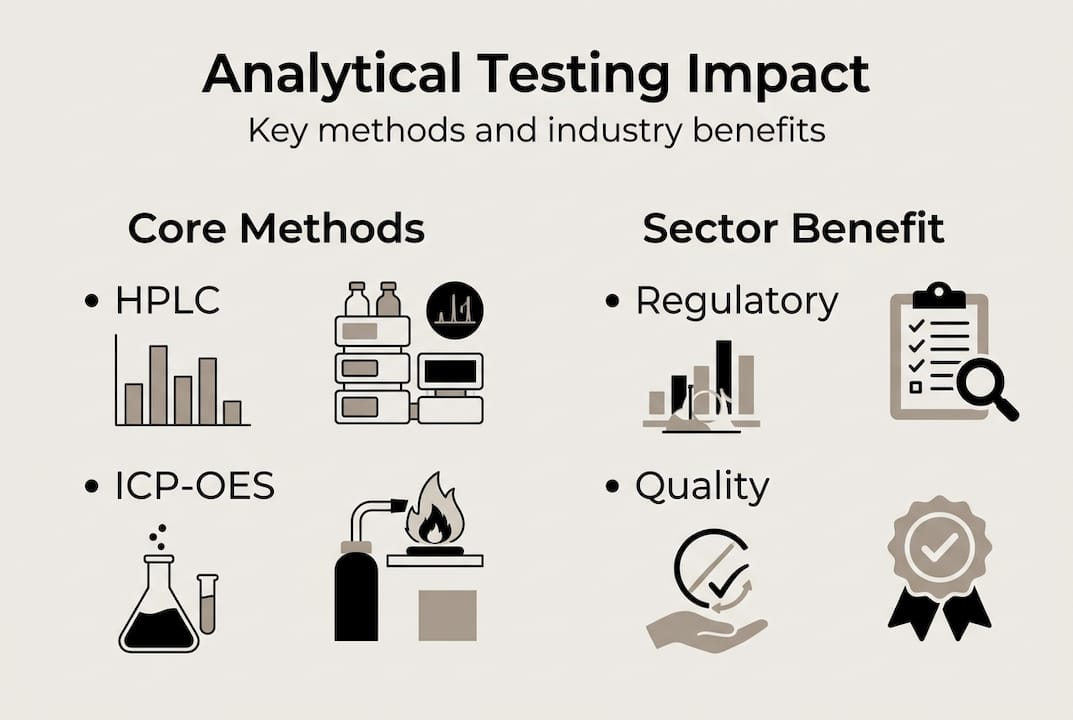
In pharmaceutical and biomedical manufacturing, PAT and QbD have fundamentally changed how quality is built into processes. Real-time monitoring using NIR and Raman allows manufacturers to detect deviations before they become batch failures. The impact is measurable: PAT reduces cycle time by approximately 30% and cuts batch reprocessing rates by up to 50%, based on documented outcomes from large-scale implementations. These are not marginal gains. They represent direct reductions in cost of goods and time to market.
In aerospace, the demands are different but equally rigorous. Structural materials must perform under extreme thermal and mechanical loads, and analytical testing provides the data that certifies they can. Low-cycle fatigue testing of alloys like Inconel 718 generates the knockdown factors that engineers use to set design margins. Surface condition data, temperature-dependent property measurements, and microstructural characterization all feed into airworthiness documentation. There is no shortcut here. A missed data point in a fatigue dataset can mean a design that fails in service. Our advanced analytical infrastructure supports the full range of these characterization needs.
In the energy sector, battery and fuel cell certification depends on precise elemental and electrochemical analyses. ICP-MS quantifies trace metal contamination in electrolytes. EIS characterizes impedance behavior across charge cycles. XRD tracks structural changes in cathode materials during aging. These analyses are not optional for grid-scale or automotive energy storage. Regulatory bodies and OEM customers require them.
| Sector | Core challenge | Primary methods | Measurable outcome |
|---|---|---|---|
| Pharma / biomed | Batch variability, real-time quality | PAT, NIR, Raman, HPLC | 30% faster cycles, 50% less reprocessing |
| Aerospace | Fatigue life, material certification | LCF testing, SEM, XRD, TGA | Validated knockdown factors for design |
| Energy | Electrode stability, contamination | ICP-MS, EIS, XRD, CV | Certified performance and safety data |
Nuances, challenges, and best practices for analytical testing success
As the complexity of analytical tasks increases, understanding the nuances, pitfalls, and emerging best practices becomes vital for robust outcomes.
Even well-designed methods can fail when real-world conditions are not accounted for. The most common challenges include:
- Matrix effects: Complex biological or industrial matrices suppress or enhance analyte signals, leading to inaccurate quantification if not controlled
- Sample instability: Degradation during storage or preparation introduces bias that no statistical correction can fully recover
- Equipment variability: Interlaboratory studies consistently show that even identical instrument models produce measurably different results at high temperatures or extreme concentration ranges
- Interference from co-eluting compounds: Particularly relevant in HPLC and LC-MS/MS work with complex mixtures
The fit-for-purpose validation framework addresses many of these by requiring teams to explicitly define the intended use before selecting validation parameters. This prevents over-engineering simple methods and under-validating critical ones.
Analytical Quality by Design (AQbD) is gaining traction as a structured approach to building robustness into methods from the start. Rather than discovering failure modes during validation, AQbD uses risk assessment and DoE to identify and control critical method parameters before they cause problems. It also aligns with green chemistry principles, reducing solvent consumption and waste without sacrificing analytical performance.
Validation scope should always be driven by the regulatory decision the data will support. Applying ICH Q2(R1) rigor to a screening assay is as problematic as applying minimal validation to a GMP release method.
Engaging custom testing method development expertise early in your program prevents the most expensive mistakes. Combining that with structured quality compliance support ensures your documentation holds up under regulatory scrutiny.
Pro Tip: When transferring methods between laboratories or instruments, always run a formal method transfer study with predefined acceptance criteria. Do not assume that a validated method will perform identically on a different instrument platform, even from the same manufacturer.
Why most analytical testing failures stem not from technology, but process design
We see a consistent pattern across sectors: organizations invest in the latest instrument platforms and still face failed validations, rejected submissions, or out-of-specification results. The technology is rarely the problem.
The real issue is almost always upstream. Testing strategies are defined too late, after formulation or material selection is locked. Validation scope is set without a clear picture of the regulatory pathway. Senior scientific judgment is absent from early-stage method design decisions. These are process failures, not instrument failures.
PAT and QbD outcomes reinforce this point. The organizations that achieve the largest reductions in cycle time and reprocessing are not necessarily the ones with the most advanced equipment. They are the ones that built quality into the process design from the beginning. The same logic applies to ASTM and ISO compliance in aerospace and energy. Meeting a standard is not about having the right instrument. It is about having the right study design, the right acceptance criteria, and the right documentation strategy.
The importance of analytical testing is best realized when senior analytical scientists are engaged at the project planning stage, not called in to troubleshoot after a failure. That shift in timing, from reactive to proactive, is where the greatest value is created.
Enhance your analytical testing results with expert support
Ready to apply these principles and level up your analytical testing practice? Reliable results, defensible data packages, and faster regulatory timelines all depend on the quality of your testing strategy and execution.
At Materials Metric, we function as an extension of your research and compliance team. Our integrated chemical and microscopy characterization services combine spectroscopic, chromatographic, and imaging techniques into cohesive analytical programs tailored to your regulatory context. Our chemical and elemental characterization capabilities cover trace analysis, purity profiling, and material identity confirmation across pharma, biomedical, aerospace, and energy applications. Learn more on analytical testing importance and contact us to discuss a testing strategy built around your specific compliance and development goals.
Frequently asked questions
What are the most common analytical testing methods?
HPLC, UV-visible, Raman, LC-MS/MS, and ICP-OES/MS are widely used for analyzing pharmaceuticals, biomaterials, and energy materials, each selected based on the analyte type, matrix complexity, and required sensitivity.
What is the difference between full and partial validation in analytical testing?
Full validation is required for methods supporting regulatory submissions, while partial validation is appropriate for early-stage research or when only specific parameters need confirmation relative to a previously validated method.
How does analytical testing improve compliance and reduce risk?
Real-time monitoring via PAT and validated methods ensure that data meets regulatory acceptance criteria, directly reducing the risk of batch failures, product recalls, or rejected submissions.
What are common challenges in analytical testing, and how can they be overcome?
Matrix effects, sample instability, and equipment variability are the most frequent obstacles, and they are best addressed through fit-for-purpose method design, robust validation planning, and formal method transfer protocols.