
Thermogravimetric analysis (TGA) is routinely described as a mass loss test. That description is accurate enough to be useful and misleading enough to cause real problems. Many pharmaceutical and biomedical development teams run TGA expecting a straightforward decomposition profile, then encounter unexpected data that stalls regulatory submissions or triggers audit queries. The core issue is this: mass gain can occur during TGA when oxygen is present, because oxidation reactions add mass to a sample rather than removing it. Understanding that single principle, along with the full range of atmosphere effects and data synchronization strategies, separates teams that interpret TGA confidently from those who spend weeks explaining anomalous results to reviewers.
Table of Contents
- What is TGA and why does it matter for advanced materials?
- Understanding mass changes: Atmosphere effects and interpretation challenges
- Combining TGA with evolved gas analysis: Unlocking deeper insights
- How TGA compares to other thermal analysis methods in pharma
- What most pharma teams miss in TGA interpretation
- How Materials Metric can support your advanced TGA needs
- Frequently asked questions
Key Takeaways
| Point | Details |
|---|---|
| TGA offers more than mass loss | Controlled atmosphere selection in TGA can reveal critical insights—including mass gain—essential for pharmaceutical materials research. |
| Integration enhances value | Combining TGA with evolved gas analysis can pinpoint decomposition products, supporting regulatory and formulation clarity. |
| Know the regulatory boundary | TGA supports but does not dictate pharmaceutical compliance—documentation and method choices remain key. |
| Comparative insight drives success | Judiciously pairing TGA with other thermal analysis methods yields more robust data for high-stakes pharmacological applications. |
What is TGA and why does it matter for advanced materials?
Thermogravimetric analysis measures changes in a sample’s mass as temperature rises at a controlled rate. The instrument records a continuous mass vs. temperature (or mass vs. time) curve, revealing precisely when and how much mass is gained or lost. For pharmaceutical and biomedical development teams, this translates directly into actionable data on moisture content, residual solvent levels, polymer filler ratios, excipient degradation thresholds, and thermal stability windows.
Understanding the thermogravimetric analysis basics is essential before mapping the technique to regulatory objectives. The three primary variables your team must specify in any TGA protocol are:
- Temperature ramp rate: Typically 5°C/min to 20°C/min; faster ramps can blur adjacent events
- Atmosphere: Nitrogen, air, argon, or oxygen; this single choice fundamentally changes what the data mean
- Sample mass: Usually 5 mg to 20 mg; too much sample suppresses heat transfer; too little amplifies noise
TGA is genuinely indispensable in pharmaceutical material workflows. Polymer excipients used in controlled-release tablets, for example, often contain residual solvents or absorbed moisture that must be quantified before stability studies begin. Bioabsorbable implant polymers such as polylactic acid (PLA) require degradation threshold verification to confirm that sterilization temperatures do not trigger early decomposition. TGA provides that verification with sub-milligram resolution.
One point worth clarifying for teams working in global regulatory environments: the acronym “TGA” is shared between thermogravimetric analysis and the Therapeutic Goods Administration in Australia. These are entirely separate entities. Australian TGA guidance addresses labeling and presentation requirements for listed medicines. It has no bearing on technical acceptance criteria for thermogravimetric analysis data. TGA as a characterization technique supports materials data that feeds regulatory submissions, but it is not itself a regulatory framework. Your analytical team needs both in scope but should never conflate them in documentation.
Statistic callout: Residual solvent content above ICH Q3C limits can disqualify a drug product from market authorization. TGA is one of the fastest screening methods to flag excipients or active pharmaceutical ingredients that exceed those thresholds before formal GC headspace analysis is commissioned.
Understanding mass changes: Atmosphere effects and interpretation challenges
Most TGA runs in pharmaceutical labs default to a nitrogen atmosphere, and for good reason. Nitrogen is inert. It suppresses oxidation reactions and gives you a clean decomposition profile free of competing chemistry. But not every material, and not every regulatory question, fits the inert atmosphere assumption.
When a sample is analyzed under air or oxygen, mass gain due to oxidation is a real possibility. Metal-based biomedical coatings, iron oxide nanoparticle formulations, and certain catalytic excipients can pick up oxygen at elevated temperatures, resulting in a positive mass deviation on the TGA curve. If your team is expecting only mass loss, this upward curve segment will look like instrument error. It is not. It is chemistry, and it carries regulatory significance.
The following table summarizes common mass change scenarios for pharmaceutical and biomedical materials:
| Material class | Atmosphere | Expected event | Curve behavior |
|---|---|---|---|
| Hydrated excipients (e.g., lactose monohydrate) | Nitrogen | Moisture loss | Mass decreases, 100°C to 150°C |
| Residual solvent in API | Nitrogen | Solvent outgassing | Sharp mass decrease, 60°C to 120°C |
| Polymer binder (e.g., HPMC) | Nitrogen | Thermal decomposition | Stepwise mass decrease, 300°C+ |
| Iron oxide nanoparticles | Air/Oxygen | Oxidation | Mass increase before decomposition |
| Stearic acid lubricant | Nitrogen | Volatilization | Smooth mass loss, 200°C to 280°C |
| Carbon-based filler | Air | Combustion | Rapid mass loss, 400°C to 600°C |
Reviewing this table makes one thing clear: the atmosphere column is not a default setting. It is a deliberate experimental decision with direct consequences for data interpretation. Teams running oxidation mode TGA studies for metal-containing biomedical materials need a fundamentally different protocol mindset than teams characterizing polymer excipients under inert conditions.
The risk of thermal degradation is another layer that demands atmosphere alignment. Some materials degrade differently when trace oxygen is present, even at levels far below a full oxidative atmosphere. This is where using ultra-high purity nitrogen, verifying purge rates, and confirming line integrity become non-negotiable steps in protocol setup.
“Although most samples show mass loss when heated, materials exposed to oxygen can show mass gain due to oxidation reactions that produce heavier oxide species.”
Pro Tip: Before finalizing any TGA protocol, cross-check your atmosphere selection against three documents: the anticipated decomposition chemistry for your material class, the relevant pharmacopeial method if one exists, and your regulatory submission data package outline. Misalignment across any of these three creates reconciliation work later.
Combining TGA with evolved gas analysis: Unlocking deeper insights
A single TGA curve tells you when and how much mass changes. It does not tell you what is leaving or forming. For pharmaceutical product development, knowing the identity of volatile decomposition products is often the difference between a clear regulatory narrative and an inconclusive data package.
Evolved gas analysis (EGA) resolves this gap. EGA systems couple the TGA furnace to a secondary detector, capturing and identifying gases as they exit the sample. The three most widely used configurations are:
- TGA-MS (mass spectrometry): Provides real-time molecular weight detection of evolved gases. Excellent for identifying water, CO2, low molecular weight solvents, and decomposition fragments. Sensitivity is high, but spectral interpretation requires expertise.
- TGA-FTIR (Fourier transform infrared spectroscopy): Identifies functional groups in evolved gases. Particularly useful for distinguishing between different organic volatile species that share similar molecular weights.
- TGA-GC-MS (gas chromatography-mass spectrometry): Captures evolved gases for chromatographic separation before mass spectrometric identification. Best suited for complex mixtures where co-elution in simpler systems would mask individual species.
Advanced TGA techniques that integrate EGA are increasingly expected in sophisticated regulatory submissions, particularly for novel drug delivery systems and combination products. When combining TGA with EGA, evolved decomposition products are identified on a synchronized time axis, giving your team a correlated thermal and chemical fingerprint of the material.

The value becomes obvious when you consider overlapping thermal events. Many pharmaceutical excipient blends show two or three mass loss steps within a 50°C window. TGA alone cannot distinguish whether those steps represent moisture loss, solvent outgassing, or early polymer chain scission. Adding FTIR or MS detection resolves each event to a specific chemical identity, supporting unambiguous data interpretation.
| Analysis type | What it measures | Overlapping event resolution | Regulatory data depth |
|---|---|---|---|
| TGA alone | Mass vs. temperature | Low (events can merge) | Basic characterization |
| TGA + MS | Mass + evolved gas molecular weight | High | Intermediate, good for known species |
| TGA + FTIR | Mass + evolved gas functional groups | High | Strong for organic decomposition |
| TGA + GC-MS | Mass + separated and identified species | Very high | Strongest for complex mixtures |
Essential workflow steps to synchronize TGA and EGA:
- Calibrate both instruments to a shared temperature standard before coupling
- Verify transfer line temperature to prevent condensation of evolved gases between furnace and detector
- Confirm purge gas flow rate is optimized for both TGA sensitivity and detector response time
- Run a reference standard with known decomposition products to validate spectral assignment
- Generate time-aligned overlay plots showing mass loss derivative (DTG) and spectral signal together
- Archive raw coupled data files separately from processed outputs for audit traceability
Pro Tip: During a regulatory audit or new drug application review, synchronized TGA-EGA data sets can resolve queries that would otherwise require repeat studies. When a reviewer questions what was released during a specific decomposition event, a time-aligned MS or FTIR trace answers that question definitively, without scheduling additional experiments.
How TGA compares to other thermal analysis methods in pharma
Thermal analysis is a family of techniques, not a single tool. Selecting the right method for your regulatory or formulation question requires clarity on what each technique actually measures and where its blind spots are.
TGA measures mass change as a function of temperature. It excels at quantifying moisture, residual solvents, filler content, and decomposition temperatures. It provides no direct information about phase transitions, melting behavior, or mechanical property changes.
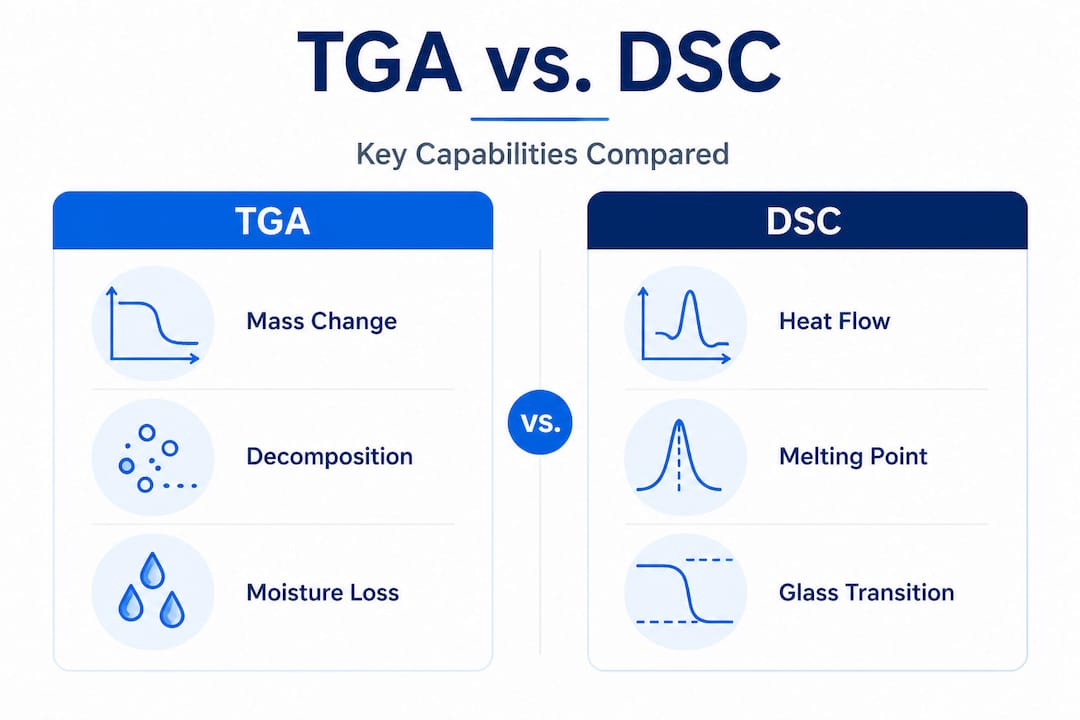
Differential scanning calorimetry (DSC) measures heat flow into or out of a sample relative to a reference. Differential scanning calorimetry identifies melting points, glass transition temperatures (Tg), crystallization events, and enthalpy changes. DSC is the preferred tool for polymorphism screening and solid-state characterization of APIs. It tells you nothing directly about mass change.
Thermomechanical analysis (TMA) measures dimensional changes (expansion, contraction, softening) under a defined load as temperature changes. Thermo-mechanical analysis is essential for implant materials, adhesive systems, and packaging components where coefficient of thermal expansion or creep behavior drives design decisions.
Situations where TGA is indispensable:
- Quantifying residual solvent in solid dosage forms prior to ICH Q3C compliance documentation
- Determining filler content in composite biomaterials or polymer matrix composites
- Establishing decomposition temperature limits for process design (e.g., hot melt extrusion setpoints)
- Verifying moisture uptake behavior of hygroscopic excipients during stability studies
- Characterizing carbon content in surface-modified medical device components
Situations where DSC or TMA would be the superior choice:
- Confirming API polymorph identity or detecting amorphous conversion
- Measuring Tg of polymer coatings for drug eluting stent applications
- Evaluating thermal expansion compatibility between adhesive layers and substrate materials
- Quantifying heat of fusion for API crystallinity determination
The thermal analysis strategies that generate the most robust regulatory data packages typically combine TGA and DSC as a baseline pair. When the question involves mechanical performance under thermal load, TMA is added. When evolved gas identification matters, EGA coupling is layered in. No single technique covers every regulatory or formulation question your team will face across a development program.
It is worth repeating clearly: Australian TGA guidance defines labeling and presentation requirements for listed medicines and is entirely separate from technical criteria for thermogravimetric analysis. Aligning your thermal characterization data with regulatory submission requirements means understanding both, but never treating them as the same document set.
What most pharma teams miss in TGA interpretation
After working with pharmaceutical and biomedical development teams on complex thermal characterization programs, we have observed one mistake more consistently than any other: underestimating how much the atmosphere selection shapes the entire data narrative.
Most teams treat the gas selection field in the instrument software as a housekeeping detail. It is not. It is a primary experimental variable, and it needs to appear in your protocol review checklist with the same rigor as temperature ramp rate and sample preparation procedure. We have reviewed data packages where a mass increase in the 200°C to 350°C range was flagged as a potential instrument artifact during an agency query. The actual cause was oxidation under residual air due to an improperly purged nitrogen line. That single oversight required a full repeat study, delayed a submission by six weeks, and generated unnecessary questions about data integrity.
The mass gain phenomenon in oxidative atmospheres is well-documented in instrument manufacturer guidance, yet it surfaces repeatedly in audit contexts because teams do not connect the atmospheric condition to the curve anomaly in real time. The fix is simple: build atmosphere verification into your pre-run checklist, not just your post-analysis report.
The second pattern we see consistently is the failure to use synchronized EGA data when thermal events overlap. Teams invest in TGA instrumentation and run hundreds of samples, but reserve TGA-FTIR or TGA-MS coupling for exceptional cases only. In practice, borderline results that cannot be explained by TGA alone represent exactly the scenarios where regulators ask the hardest questions. Proactive EGA coupling on formulation development studies, not just validation batches, gives your team a deeper understanding of the material before regulatory review begins.
Our recommendation is practical: establish a two-tier TGA protocol framework. Tier one is standard TGA under defined atmosphere for routine screening. Tier two triggers TGA plus EGA automatically when overlapping events are detected or when the material is novel. Document the decision criteria for tier escalation, and you have built an advanced thermal analysis governance structure that survives audit scrutiny.
How Materials Metric can support your advanced TGA needs
Mastering the nuances of TGA interpretation requires both the right instrumentation and deep methodological expertise. If your team is managing complex formulation questions, addressing audit queries, or building a regulatory submission that depends on robust thermal characterization data, we are here to act as an extension of your analytical team.

At Materials Metric, we provide analytical compliance services that cover TGA method development, atmosphere protocol optimization, and full TGA-EGA coupling studies with expert data interpretation. We work directly with pharmaceutical and biomedical product development teams to design testing workflows that align with regulatory submission standards and GLP/GMP documentation requirements. Our material characterization toolkit spans thermal, chemical, and microscopy-based techniques that can be combined to answer the most demanding characterization questions. When your project requires integrated chemical characterization, we bring these capabilities together in a coordinated, audit-ready data package tailored to your submission timeline.
Frequently asked questions
Can TGA be used to support regulatory submissions in pharmaceuticals?
TGA data supports materials characterization for regulatory submissions by quantifying moisture, residual solvents, and decomposition behavior, but TGA itself does not define compliance criteria or replace official regulatory agency review. It functions as characterization evidence within a broader submission package.
What’s a common source of error in interpreting TGA results?
Ignoring atmosphere selection is one of the most frequent mistakes, because oxygen in the atmosphere can produce mass gain rather than the expected mass loss through oxidation reactions, leading teams to misidentify the event as instrument error.
When should TGA be combined with other techniques?
Combine TGA with evolved gas analysis (MS, FTIR, or GC-MS) whenever thermal events overlap or when you need to positively identify decomposition products rather than simply quantify mass change.
Does TGA follow specific criteria set by regulatory agencies like the Australian TGA?
No. Thermogravimetric analysis has its own technical criteria defined by instrument methodology and pharmacopeial guidance; Australian TGA requirements govern labeling and presentation of medicines and are entirely separate from thermogravimetric analysis acceptance standards.