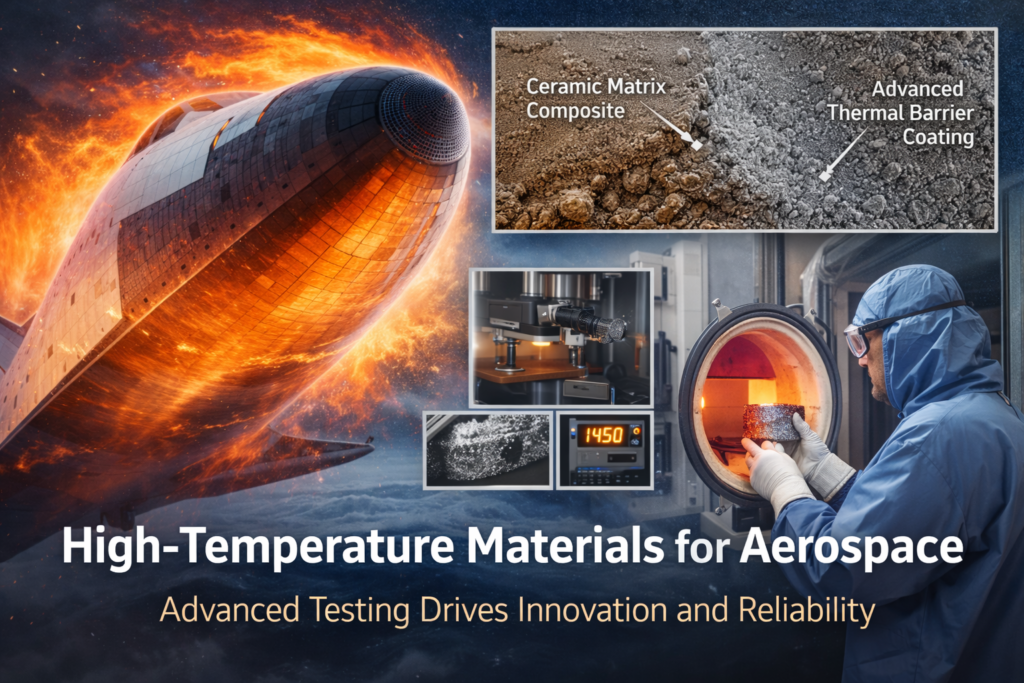
Aerospace materials operate under some of the most extreme conditions encountered in engineering. High temperatures, thermal cycling, oxidative environments, and mechanical stress demand materials that perform reliably where failure is not an option.
Advancing high-temperature materials requires not only novel material systems but also custom testing strategies that reflect real operating conditions.
Challenges in High-Temperature Aerospace Materials
Modern aerospace systems rely on materials that must:
Maintain structural integrity at elevated temperatures
Resist thermal degradation and oxidation
Perform under sustained mechanical and thermal loading
Meet strict safety and reliability standards
These requirements drive innovation in polymers, composites, ceramics, and protective coatings.
Emerging High-Temperature Material Systems
Key areas of research include:
High-performance polymers and polymer matrix composites
Ceramic and ceramic-matrix composites for thermal protection
Advanced coatings for heat, oxidation, and corrosion resistance
Additively manufactured components with complex microstructures
Each material system introduces unique testing challenges that standard methods often fail to address.
How Materials Metric Supports Aerospace Materials Development
Materials Metric delivers custom testing solutions tailored to high-temperature aerospace applications, including:
Thermal stability and degradation analysis at elevated temperatures
Mechanical and structural characterization under extreme conditions
Surface and interfacial analysis of coatings and composites
Our testing protocols are designed around application-specific requirements, ensuring meaningful and actionable data.