Summary
- Standard thermal analysis often misses subtle phase transitions critical for material stability and performance.
- DSC measures heat flow differences during temperature changes to detect and quantify thermal events precisely.
- Combining DSC with techniques like TGA, FTIR, and XrPD ensures comprehensive material characterization and regulatory compliance.
Standard thermal analysis often fails to detect the subtle phase transitions that determine whether a drug formulation stays stable on the shelf, a biomedical polymer maintains its mechanical integrity in vivo, or an aerospace composite cures to the correct degree. These gaps are not trivial. They translate directly into failed regulatory submissions, costly reformulations, and structural failures in high-performance applications. DSC fundamentals resolve this by delivering quantitative, high-resolution thermal event data that conventional methods simply cannot match. In this guide, we walk through how DSC chemistry works, which modes apply to your material system, where it delivers the greatest value across industries, and how to integrate it with complementary techniques for maximum analytical confidence.
Table of Contents
- What is DSC chemistry? principles and core mechanisms
- Key DSC modes: techniques for complex materials
- DSC applications in pharmaceuticals, biomedical, and aerospace R&D
- integrating DSC with complementary characterization techniques
- Why most experts miss the full value of DSC chemistry
- Your next step: advanced material analysis with Materials metric
- frequently asked questions
Key Takeaways
| Point | Details |
|---|---|
| DSC enables precise heat flow analysis | You can identify critical material transitions for advanced product development. |
| Method selection drives data quality | Choosing the right DSC mode improves sensitivity in complex pharmaceutical and aerospace systems. |
| Integrate DSC with other techniques | Pairing DSC with structural and mass-change tests ensures reliable, actionable insights. |
| Expert interpretation avoids pitfalls | Optimizing scan rates and validating with orthogonal data maximize research accuracy. |
What is DSC chemistry? principles and core mechanisms
Now that you know why DSC is becoming essential in high-performance material R&D, let’s break down its fundamental science.
DSC is a thermal analysis technique that measures heat flow differences between a sample and a reference material during a controlled temperature program. As the sample undergoes a physical or chemical transition, it absorbs or releases energy at a rate that differs from the inert reference. That differential is the signal.
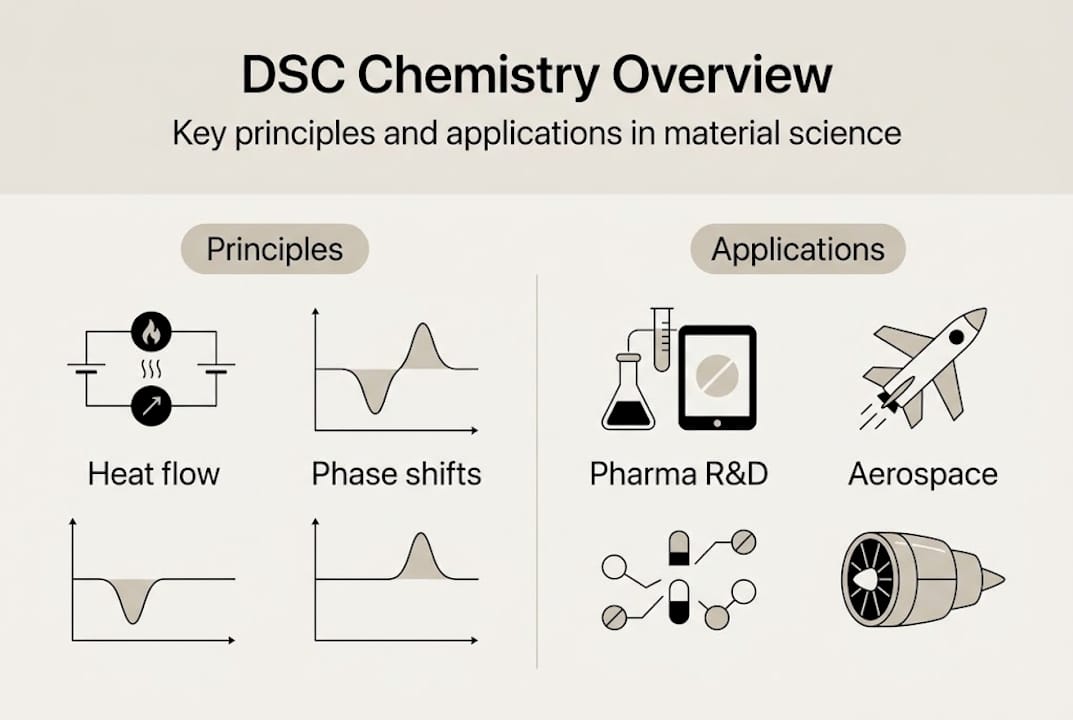
Two instrument designs dominate the field. Heat-flux DSC uses a single furnace where both sample and reference share a common heat source, and a thermocouple array measures the temperature difference between them. Power-compensation DSC uses two independent micro-furnaces, actively adjusting power input to maintain identical temperatures in both cells. Power-compensation instruments offer faster response and better baseline stability for precision work, while heat-flux designs are often more robust for routine screening.
What makes DSC particularly powerful for advanced material studies is its quantitative capacity for enthalpy/11:_thermal_methods/11.02:_differential_thermal_analysis_and_differential_scanning_calorimetry). The area under a DSC peak directly corresponds to the enthalpy change (expressed as delta H) for that transition. This means you are not just detecting that a transition occurred, you are measuring how much energy was involved.
Common thermal events captured by DSC include:
- Glass transition (T_g): A reversible change in polymer chain mobility, appearing as a step change in heat capacity
- Cold crystallization: An exothermic event where an amorphous phase organizes into a crystalline structure upon heating
- Crystal melting: An endothermic peak marking the transition from solid to liquid phase
- Chemical curing: An exothermic reaction during thermoset or composite processing
- Phase separation and decomposition: Secondary events that signal material instability
| Material class | Primary DSC event | 典型 delta H range (J/g) | Notes on detection sensitivity |
|---|---|---|---|
| Small molecule pharmaceuticals | Crystal melting | 80 to 200 | Sharp, well-defined peaks |
| Semi-crystalline polymers | T_g + melting | 20 to 150 | Multiple overlapping events common |
| thermoset composites | curing exotherm | 50 to 400 | Rate-dependent; modulated DSC preferred |
| lipid-based formulations | Phase transition | 10 to 80 | moisture sensitivity critical |
This combination of event detection and energy quantification makes DSC indispensable for any team working with advanced thermal strategies in materials validation.
Key DSC modes: techniques for complex materials
With a grasp of DSC’s basics, it’s vital to understand the specialized techniques available for extracting complex insights from modern material systems.
Selecting the right DSC mode is as important as selecting the right sample. Standard heat-flux and power-compensation instruments handle routine characterization well, but many advanced material systems present overlapping transitions that a single linear heating ramp cannot resolve. DSC operates via heat-flux or power-compensation/11:_thermal_methods/11.02:_differential_thermal_analysis_and_differential_scanning_calorimetry) and is used to resolve endothermic and exothermic transitions, but the mode you choose determines the resolution you achieve.
Temperature-modulated DSC (also called modulated DSC or TM-DSC) superimposes a sinusoidal temperature oscillation on the conventional linear ramp. This separates the total heat flow signal into two components: a reversing signal (capturing reversible events like T_g and heat capacity changes) and a non-reversing signal (capturing irreversible events like cold crystallization, curing, and relaxation enthalpy). Calibrated modulated DSC helps resolve overlapping transitions and quantify trade-offs in advanced materials, which is why it has become the preferred mode for pharmaceutical amorphous solid dispersions and nanocomposite thermosets.
| Parameter | routine DSC | modulated DSC (TM-DSC) |
|---|---|---|
| T_g resolution | moderate | High |
| overlapping event separation | Limited | excellent |
| measurement time | Short | longer |
| ideal application | screening, melting point | amorphous phases, composites |
| data output | total heat flow | reversing + non-reversing components |
Optimizing scan rates is critical to avoiding artifacts, especially in amorphous systems. Follow these steps:
- Start with a standard 10°C/min scan to establish baseline event positions
- Run a slower scan (2 to 5°C/min) to improve resolution for closely spaced transitions
- For modulated DSC, select a modulation amplitude of 0.5 to 2°C and a period of 40 to 100 seconds
- Run a heat-cool-heat cycle to separate reversible from irreversible transitions
- Always anneal amorphous samples below T_g before the final measurement to remove thermal history effects
Pro tip: For pharmaceutical amorphous solid dispersions and polymer nanocomposites, modulated DSC consistently outperforms classical DSC because it isolates the T_g signal from overlapping relaxation events. If your team is still relying on standard ramps for these systems, you are likely underreporting or misassigning transitions. Consider modulated DSC techniques as a first-line tool rather than a fallback.
DSC applications in pharmaceuticals, biomedical, and aerospace R&D
Equipped with an understanding of DSC operation modes, you can see how these choices directly translate to measurable impact in industry research and product development.

Across sectors, DSC delivers answers to questions that other techniques leave open. DSC is used for purity assessment, glass transition, and excipient compatibility in pharmaceuticals, and for optimization of composites in aerospace, making it one of the few techniques that genuinely spans the full spectrum of advanced material R&D.
Modulated DSC methods can improve phase event resolution by over 40% compared to traditional techniques, a margin that matters significantly when you are working within tight regulatory tolerances or qualifying a new polymer for implantable device use.
Here is how DSC maps to specific research scenarios:
- Drug formulation: DSC confirms the amorphous or crystalline state of an active pharmaceutical ingredient, detects drug-excipient incompatibilities through shifted or broadened melting peaks, and quantifies the degree of crystallinity after milling or spray drying
- Medical device polymer qualification: DSC characterizes polymers in biomedical applications through T_g, cure degree, and stability metrics, giving your regulatory team quantitative data for ISO 10993 submissions
- aerospace composite quality control: DSC maps the degree of cure across composite panels, identifies residual monomer or incomplete cross-linking, and validates thermal cycling performance against design specifications
- stability studies: DSC detects recrystallization or phase separation events that signal formulation instability during accelerated aging protocols
Pro tip: When T_g values appear anomalously low or broad, do not immediately attribute this to formulation variability. Check for moisture uptake first. Many amorphous polymers and drug dispersions are hygroscopic, and even small amounts of absorbed water act as plasticizers, depressing T_g by 10 to 30°C. A pre-drying protocol and controlled atmosphere testing will distinguish true material behavior from measurement artifacts. For moisture-sensitive systems, pairing DSC with thermogravimetric analysis provides the weight-loss data needed to confirm whether water is the cause.
For teams managing regulatory submissions, our thermal analysis lab services provide GLP-compliant DSC data packages that support both FDA and ISO compliance pathways.
integrating DSC with complementary characterization techniques
Even the best DSC method has limits. To unlock full confidence, let’s see how it integrates into a broader testing strategy.
DSC tells you when a transition occurs and how much energy it involves. It does not tell you what phase formed or why the composition shifted. That distinction matters enormously in regulatory and R&D contexts.
“DSC alone cannot confirm phase identity or composition without structural data.” This is the expert consensus across pharmaceutical, biomedical, and materials science communities, and it should guide every analytical testing strategy your team designs.
Best practices for integrating DSC into a multi-technique workflow:
- DSC + X-ray powder diffraction (also called using TGA with DSC): When DSC shows an unexpected exotherm, pair with TGA to determine whether the event involves mass loss, which distinguishes decomposition from solid-state transitions
- DSC + attenuated total reflectance-fourier transform infrared spectroscopy (ATR-FTir): Use infrared spectroscopy to confirm chemical changes at the molecular level following a DSC-detected curing exotherm
- DSC + X-ray powder diffraction (XrPD): DSC should be paired with XrPD and FTir for structure and TGA for mass change validation, providing phase identity data that DSC cannot supply alone
- DSC + dynamic mechanical analysis (DMA): For composites, DMA measures viscoelastic properties at the T_g identified by DSC, confirming mechanical relevance of the thermal event
A practical example: when characterizing a nanocomposite thermoset for aerospace application, DSC identifies the curing exotherm peak temperature and total enthalpy. TGA then confirms that no solvent or low-molecular-weight species are volatilizing during the cure window. FTir maps the conversion of reactive groups. Together, these three datasets provide a complete picture that no single instrument could deliver. For teams exploring broader thermal analysis strategies, this integrated approach is the standard we recommend and practice.
Why most experts miss the full value of DSC chemistry
You have now seen how DSC integrates with other methods, but common pitfalls and missed opportunities still exist, even among experienced researchers.
The most frequent mistake we observe is treating DSC as a standalone confirmation tool rather than a discovery platform. Teams run a single scan, identify the expected T_g or melting peak, and move on. What they miss are the subtle shoulders, baseline shifts, and secondary events that signal real problems: residual stress, incomplete cure, or phase separation at low concentration.
More instrumentation does not automatically produce better insights. We have seen projects where teams invested in high-end modulated DSC equipment but continued using scan rates optimized for simple polymers on complex amorphous dispersions. The result was artifacts that were mistaken for real transitions, leading to incorrect formulation decisions.
Our hard-won lesson: scan rate selection for amorphous materials deserves as much attention as instrument selection. When in doubt, prioritize investment in TM-DSC for any system where T_g and relaxation events are likely to overlap. And always cross-validate with at least one orthogonal technique. This single practice transforms DSC data from a plausible result into compliance-grade evidence. Our advanced thermal strategies resource outlines the validation frameworks we apply across pharmaceutical and aerospace projects.
Pro tip: Always cross-validate DSC data with at least one orthogonal technique. This is not redundancy. It is the difference between a result that satisfies internal review and one that holds up under regulatory scrutiny.
Your next step: advanced material analysis with Materials metric
This editorial perspective highlights the difference smart integration and validation make. Here is how to elevate your research outcomes further.

At Materials metric, we provide specialized DSC and advanced material techniques that go beyond routine thermal screening. Our team combines modulated DSC, TGA, FTir, and XrPD into tailored analytical workflows designed for pharmaceutical, biomedical, and aerospace applications. Every data package we deliver is GLP-aligned and built to support regulatory submissions. Whether you are qualifying a new polymer, validating a drug formulation, or characterizing a composite for flight-critical use, we function as an extension of your research team. Our integrated chemical and microscopy services ensure that your DSC results are contextualized within a complete material picture. Contact us to discuss your project requirements.
frequently asked questions
What does DSC measure in chemistry?
DSC quantifies heat flow changes/04%3A_differential_scanning_calorimetry_(dsc)) to detect phase transitions including melting, crystallization, and glass transition in materials, providing both temperature and enthalpy data for each event.
Why is DSC important in pharmaceutical research?
DSC is critical for purity, stability, and compatibility analysis in pharmaceutical development, giving formulators and regulatory teams quantitative thermal data that directly supports drug approval submissions.
How does DSC improve aerospace composite development?
DSC characterizes polymers in aerospace by quantifying T_g, degree of cure, and crystallinity metrics, enabling engineers to optimize processing conditions and verify that composites meet performance specifications.
When should DSC be combined with other techniques?
Combine DSC with XrPD, FTir, and TGA whenever you need to confirm structural identity, compositional changes, or mass loss alongside thermal event data, which is standard practice for regulatory-grade material validation.
What’s a common source of error in DSC measurements?
scan rate and moisture sensitivity frequently introduce artifacts in amorphous systems. TM-DSC with controlled atmosphere testing and a pre-drying protocol mitigates these errors effectively.