TL;DR:
- Engaging early with specialized quality consulting accelerates medical device compliance and reduces development time.
- Effective consulting involves comprehensive QMS design, gap analysis, digital transformation, and risk management aligned with standards like ISO 13485, FDA QMSR, and EU MDR.
- Most organizations fail by treating consulting reactively or as mere documentation, missing out on strategic value and significant cost savings.
Most medical device manufacturers treat regulatory quality as a bottleneck. That assumption is expensive. Strategic quality consulting routinely delivers 40% faster document release, 33% shorter development cycles, and a 90% reduction in audit preparation time. These are not aspirational targets. They are benchmarks from real programs where quality consulting was embedded early and executed with precision. In this article, we break down what medical device quality consulting actually involves, which standards and methodologies matter most, where manufacturers consistently stumble, and how you can use consulting as a strategic accelerator rather than a last-minute compliance fix.
Table of Contents
- What is medical device quality consulting?
- Key standards and methodologies consultants use
- Edge cases, pitfalls, and advanced applications
- How quality consulting drives results: Benchmarks and real-world strategies
- Our perspective: Why most get medical device quality consulting wrong
- Ready to accelerate your device development and compliance?
- Frequently asked questions
Key Takeaways
| Point | Details |
|---|---|
| Strategic consulting accelerates compliance | Expert consultants help you achieve regulatory approval faster and avoid costly delays. |
| Digital QMS and process mapping boost results | Modern tools reduce manual errors, increase traceability, and prepare you for any audit. |
| Early assessment and expert guidance prevent pitfalls | Consultants spot hidden risks and inefficiencies, preventing problems before they impact your project. |
| Benchmarked strategies cut costs and cycle times | Companies using consulting often see 30%+ increases in productivity and major cost savings. |
What is medical device quality consulting?
Medical device quality consulting is the practice of engaging specialized experts to design, build, remediate, or optimize a company’s quality management system (QMS) in alignment with applicable regulatory standards. It is not simply document review. It spans the full arc of product development, from early design controls through post-market surveillance, and it is increasingly critical as global regulatory frameworks grow more complex and harmonized.
The regulatory landscape in 2026 demands fluency across multiple standards. Core standards include ISO 13485 for quality management systems, the FDA’s updated Quality Management System Regulation (QMSR) taking full effect in 2026, EU MDR/IVDR for European market access, and ISO 14971 for risk management. Notably, the FDA QMSR is intentionally aligned with ISO 13485, which means manufacturers targeting both US and EU markets can pursue more unified compliance strategies than ever before. A quality consultant guides that alignment, reducing duplicated effort and closing regulatory gaps before they become submission blockers.
Understanding key regulatory consulting strategies is essential before engaging a consultant, because scope matters enormously. A well-defined engagement covers far more than writing SOPs. Core tasks typically include:
- Gap assessments against current or target regulatory standards
- QMS design and remediation tailored to your device classification and risk profile
- CAPA (corrective and preventive action) system development and effectiveness monitoring
- Design controls mapped to your development lifecycle
- Process validation planning and execution support
- Supplier audits and vendor qualification programs
- Risk mapping across process and product dimensions using ISO 14971 frameworks
Engaging FDA consulting insights early in development, rather than reactively, is what separates manufacturers who hit submission timelines from those who face costly remediation cycles.
Manufacturers who embed quality consulting from the design phase report up to 90% reductions in audit preparation time and significant reductions in development cost overruns, outcomes that compound over the full product lifecycle.
Key standards and methodologies consultants use
After establishing what quality consulting encompasses, let’s examine the standards, step-by-step methodologies, and innovative tools consultants use to create measurable results.
The three dominant frameworks that consultants must navigate are ISO 13485, FDA QMSR, and EU MDR/IVDR. Each has a distinct focus, and understanding their differences helps your team prioritize resources and documentation.

| Standard | Primary focus | Key document requirements |
|---|---|---|
| ISO 13485 | QMS structure and process control | Quality manual, SOPs, risk records, CAPA logs |
| FDA QMSR (2026) | US market QMS aligned with ISO 13485 | Device history records, design controls, complaint files |
| EU MDR/IVDR | Clinical evidence and post-market data | Clinical evaluation reports, PMCF plans, UDI records |
Effective consulting is not ad hoc. The most reliable approach follows a phased methodology that Medical Device QMS Consulting firms consistently apply:
- Gap analysis against target standards to identify specific deficiencies
- Roadmap development with prioritized, time-bound remediation actions
- QMS design or rebuild covering all applicable clauses and process interactions
- Training programs for cross-functional teams, including R&D, manufacturing, and regulatory affairs
- Audit preparation including internal audits, mock inspections, and documentation readiness reviews
One area where manufacturers consistently underinvest is digital transformation of their QMS. Electronic QMS (eQMS) platforms automate document control, link CAPA records to risk data, and generate audit-ready reports on demand. Consultants who integrate eQMS implementation alongside QMS design deliver compounding returns.
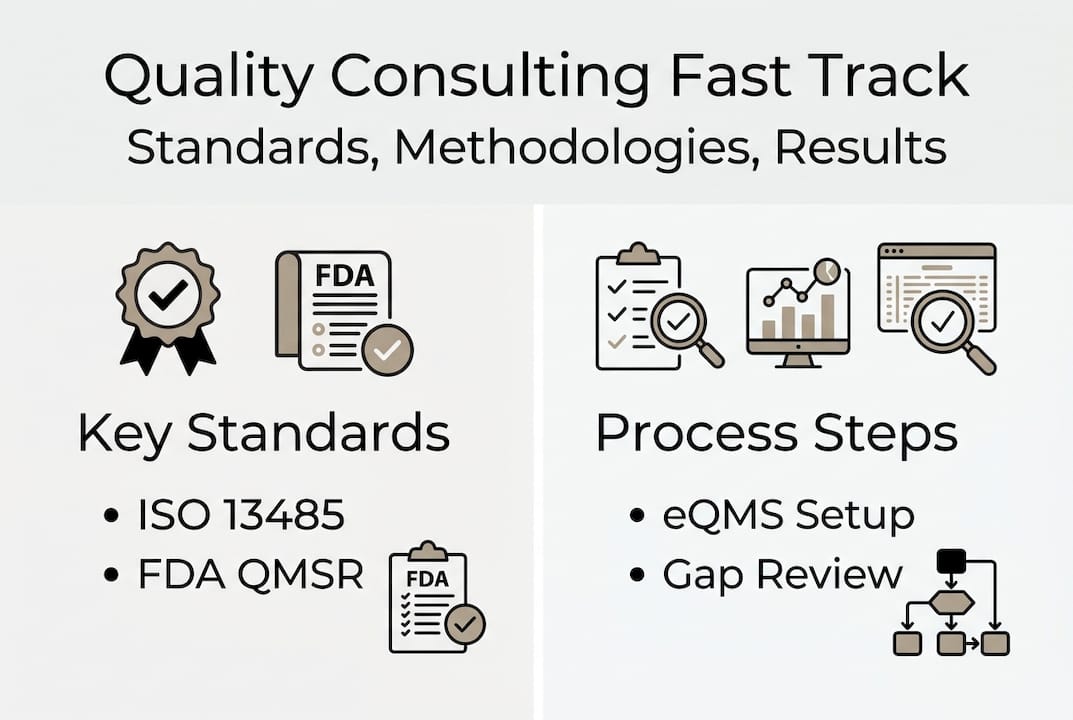
Pro Tip: Implement your eQMS in parallel with QMS design, not after it. Configuring the system around your actual workflows, rather than retrofitting workflows to an already-live system, prevents the documentation lapses that cause audit findings.
For manufacturers pursuing ISO 13485 certification, the phased approach above, combined with eQMS adoption, consistently shortens certification timelines. Consultants also integrate materials testing and ISO 10993 analysis into the QMS framework, ensuring biocompatibility data is traceable and submission-ready. Similarly, connecting medical device safety testing outputs to design control records closes a gap that regulators frequently flag during technical file reviews.
Edge cases, pitfalls, and advanced applications
While standard consulting methodologies are critical, real-world applications often run into unique challenges and regulatory nuances. Knowing where programs fail is as valuable as knowing what success looks like.
A useful comparison for teams operating across multiple markets:
| Area | FDA QMSR | EU MDR | ISO 13485 |
|---|---|---|---|
| Risk approach | Risk-based, aligned with ISO 14971 | Mandatory clinical risk-benefit analysis | Risk management integrated throughout |
| Documentation depth | Device history records, DHF | Technical documentation, clinical evaluation | QMS records, process outputs |
| Design transfer | Required, traceability to DHR | Design verification and validation documented | Controlled transfer to manufacturing |
The most common pitfalls ISO 13485 compliance teams encounter are predictable, yet they keep appearing in audit findings:
- Scope exclusions misapplied: Clause 7 exclusions (such as sterilization or servicing) must be justified and documented. Unjustified exclusions are a recurring nonconformance trigger.
- Design transfer failures: The handoff from R&D to manufacturing is where uncontrolled changes and undocumented specifications create significant post-market risk.
- Weak CAPA systems: CAPAs that close on paperwork rather than verified effectiveness undermine the entire QMS and signal systemic dysfunction to auditors.
- Vendor management gaps: Supplier audits that exist only on paper, without evidence of objective evaluation, create both regulatory and supply chain risk.
Advanced applications go beyond standard compliance. Risk mapping using turtle diagrams provides a visual, process-level view of inputs, outputs, controls, and competencies that regulators find compelling during audits. Outsourced process management, where critical manufacturing or testing steps are delegated to third parties, requires consultants to build robust oversight frameworks that satisfy ISO 13485 QMS implementation requirements without stifling operational flexibility.
Audit data consistently shows that documentation-to-practice gaps and inadequate supplier oversight account for a disproportionate share of critical findings across FDA and notified body inspections.
For EU submissions, integrating clinical evaluation reports into the technical file early, rather than assembling them under submission pressure, reduces the risk of incomplete evidence packages. Teams preparing for biocompatibility reviews should use a structured biocompatibility testing checklist to ensure all ISO 10993 series requirements are addressed systematically. Quality consultants can also connect QMS outputs to IPC testing insights for manufacturers operating across pharmaceutical and biomedical verticals.
How quality consulting drives results: Benchmarks and real-world strategies
Recognizing where pitfalls occur, it’s crucial to highlight the real-world impact and how companies are leveraging quality consulting for measurable gains.
Benchmark spotlight: Organizations that pair quality consulting with digital QMS tools report projected savings of $1M per product line, an average of 2.5 months faster program restart after regulatory holds, and 90% reduction in audit prep time. Those same programs show 40% faster document release and 30% productivity gains across quality and regulatory functions.
These results don’t happen by accident. They follow a deliberate sequence of decisions:
- Prioritize early gap assessments. Engaging a consultant before design freeze, rather than at pre-submission, eliminates the expensive retrofit of design controls and risk documentation.
- Deploy digital QMS tools from the start. eQMS platforms that connect document control, CAPA, training, and supplier records create a single source of truth that dramatically reduces audit preparation cycles.
- Integrate CAPA into real workflows. CAPA systems that are embedded in day-to-day operations, not maintained separately by a quality team, generate the effectiveness data that auditors and notified bodies expect.
- Use quality and compliance digital support throughout development. Waiting until a regulatory hold or audit failure to engage external support is the most costly timing decision manufacturers make.
Pro Tip: R&D managers should involve quality consultants before design freeze, not after. Post-freeze changes to risk documentation and design controls can add months to submission timelines and trigger formal design change processes.
A practical example: one auto-injector manufacturer partnered with quality consultants to rebuild their document control system and integrate it with their eQMS. The result was a 33% reduction in development cycles and a measurable drop in cost overruns, achieved without adding permanent headcount. The quantitative systems used to model process interactions also informed risk documentation, creating a feedback loop between engineering data and QMS records. For further context on what digitalized quality looks like in practice, digital QMS case studies from MedTech startups offer instructive parallels.
Our perspective: Why most get medical device quality consulting wrong
Drawing on these proven frameworks and benchmarks, here’s the hard-won perspective that rarely makes it into consultant sales pitches.
Most organizations approach quality consulting reactively. They engage consultants when an audit is imminent, when a submission has been refused, or when a remediation is already in progress. This is the most expensive version of quality consulting available, because by that point, the structural problems are embedded in products, processes, and records that are difficult and costly to unwind.
The second failure mode is treating consulting as a documentation exercise. Quality is not a set of controlled documents. It is a set of verified practices. When the gap between what your QMS says and what your team actually does grows wide enough, no amount of documentation polish will close it during an inspection.
The organizations that extract the most value from consulting treat it as strategic process redesign, not administrative support. They involve consultants at program initiation, they invest in digital infrastructure early, and they measure consulting ROI in development cycle time and submission success rates, not just in audit outcomes. That mindset shift is what converts quality from a cost center into a competitive advantage.
Ready to accelerate your device development and compliance?
If these benchmarks and strategies align with where your program needs to go, we are positioned to help you get there faster. At Materials Metric, we integrate advanced analytical testing, materials characterization, and regulatory consulting to support your QMS and product development pipeline from early-stage R&D through market submission.
Our capabilities span analytical testing and compliance support, biocompatibility evaluation, chemical characterization, and expert interpretation aligned with ISO 13485, FDA QMSR, and EU MDR requirements. Whether you need biocompatibility compliance guidance or a full suite of materials testing to support your technical file, our team functions as an extension of your development and regulatory team. Reach out to discuss how we can tailor our services to your device classification and submission timeline.
Frequently asked questions
What is the main benefit of medical device quality consulting?
Quality consulting accelerates compliance, reduces costly errors, and unblocks global market entry with tailored QMS and regulatory strategy. Documented outcomes include 40% faster document release and 30% productivity gains across quality functions.
What regulations do medical device quality consultants cover?
Consultants address ISO 13485, FDA QMSR (2026), EU MDR/IVDR, ISO 14971 risk management, and regional compliance frameworks. Core standards are increasingly harmonized, allowing unified compliance strategies for manufacturers targeting multiple markets.
How does consulting impact development speed?
Early gap assessments and structured QMS remediation reduce development cycles by up to 33% and audit preparation time by up to 90%, compressing overall timelines significantly.
Should startups invest in quality consulting or go it alone?
Startups benefit from right-sized QMS consulting that avoids costly rework and accelerates regulatory submissions, making early investment in consulting far less expensive than late-stage remediation.