Thermal Infrared & Optical Analysis
At Materials Metric, our thermal analysis services provide critical insights into the thermal stability, phase transitions, and mechanical behavior of materials under temperature variations. These techniques are essential for materials development, quality control, and failure analysis across industries such as polymers, pharmaceuticals, composites, and metallurgy.
Understanding how materials respond to heat, stress, and optical stimuli is critical to evaluating their stability and performance. At Materials Metric, our Thermal, Infrared & Optical Analysis services combine thermo-mechanical testing, infrared spectroscopy, and non-contact optical imaging to provide a complete thermal–structural profile of materials.
These techniques enable simultaneous evaluation of phase transitions, degradation behavior, surface deformation, and heat distribution, offering valuable insights for R&D, failure analysis, and process optimization.

Techniques Include:
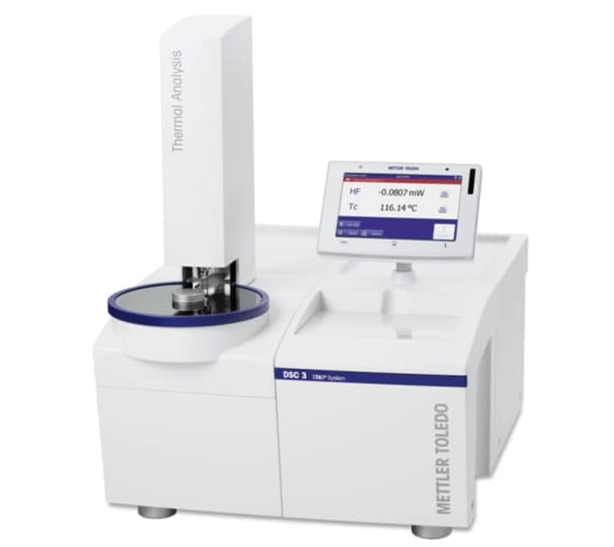
Differential Scanning Calorimetry (DSC)
Differential Scanning Calorimetry (DSC) measures the heat absorbed or released by a material during temperature changes, providing essential data on phase transitions, melting points, and crystallization behavior.
Capabilities:
Detection of glass transition, melting, and crystallization temperatures
Measurement of heat capacity and thermal stability
Analysis of reaction kinetics and curing behavior in polymers
- Differential Scanning Calorimetry (DSC):
Measures melting points, crystallization, and glass transition temperature (Tg), helping to optimize material formulations and process parameters.
- Thermogravimetric Analysis (TGA):
Evaluates compositional stability, oxidation, and thermal degradation across a wide temperature range.
- Thermo-Mechanical Analysis (TMA):
Monitors dimensional changes, softening points, and expansion coefficients under thermal stress.
- Dynamic Mechanical Analysis (DMA):
Determines viscoelastic properties such as modulus and damping behavior as a function of temperature and frequency.
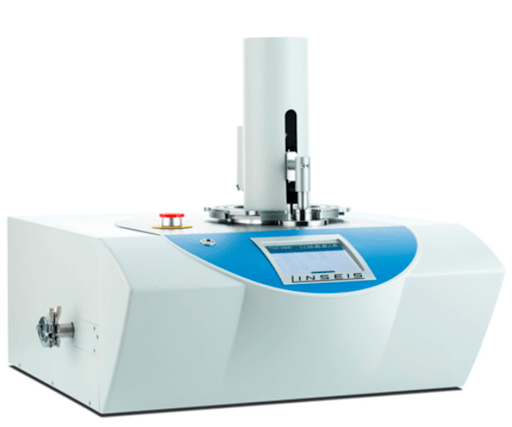
Thermogravimetric Analysis (TGA)
Weight loss analysis due to thermal decomposition
Thermogravimetric Analysis (TGA) examines the mass change of a material as it is heated, providing data on decomposition, oxidation, and thermal stability.
Capabilities:
Measurement of thermal degradation and stability
Analysis of moisture, volatile content, and residual mass
Detection of decomposition temperatures and oxidation resistance
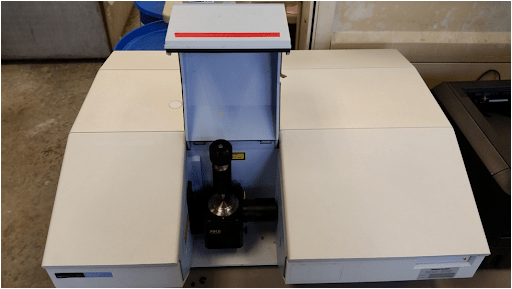
- Fourier Transform Infrared (FTIR) Spectroscopy:
Detects molecular vibrations and bonding changes during heating or environmental exposure, linking chemical transitions with thermal events.
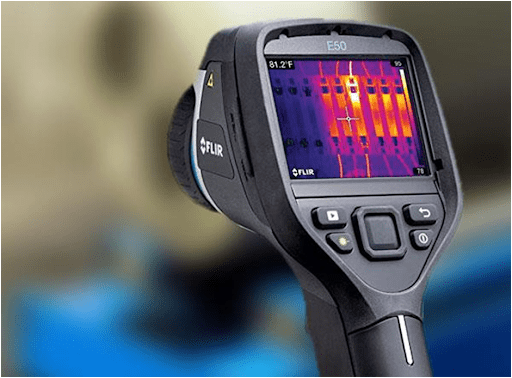
- Infrared Thermography (IR Imaging):
Provides non-contact, real-time surface temperature mapping and thermal gradient visualization.
Ideal for detecting thermal anomalies, hot spots, and material fatigue in polymers, coatings, and composites.
- Light Interferometry & Optical Profilometry:
Measures nanoscale surface deformation, flatness, and thermal expansion through precise optical interference.
Enables correlation of surface topography with thermal or mechanical loading conditions.
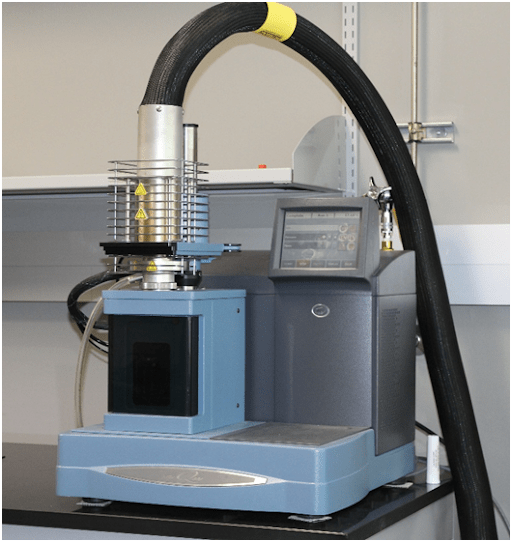
Dynamic Mechanical Analysis (DMA)
Dynamic Mechanical Analysis (DMA) evaluates the viscoelastic properties of materials by applying an oscillating force while varying temperature or frequency.
Capabilities:
Measurement of storage modulus, loss modulus, and damping properties
Identification of glass transition temperature (Tg)
Evaluation of material stiffness and damping behavior under real-world conditions
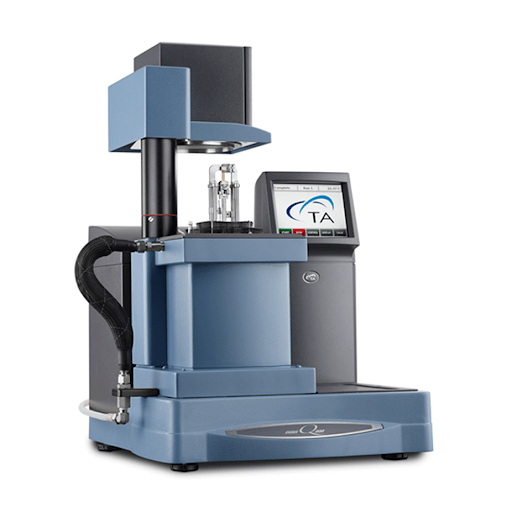
Thermomechanical Analysis (TMA)
Thermomechanical Analysis (TMA) measures a material’s dimensional changes as a function of temperature, time, and applied force. It is used to assess thermal expansion, shrinkage, and softening points.
Capabilities:
Measurement of Coefficient of Thermal Expansion (CTE)
Softening point and heat deflection temperature analysis
Analysis of sintering, creep, and stress relaxation behavior