
TL;DR:
- Advanced NMR techniques are vital for detailed pharmaceutical solid form analysis and regulatory compliance.
- Benchtop NMR provides cost-effective, rapid screening for QA but has resolution limits in complex samples.
- Combining solid-state NMR with other methods enhances detection of polymorphs, disorder, and structural nuances.
Nuclear magnetic resonance (NMR) analysis has long been dismissed as a tool reserved for academic research or early-stage discovery work. That perception is outdated. Solid-state NMR characterizes polymorphs with a level of detail that directly supports regulatory submissions and product launch decisions. For biomedical and pharmaceutical companies navigating increasingly complex compliance landscapes, advanced NMR methods are becoming a strategic asset, not a luxury. This article walks through how NMR analysis works, where it delivers the most value across product development and QA workflows, and how your team can apply it confidently at every stage of the materials characterization process.
Table of Contents
- What is NMR analysis and why does it matter?
- Solid-state NMR and its role in detecting polymorphs
- Low-field and benchtop NMR: Practical solutions for QA and metabolomics
- Challenges and edge cases: Navigating spectral overlap, sensitivity, and disorder
- A fresh perspective: Why advanced NMR methods are the unsung heroes of compliance and innovation
- Find the right NMR analysis partner for your needs
- Frequently asked questions
Key Takeaways
| Point | Details |
|---|---|
| Advanced NMR drives quality | NMR analysis boosts product integrity and compliance for biomedical and pharmaceutical companies. |
| Solid-state NMR reveals hidden issues | SSNMR uncovers polymorph and disorder problems missed by conventional techniques like XRD. |
| Benchtop NMR is efficient for routine QA | Low-field NMR offers reliable results and cost savings, ideal for high-throughput quality assurance. |
| Edge cases need specialized methods | Complex materials and subtle disorders require advanced NMR strategies to ensure robust analysis. |
What is NMR analysis and why does it matter?
NMR analysis is a non-destructive analytical technique that exploits the magnetic properties of atomic nuclei to reveal molecular structure, dynamics, and chemical environment. When a sample is placed in a strong magnetic field and exposed to radiofrequency pulses, nuclei such as hydrogen-1, carbon-13, nitrogen-15, and phosphorus-31 resonate at specific frequencies. Those frequencies encode precise structural information. No other technique provides this level of chemical resolution without altering or destroying the sample.
For biomedical and pharmaceutical QA teams, this matters enormously. NMR captures molecular fingerprints that other methods simply cannot. It identifies impurities, confirms molecular identity, quantifies active ingredients, and reveals structural changes that could compromise product safety or efficacy. The technique works across a broad range of sample types, from small molecules in solution to complex solid-state drug formulations.
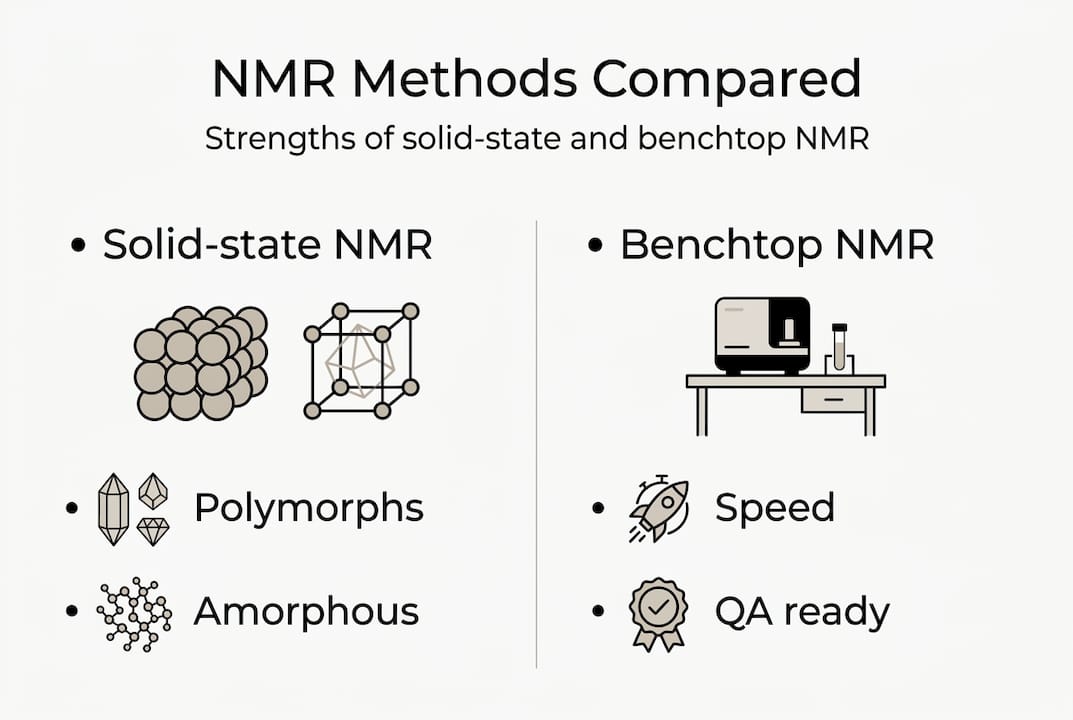
A common misconception is that NMR requires a massive high-field instrument and a dedicated research team to operate it. That is no longer true. The NMR spectroscopy landscape now spans instruments from benchtop systems at 40 to 80 MHz up to ultra-high-field platforms above 900 MHz. Each serves a different purpose within the analytical workflow.
Key factors that determine which instrument suits your application include:
- Sample state: Solution-state versus solid-state requirements drive instrument selection
- Resolution needs: Complex mixtures demand higher field strength for peak separation
- Throughput targets: Benchtop systems enable faster screening at lower cost per sample
- Regulatory context: Method validation requirements differ between GMP and R&D settings
- Complementary methods: NMR pairs well with chemical analysis techniques for full characterization workflows
High-field instruments remain the gold standard for resolution-intensive work, but benchtop NMR offers a cost-effective alternative for metabolomics and routine QA despite limitations in signal-to-noise ratio and spectral resolution.
Pro Tip: Match your NMR instrument to your actual analytical need. Using a 600 MHz system for a routine identity check adds cost without adding value. A validated benchtop method can satisfy many QA release specifications at a fraction of the cost.
Solid-state NMR and its role in detecting polymorphs
Polymorphism refers to the ability of a solid compound to exist in more than one crystal structure. Two polymorphic forms of the same drug can have dramatically different solubility, bioavailability, stability, and even toxicity profiles. Regulatory agencies require that manufacturers characterize and control polymorphic form throughout the product lifecycle. Getting this wrong has real consequences.
The ritonavir crisis of the late 1990s is the most cited example. An undetected polymorph caused widespread product failures and supply disruptions. More recently, nirmatrelvir formulation work has required careful monitoring of solid-state transitions during processing and storage. These are not edge cases. They represent a class of risk that every solid oral dosage form carries.
Solid-state NMR is essential for solid forms because it detects hidden disorder and polymorph transitions that X-ray diffraction (XRD) misses entirely. XRD relies on long-range crystalline order. When a material is partially amorphous, or when two forms coexist at low concentrations, XRD can fail to flag the difference. SSNMR probes short-range chemical environments, making it far more sensitive to subtle structural shifts.

| Feature | Solid-state NMR | X-ray diffraction |
|---|---|---|
| Detects amorphous content | Yes | Limited |
| Identifies hidden disorder | Yes | No |
| Quantifies polymorph ratios | Yes | Partially |
| Requires crystalline sample | No | Yes |
| Sample preparation complexity | Moderate | Low to moderate |
| Sensitivity to minor forms | High | Low to moderate |
Advanced material characterization often demands that multiple techniques be applied in combination. SSNMR paired with XRD gives you both short-range and long-range structural insight.
The specific advantages of SSNMR for polymorph work include:
- Detection of amorphous phases even within a predominantly crystalline matrix
- Quantification of polymorph ratios in multi-component mixtures
- Identification of local structural environments that predict stability
- Non-destructive testing with minimal sample preparation
“Solid-state NMR provides structural resolution at the molecular level that no other solid-form technique replicates, making it the definitive tool for polymorph characterization in regulated pharmaceutical development.”
Our spectroscopic analysis services incorporate SSNMR as part of a broader analytical toolkit, enabling your team to address polymorph risk before it becomes a regulatory or manufacturing problem.
Low-field and benchtop NMR: Practical solutions for QA and metabolomics
Not every analytical challenge requires the power of a high-field NMR system. In many QA settings, what matters most is speed, throughput, and reproducibility. Benchtop NMR systems, typically operating between 40 and 80 MHz, are engineered for exactly these scenarios. They are compact, require no liquid helium cryogenics, and can be deployed directly on the production floor or within a QC laboratory.
For metabolomics applications, low-field instruments have demonstrated strong performance in profiling biofluids and fermentation samples. Recovery rates of 97 to 103% at SNR of 300 confirm that benchtop NMR can deliver quantitatively reliable results when workflows are properly optimized. This level of accuracy supports identity confirmation, excipient monitoring, and raw material screening in a GMP-compliant environment.
| SNR Level | Recovery Rate Range | Typical Application |
|---|---|---|
| SNR = 300 | 97 to 103% | Metabolomics, QA screening |
| SNR = 100 | 92 to 108% | Exploratory profiling |
| SNR = 50 | Variable, wider bias | Research only, not QA release |
A practical benchtop NMR QA workflow typically follows these steps:
- Sample preparation: Dissolve or suspend the sample according to validated protocols
- Instrument calibration: Run reference standards to verify field homogeneity and sensitivity
- Spectral acquisition: Collect spectra under fixed, validated acquisition parameters
- Peak assignment: Compare against reference libraries or in-house databases
- Quantification: Apply internal standard or external calibration for concentration data
- Reporting: Generate compliance-ready documentation aligned with GMP records
The main limitations are resolution and sensitivity. Benchtop systems struggle to resolve closely overlapping peaks in complex mixtures. Mitigation strategies include optimizing pulse sequences, using deuterated solvents, and pairing benchtop results with periodic high-field confirmation runs.
Non-destructive material testing approaches like benchtop NMR preserve samples for downstream testing, which is especially valuable when working with scarce or expensive intermediates.
Pro Tip: Validate your benchtop NMR method explicitly for each matrix type you test. Transfer from high-field validation data is possible but requires bracketing experiments to confirm that SNR and resolution differences do not introduce systematic bias.
Challenges and edge cases: Navigating spectral overlap, sensitivity, and disorder
Even when teams adopt the right NMR strategy, certain analytical scenarios push the technique to its limits. Recognizing these edge cases early prevents costly delays and protects data integrity during regulatory review.
The most common challenges advanced NMR users encounter include:
- Spectral overlap: In-cell NMR and complex biological matrices generate crowded spectra where peaks from target molecules overlap with cellular background signals
- Low sensitivity in benchtop systems: Minor components present at less than 1% concentration may fall below the detection threshold of low-field instruments
- Polymorph disorder in final products: Drugs like ritonavir and nirmatrelvir require SSNMR specifically because their solid-state transitions are invisible to standard characterization methods
- Dynamic disorder: Partially ordered or liquid-crystalline phases produce broad, featureless signals that are difficult to interpret without advanced processing
- Isotopic labeling requirements: Some in-cell or biomolecular NMR studies require isotope enrichment, adding cost and workflow complexity
Spectral overlap in in-cell NMR, low sensitivity in low-field platforms, and polymorph disorder in complex pharmaceutical systems represent the three most technically demanding edge cases in applied NMR work today.
Advanced solutions exist for each of these challenges. Multidimensional NMR experiments separate overlapping peaks by adding frequency dimensions. Dynamic nuclear polarization (DNP) can amplify sensitivity by orders of magnitude. Computational tools now assist with spectral deconvolution and assignment, reducing analyst time and improving reproducibility.
“The labs that struggle most with NMR are not those with outdated instruments. They are those without a systematic strategy for selecting methods, validating results, and integrating NMR with complementary techniques.”
Complementary tools like advanced microscopy techniques and atomic force microscopy provide spatial and surface-level structural data that NMR cannot access, making a multi-method strategy the most reliable path through complex characterization challenges.
A fresh perspective: Why advanced NMR methods are the unsung heroes of compliance and innovation
We see a consistent pattern across regulatory and QA teams in the biomedical and pharmaceutical space: NMR is treated as a confirmatory tool rather than a discovery asset. The assumption is that conventional methods such as XRD and HPLC are sufficient for compliance, and NMR is only needed when something goes wrong. That thinking is exactly backward.
The companies that build advanced NMR into their early development workflows consistently identify structural risks before they reach the manufacturing stage. They submit regulatory packages with stronger evidence, fewer deficiency responses, and faster approvals. They catch polymorph transitions in stability studies, not during commercial batch failures.
The return on investment here is not abstract. Catching a polymorph risk in development costs far less than a product recall or a complete response letter from a regulatory agency. Advanced NMR is not a cost center. It is a risk management tool with measurable commercial value.
Our view, grounded in working with biomedical and pharmaceutical clients across multiple product classes, is that teams investing in material characterization strategies that include NMR from the earliest formulation stage consistently outperform those who add it reactively. The data quality is better, and the regulatory confidence is significantly higher.
Find the right NMR analysis partner for your needs
Advanced NMR analysis requires more than access to the right instrument. It demands experienced analysts who understand your regulatory context, your product chemistry, and the downstream implications of every data point.
At Materials Metric, we support biomedical and pharmaceutical teams with NMR analysis as part of a broader suite of advanced material characterization services. Our team integrates solid-state NMR, solution NMR, and complementary chemical and microscopy characterization to give you complete structural insight. Whether you need polymorph detection, method validation, or chemical and elemental analysis for regulatory submissions, we work as an extension of your team. Contact us today to discuss how we can support your specific characterization and compliance needs.
Frequently asked questions
What is the main advantage of solid-state NMR over XRD in pharmaceutical analysis?
Solid-state NMR detects hidden disorders and polymorph transitions that XRD misses, providing molecular-level structural insight even in partially amorphous or disordered samples.
Are benchtop NMR instruments reliable for routine QA in pharma and biomedical labs?
Yes. Benchtop NMR delivers recovery rates of 97 to 103% at an SNR of 300, making it a validated and cost-effective option for screening and identity testing, though it has lower resolution than high-field systems.
How does advanced NMR contribute to regulatory compliance?
Advanced NMR identifies structural issues such as polymorphs and hidden disorders that could compromise product efficacy or safety, giving regulatory teams the evidence needed for robust submissions.
What challenges limit NMR’s efficiency in certain applications?
Spectral overlap in complex matrices, low sensitivity in benchtop platforms, and dynamic disorder in pharmaceutical solids are the most common technical barriers that require advanced methods or complementary techniques to resolve.