
TL;DR:
- A single 800°C heat treatment can double creep life and improve corrosion resistance in high-performance alloys.
- Proper adherence to standards like AMS2801B, AMS2759G, and NADCAP is essential for regulatory compliance and process validation.
- Optimizing heat treatment parameters through empirical testing enhances material performance beyond basic compliance.
A single 800°C heat treatment can double creep life in high-temperature aerospace alloys and measurably improve corrosion resistance across the component’s service life. For manufacturers developing implants, turbine components, reactor parts, or pharmaceutical processing equipment, this is not a trivial detail. Heat treatment is often the difference between a material that meets specification and one that fails prematurely in the field. This guide walks through core processes, compliance standards, optimization strategies, and real-world applications, giving your engineering and regulatory teams a clear, actionable framework for advanced material performance.
Table of Contents
- Understanding heat treatment fundamentals for advanced materials
- Heat treatment standards, compliance, and certification
- Optimization strategies: Process parameters and performance benchmarks
- Application focus: Heat treatment in biomedical, aerospace, energy, and pharmaceutical materials
- Why heat treatment innovation is the real competitive advantage
- Specialized services for advanced heat treatment and material analysis
- Frequently asked questions
Key Takeaways
| Point | Details |
|---|---|
| Process matters most | Heat treatment parameters directly control mechanical and chemical properties of advanced materials. |
| Compliance is foundational | Adhering to standards like AMS2801B, AMS2759G, and NADCAP is essential for regulatory approval and market entry. |
| Optimization boosts performance | Fine-tuning temperature, hold time, and cycles yields targeted results and helps meet demanding application requirements. |
| Industry-specific needs | Sector focus—biomedical, aerospace, pharma, and energy—drives unique material and treatment choices. |
| Innovation drives advantage | Continuous heat treatment innovation ensures the highest levels of compliance, reliability, and product differentiation. |
Understanding heat treatment fundamentals for advanced materials
Having set the stage, let’s break down what heat treatment really means for high-performance materials. At its core, heat treatment is a controlled sequence of heating and cooling applied to a metal or alloy to change its microstructure without altering its geometry. The result is a material with tailored mechanical, chemical, and thermal properties suited to a specific application.
The four primary processes your team will encounter are:
- Annealing: Heats the material to a set temperature and cools it slowly to reduce hardness, relieve internal stresses, and improve ductility. Commonly applied to titanium and steel alloys after forming or machining.
- Solution treatment: Dissolves alloying elements into a solid solution at elevated temperature, then quenches rapidly to lock in a supersaturated state. Critical for nickel superalloys like Inconel 718 and HAYNES 282.
- Aging (precipitation hardening): Follows solution treatment, using lower temperatures over a defined hold time to precipitate strengthening phases. Produces significant gains in yield strength and hardness.
- Stress relief: Applied at moderate temperatures to reduce residual stresses from welding, machining, or additive manufacturing without major microstructural change.
Each method produces distinct microstructural outcomes. Advancing corrosion resistance in additively manufactured titanium alloys, for example, depends directly on which heat treatment sequence is applied and at what temperature. Ti-6Al-4V responds differently to annealing versus solution treatment, producing alpha-beta phase ratios that govern fatigue life and corrosion behavior in implant environments.
For aerospace materials testing, nickel superalloys like Inconel 718 require precise solution and aging cycles to precipitate the gamma-prime and gamma-double-prime phases responsible for high-temperature creep resistance. Aluminum alloys used in structural aerospace components rely on T6 temper, a combined solution treatment and artificial aging sequence, for optimal strength-to-weight ratios.
In biomedical applications, the stakes are even higher. Implant-grade titanium must achieve specific surface oxide chemistry and bulk phase distribution to support osseointegration and long-term biocompatibility. A misstep in hold temperature or quench rate can produce a microstructure that passes tensile testing but underperforms in fatigue or electrochemical environments.
Pro Tip: Before committing to a heat treatment schedule for a new alloy or geometry, run heat stability studies on representative coupons. Characterizing phase transformations at multiple temperatures upfront prevents costly rework during validation.
Heat treatment standards, compliance, and certification
With processes understood, it’s vital to examine how compliance and certification shape heat treatment success. In regulated industries, the process itself must be as defensible as the outcome. That means documented procedures, calibrated equipment, and third-party certification.
Three standards dominate advanced material heat treatment compliance:
- AMS2801B covers heat treatment of titanium alloys, specifying pyrometry per AMS2750 and strict temperature tolerances for solution and aging cycles.
- AMS2759G addresses steel alloy heat treatment, including furnace class requirements, protective atmospheres, and quench media specifications.
- NADCAP certification provides third-party compliance assurance for aerospace, biomedical, and energy suppliers, requiring periodic audits of equipment, procedures, and operator qualification.
Here is a quick comparison of key standards:
| Standard | Primary alloys | Key requirement | Temperature tolerance |
|---|---|---|---|
| AMS2801B | Titanium alloys | Pyrometry, AMS2750 compliance | ±10°F to ±25°F depending on class |
| AMS2759G | Steels | Furnace class, atmosphere control | ±10°F (Class 2) to ±25°F (Class 5) |
| NADCAP Heat Treating | All aerospace/defense alloys | Process audit, equipment calibration | Per applicable specification |
Certification matters because regulators and OEM (original equipment manufacturer) customers often require documented proof that your process falls within validated parameters. A NADCAP-certified supplier carries presumption of process adequacy, which accelerates supplier qualification and reduces audit burden on your side.
For teams working across industries we serve such as biomedical devices and energy systems, compliance often extends beyond metallurgical standards. FDA submissions for implants and pressure vessel approvals for energy systems both require traceable documentation of every heat treatment cycle applied during manufacturing.
Pro Tip: Maintain complete pyrometry logs for every furnace run, including calibration records, thermocouple placement diagrams, and load maps. Auditors scrutinize these records closely, and gaps in documentation are among the most common NADCAP findings.
For deeper guidance on how these requirements interface with advanced alloy testing, our custom aerospace materials testing resource covers practical compliance alignment for high-temperature programs.
Optimization strategies: Process parameters and performance benchmarks
After achieving compliance, attention turns to optimizing the process for best performance. Compliance defines the floor. Optimization raises the ceiling.
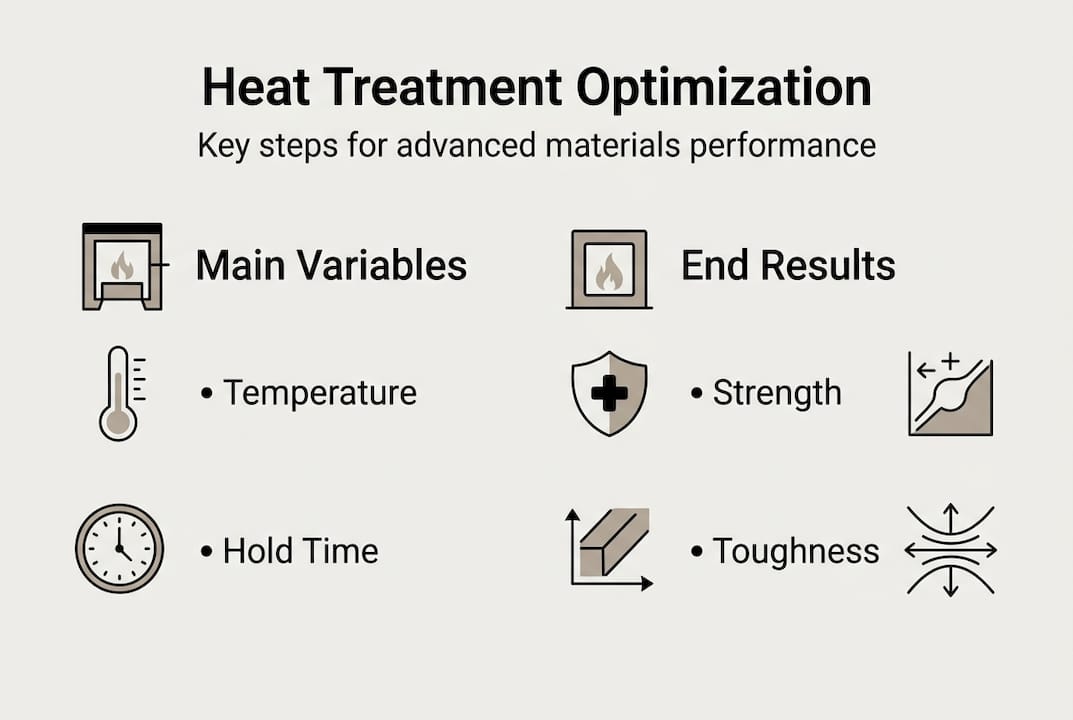
The three primary variables your team controls are temperature, hold time, and furnace atmosphere. Each interacts with alloy chemistry and starting microstructure in ways that require empirical validation, not just theoretical prediction.
Consider this performance benchmark data for common heat treated alloys:
| Alloy | Heat treatment | Yield strength (MPa) | UTS (MPa) | Elongation (%) |
|---|---|---|---|---|
| Ti-6Al-4V (AM) | 800°C/2h + AC | ~830 | ~950 | ~14 |
| IN718 (AM) | ST + aging (AMS5664) | ~1034 | ~1141 | ~12 |
| HAYNES 282 | Solution + aging | ~700 | ~1050 | ~26 |
| Al 6061-T6 | Solution + artificial aging | ~276 | ~310 | ~12 |
For additive manufacturing (AM) alloys, solution treatments at 800 to 1040°C followed by appropriate aging cycles relieve process-induced residual stresses and yield properties comparable or superior to wrought equivalents. This is not automatic. It requires careful parameter selection.
The optimization process typically follows these steps:
- Define target properties based on application load cases, regulatory requirements, and service environment.
- Screen temperature and time combinations using small-scale coupon studies across the relevant phase transformation range.
- Apply Taguchi design of experiments to efficiently identify the parameter set that achieves target yield strength, UTS, and elongation with minimum variation.
- Validate atmosphere control since reactive alloys like titanium require inert or vacuum environments to prevent surface contamination during solution treatment.
- Benchmark against wrought equivalents to confirm that AM-specific microstructural features do not degrade performance under cyclic or high-temperature loading.
Empirical data shows that AM Ti TC4 heat treated at 800°C for one to four hours raises self-corrosion potential significantly, while IN718 processed via solution treatment and aging achieves a UTS of 1141 MPa, meeting or exceeding wrought specifications.
“Optimization of SLM parameters is essential for performance parity with wrought materials.”
Overaging is a critical edge case. Exceeding the optimal aging temperature or hold time causes excessive precipitate coarsening, reducing strength without any visible surface indicator. Your thermal analysis services program should include differential scanning calorimetry (DSC) to identify transformation temperatures before finalizing the schedule. Pairing this with chemical stability testing confirms that no unintended phase changes occur during extended service at elevated temperatures.

Application focus: Heat treatment in biomedical, aerospace, energy, and pharmaceutical materials
With practical strategies formed, how do these apply in real-life manufacturing and product development contexts?
Each sector brings distinct performance demands and regulatory expectations to the heat treatment table:
- Aerospace: Inconel and titanium components must achieve tight creep resistance and fatigue life targets. Solution and aging cycles for Inconel 718 are non-negotiable for turbine disk qualification. Ti-6Al-4V structural components require annealing to reduce beta-phase content and improve damage tolerance.
- Biomedical: Implant-grade titanium and surgical steels need heat treatment to achieve the right surface chemistry for sterilization material integrity and long-term osseointegration. Corrosion resistance in physiological fluids depends directly on the oxide layer formed during controlled heat treatment.
- Energy: Nickel superalloys in turbine and reactor applications must sustain creep resistance over thousands of operating hours at extreme temperatures. Heat treatment cycles for these materials are validated against standardized creep test data, and any deviation from the approved schedule requires requalification.
- Pharmaceutical: Aluminum alloys used in processing and containment equipment, particularly EN42000 series alloys in T6 temper, show improved UTS and surface finish after optimized heat treatment, supporting purity requirements and equipment longevity.
Material selection is itself shaped by heat treatability. Alloys that respond predictably to established schedules reduce development risk and shorten regulatory timelines. For AM parts entering regulated supply chains, HIP (hot isostatic pressing) followed by solution treatment and aging (HIP+STA) is becoming the preferred sequence because it simultaneously eliminates internal porosity and achieves target mechanical properties.
Pro Tip: If you are submitting an AM component for biomedical or aerospace regulatory review, document the HIP+STA cycle as a single integrated process step. Regulators respond better to a unified, validated sequence than to separate, loosely connected processing stages. Heat transfer property testing data from the final processed state should accompany your submission package.
Why heat treatment innovation is the real competitive advantage
We see a persistent misconception in regulated manufacturing: teams treat compliance as the goal rather than the baseline. Meet the standard, pass the audit, ship the part. That mindset works until a competitor delivers a component with 20% better fatigue life using the same alloy, the same specification, and a better-optimized process.
Regulatory compliance follows rigorous process discipline. It is not the other way around. Manufacturers who invest in empirical process development—running designed experiments, characterizing microstructure at each step, and benchmarking against real service data—consistently produce materials that exceed specification minimums rather than simply meeting them.
Cross-sector learning accelerates this. Lessons from nickel superalloy optimization in aerospace have directly improved biomedical titanium processing. Energy sector experience with long-hold aging cycles at moderate temperatures has informed pharmaceutical aluminum alloy development. The underlying physics is shared. The translation just requires deliberate effort.
Data-driven method development services are the operational path to this kind of performance leadership. In our experience, teams that treat heat treatment as a controlled variable rather than a fixed recipe consistently outperform those that default to handbook schedules. The handbook is a starting point. Your application demands more.
“Regulatory success is a byproduct of rigorous heat treatment innovation.”
Specialized services for advanced heat treatment and material analysis
To turn these insights into results, explore advanced characterization and compliance solutions with us.
We support manufacturers across biomedical, aerospace, pharmaceutical, and energy sectors with the analytical depth needed to move from compliant to genuinely optimized.
Our team provides analytical testing methods that span microstructural characterization, phase identification, thermal analysis, and mechanical property validation, all aligned with GLP/GMP and ISO 9001:2015 standards. Whether you are developing a new heat treatment schedule for an AM alloy or preparing documentation for a regulatory submission, we function as an extension of your engineering team. For teams navigating device qualification, our medical device biocompatibility guide connects material processing decisions to downstream biocompatibility testing requirements.
Frequently asked questions
What is the main purpose of heat treatment for advanced materials?
Heat treatment optimizes mechanical and chemical properties such as strength and corrosion resistance for demanding applications in aerospace, biomedical, energy, and pharmaceutical industries. Without it, most high-performance alloys cannot meet the property targets required for service.
Which heat treatment standards are most important for compliance?
AMS2801B for titanium and AMS2759G for steels are the primary SAE standards, while NADCAP certification provides third-party process validation recognized across aerospace and biomedical supply chains globally.
How do heat treatment parameters impact material performance?
Adjusting temperature, hold time, and atmosphere fine-tunes microstructure and phase distribution. For example, AM Ti TC4 at 800°C significantly raises self-corrosion potential, while IN718 solution treatment and aging achieves a UTS of 1141 MPa.
Are there special considerations for additive manufacturing alloys?
AM alloys often contain residual stresses and anisotropic microstructures that standard wrought schedules cannot fully address. Solution treatment at 800 to 1040°C combined with HIP+STA cycles relieves these stresses and brings properties in line with or above wrought equivalents.
Why is process documentation important in heat treatment?
Complete pyrometry logs and certification records create a traceable record that satisfies both internal quality audits and external regulatory reviews. AMS2801B pyrometry requirements specify the exact calibration and recording standards your documentation must meet.