TL;DR:
- NMR is essential for pharmaceutical, biomedical, and aerospace quality control beyond academic use.
- Proper referencing, validation, and documentation are critical for regulatory compliance and data comparability.
- Automation and AI enhance high-throughput analysis but still require expert oversight for accuracy.
Nuclear magnetic resonance (NMR) analysis carries an undeserved reputation as a tool confined to academic chemistry labs. In practice, it sits at the center of pharmaceutical purity verification, biomedical polymer characterization, and aerospace composite quality control. R&D leaders who treat NMR as a routine box-check are leaving significant value on the table. This guide covers the scientific foundation of NMR, the critical difference between qualitative and quantitative modes, how reference standard selection affects regulatory defensibility, and where automation and machine learning are reshaping the field. Whether you are preparing a regulatory submission or accelerating material development, understanding these layers will sharpen your analytical strategy.
Table of Contents
- The fundamentals of nuclear magnetic resonance analysis
- Methods and modes: Quantitative vs qualitative NMR
- Reference standards and comparability: Avoiding hidden compliance risks
- Automation, AI, and advanced applications: Opportunities and edge cases
- Why defensible NMR analysis is now a business-critical differentiator
- Next steps: Make NMR analysis part of your R&D advantage
- Frequently asked questions
Key Takeaways
| Point | Details |
|---|---|
| NMR powers compliance and innovation | Nuclear magnetic resonance analysis is critical for verifying structure, purity, and comparability in regulated product development. |
| Method validation ensures accuracy | A validated and documented strategy for referencing and quantitation supports defensible data and smooth regulatory approval. |
| Automation needs expert oversight | While advanced tools enhance analysis, manual verification is necessary to avoid errors from automation edge cases. |
| Large datasets drive better AI | Curated NMR records and benchmark metrics underpin reliable, scalable machine-learning solutions. |
The fundamentals of nuclear magnetic resonance analysis
With the misconceptions aside, let’s start with the science behind NMR analysis.
NMR analysis works by placing a sample in a strong static magnetic field and applying radiofrequency (RF) pulses. Atomic nuclei with nonzero spin, such as ¹H, ¹³C, ¹⁵N, and ³¹P, absorb and re-emit energy at frequencies determined by their local electronic environments. The NMR spectroscopy’s core mechanics involve RF pulses in a static magnetic field, generating signals based on local electronic environments. The resulting spectrum is a precise map of molecular architecture.
The most practically useful output is the chemical shift, reported in parts per million (ppm). Chemical shifts are dimensionless ratios, which means they remain consistent regardless of instrument field strength. This field independence is what makes NMR data transferable across labs and instruments, a property no other spectroscopic technique fully replicates. Our NMR spectroscopy overview details how we apply this principle across multiple industries.
Chemical shifts serve as field-independent fingerprints of the nuclear environment, making NMR data inherently portable across instruments and laboratories when referencing protocols are correctly applied.
NMR reveals a remarkable range of sample properties in a single experiment. Here is what a well-designed NMR study can tell you:
- Molecular structure: Connectivity, stereochemistry, and conformation of organic and inorganic compounds
- Compound identity: Positive identification against reference databases or authenticated standards
- Purity and impurities: Detection and quantification of trace contaminants, degradation products, or residual solvents
- Molecular dynamics: Motional behavior, exchange rates, and flexibility in polymers or biologics
- Intermolecular interactions: Binding affinities and complex formation in drug-receptor or polymer-filler systems
For pharmaceutical teams, NMR is often the definitive tool for confirming active pharmaceutical ingredient (API) identity and detecting process-related impurities. For biomedical device manufacturers, it characterizes polymer chain architecture and crosslink density. Aerospace composites teams use it to verify resin cure states and monitor aging. The technique scales from small molecules to macromolecular assemblies, which is why it remains irreplaceable in advanced R&D programs.
Methods and modes: Quantitative vs qualitative NMR
Understanding the basics sets the stage for distinguishing between two key NMR applications: qualitative and quantitative analysis.
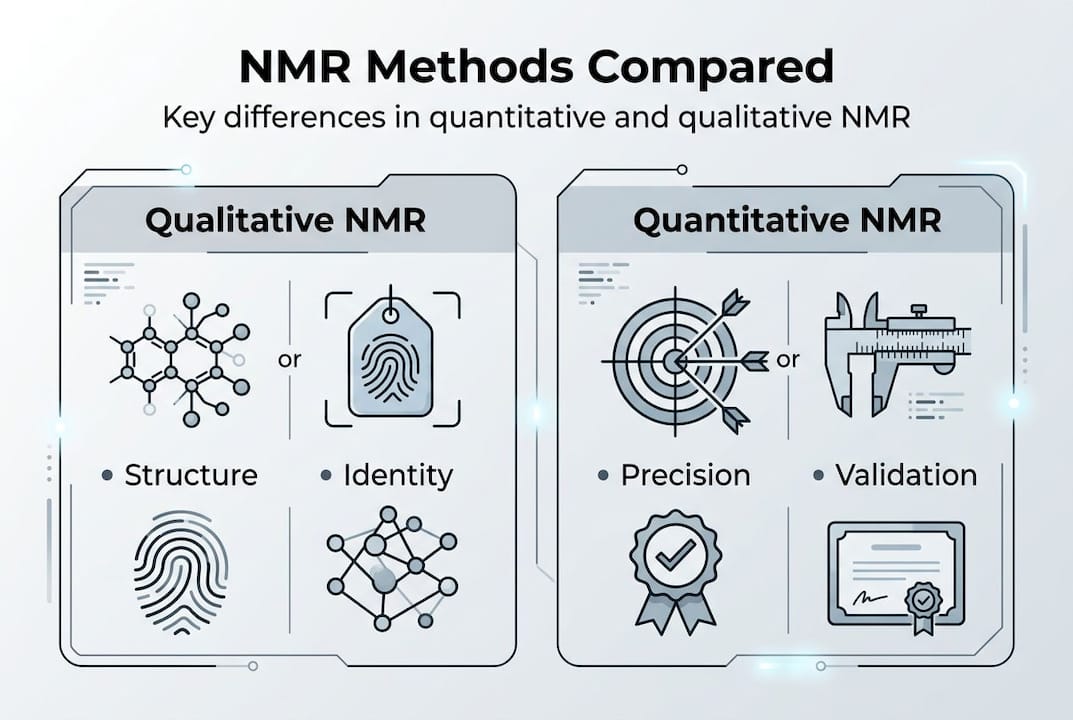
Qualitative NMR focuses on structure elucidation and compound identification. You are asking: what is this molecule, and is its structure correct? Techniques like COSY, HSQC, and HMBC map connectivity through bond networks, giving your team a complete structural picture. This mode is standard for new chemical entity characterization and is routinely used in biomedical polymer research.

Quantitative NMR (qNMR) asks a different question: how much of a given compound is present? qNMR exploits the direct proportionality between signal area and the number of contributing nuclei. With a calibrated internal or external standard, you can determine absolute concentrations and purity values with accuracy that rivals chromatographic methods. Importantly, low-field qNMR can be performed reliably even on low-field instruments with adequate controls, expanding access for quality control labs.
A typical qNMR workflow for pharmaceutical purity analysis follows these steps:
- Select and weigh a certified reference standard with known purity
- Prepare the sample and standard at appropriate molar ratios
- Acquire spectra with sufficient relaxation delays (typically 5x T1) to ensure full signal recovery
- Integrate target peaks and reference peaks with consistent baseline correction
- Apply the qNMR equation to calculate analyte purity or concentration
- Validate results against acceptance criteria and document all acquisition parameters
| Parameter | High-field qNMR (400+ MHz) | Low-field qNMR (60-100 MHz) |
|---|---|---|
| Sensitivity | High | Moderate |
| Resolution | Excellent | Limited for complex mixtures |
| Regulatory acceptance | Established | Growing, with validation |
| Cost per analysis | Higher | Lower |
| Typical use case | API purity, complex biologics | Raw material screening, QC |
Method validation is non-negotiable in regulated environments. You need to establish linearity, precision, accuracy, and specificity before submitting qNMR data to any regulatory agency. Our NMR for compliance resource outlines how we structure these validation packages for pharmaceutical and biomedical clients.
Pro Tip: When selecting an internal reference standard for qNMR, prioritize compounds with a single, well-resolved resonance that does not overlap with your analyte signals. Maleic acid and dimethyl sulfone are common choices for aqueous and organic systems, respectively.
Reference standards and comparability: Avoiding hidden compliance risks
With measurement strategies defined, you need to ensure your data can stand up to cross-lab scrutiny and regulatory expectations.
The choice of chemical shift reference standard is one of the most underappreciated decisions in NMR method development. Tetramethylsilane (TMS) is the traditional reference for organic solvents, while 4,4-dimethyl-4-silapentane-1-sulfonic acid (DSS) is standard for aqueous systems. Residual solvent peaks, such as CDCl₃ at 7.26 ppm, are widely used as secondary references. Each option carries different practical and regulatory implications.
Chemical-shift referencing practices can create measurable discrepancies, affecting regulatory and comparability outcomes. This is not a minor technical footnote. For nuclei like ¹⁵N and ³¹P, inconsistent referencing can shift reported values by up to 1.9 ppm, which is large enough to cause misidentification or failed comparability studies between labs.
| Reference standard | Solvent compatibility | Regulatory familiarity | Key limitation |
|---|---|---|---|
| TMS | Organic solvents | High | Insoluble in water |
| DSS | Aqueous, D₂O | High for biologics | Binds some proteins |
| Residual solvent peaks | Broad | Common in practice | Temperature-sensitive |
| Secondary external reference | Flexible | Requires documentation | Adds procedural steps |
For regulated submissions, analytical data integrity requires that your referencing strategy is explicitly documented in your method description. Auditors will look for this. If your team switches instruments or contract labs mid-project, a poorly documented referencing protocol can invalidate months of comparative data.
Pro Tip: Before initiating any multi-site or multi-instrument NMR study, create a referencing protocol document that specifies the exact standard, concentration, solvent, and temperature. Share it with all participating labs before data collection begins. This single step prevents the most common comparability failures we see in regulatory submissions.
Automation, AI, and advanced applications: Opportunities and edge cases
Data comparability leads naturally to the latest frontier: how digital tools and data scale are transforming NMR analysis.
Semi-automated and machine learning (ML) driven NMR workflows are now capable of processing large spectral datasets, predicting chemical shifts, and flagging structural anomalies faster than manual review. Tools trained on curated databases can propose structural assignments in seconds. For high-throughput screening in pharmaceutical development or NMR in manufacturing quality pipelines, this speed is genuinely transformative.
However, automation introduces edge cases that your team needs to anticipate:
- False positives in structure matching: Algorithms may flag structurally distinct compounds as matches when their spectra appear superficially similar
- Annotation library gaps: Most ML models are trained on small-molecule databases and perform poorly on polymers, biologics, or novel chemical entities
- Data quality sensitivity: Automated pipelines amplify the impact of poor shimming, incorrect referencing, or inadequate signal-to-noise ratios
- Overconfidence in predictions: Predicted chemical shifts from ML models carry uncertainty ranges that are often not communicated clearly to end users
The NMRexp benchmark database offers high-accuracy benchmarks with large, curated experimental datasets useful for ML tools, setting a new standard for training data quality. NMRexp’s structured approach to data curation is helping the field move toward more reliable automated predictions.
| Metric | NMRexp reported performance |
|---|---|
| Dataset size | >100,000 experimental spectra |
| Mean absolute error (¹H shifts) | <0.1 ppm |
| Coverage (compound classes) | Broad, including heterocycles |
| Benchmark reproducibility | High, with documented protocols |
Despite these advances, spectral similarity limitations remain real. Direct spectral similarity often fails to perfectly match structural similarity, which impacts automated workflows.
Spectral similarity is a useful heuristic, but it is not a substitute for structural verification. Automated tools should be treated as a first-pass filter, not a final answer.
For spectroscopy compliance insights in regulated industries, expert review of automated outputs remains essential. The most reliable programs pair ML speed with trained spectroscopist oversight, especially for novel compounds or regulatory-grade submissions.
Why defensible NMR analysis is now a business-critical differentiator
These technical elements come together in a bigger business and compliance picture. Here is an insider’s perspective.
In our experience supporting pharmaceutical and biomedical R&D teams, the most common point of failure is not instrument quality or spectral acquisition. It is documentation. Teams invest in high-field instruments and sophisticated software, then submit regulatory packages with vague or inconsistent referencing descriptions. Auditors notice. The result is a request for additional information that can delay approval by months.
Shortcutting reference documentation is not a minor procedural gap. It is a liability that compounds over time, especially when data from multiple sites or time points must be compared.
Investing in consistent, defensible NMR practice from the start of a project is not overhead. It is risk management. The teams that move fastest through regulatory review are not those with the most advanced instruments. They are the ones with the most disciplined methods and the clearest audit trails.
Emerging ML tools are amplifying this dynamic. Automated workflows can generate large volumes of spectral data quickly, but if the underlying referencing and acquisition protocols are inconsistent, the automation scales the problem rather than solving it. Spectroscopy for compliance must be built on a foundation of method discipline before automation adds value.
Pro Tip: Industry leaders build defensibility into their NMR programs from day one by linking every acquisition to a version-controlled method document, a traceable reference standard lot, and a named responsible analyst. This triad is what survives regulatory scrutiny.
Next steps: Make NMR analysis part of your R&D advantage
If you need practical next steps, here is where to start.
Advanced NMR analysis does not have to be a bottleneck in your development or compliance program. At Materials Metric, we function as an extension of your research team, providing validated NMR methods, expert spectral interpretation, and regulatory-ready documentation across pharmaceutical, biomedical, and aerospace applications.
Our integrated approach connects NMR with complementary analytical testing methods and a full lab characterization toolkit to give you a complete material picture. For teams needing combined spectroscopic and microscopic analysis, our chemical and microscopy CRO services deliver coordinated results under one quality framework. Contact us to discuss how we can support your next NMR-driven project.
Frequently asked questions
What does nuclear magnetic resonance analysis reveal about a sample?
NMR analysis identifies molecular structure, dynamic behavior, and impurities by detecting the unique patterns of nuclear spins in chemical environments. NMR signals provide chemical shift data that serve as fingerprints of the local environment.
How important is referencing in NMR for regulatory compliance?
Accurate referencing is essential because choice of standard can cause inter-lab differences that impact regulatory defensibility and comparability studies. Choice of reference standard can result in measurable discrepancies in chemical shift reporting.
Can low-field NMR be used for quantitative pharmaceutical analysis?
Yes, with proper validation and internal standards, low-field NMR can deliver precision suitable for pharmaceutical quantification. Validated low-field NMR approaches deliver reproducible, precise results for qNMR.
What are the limitations of automated NMR data interpretation?
Automated spectral similarity tools can yield false positives, so expert review and careful algorithmic constraints are crucial for reliable results. Spectral similarity does not always align with true structural similarity, posing limitations for automation.
How are large NMR datasets advancing AI analysis?
Curated large-scale datasets enhance machine learning by providing accurate benchmarks and reliability metrics critical for automated spectral predictions. NMRexp reports consistent, high-quality data for ML model training.