Scanning electron microscopy is widely assumed to reveal everything your material needs to pass regulatory review, but that assumption has led more than a few R&D teams down costly paths. The reality is more nuanced. SEM is an extraordinarily capable technique, yet its outputs are only as reliable as the protocols behind them. For product developers in biomedical and aerospace environments, where a flawed surface analysis can delay a submission or trigger a design change, understanding what SEM can and cannot do is not optional. This guide cuts through the confusion, defines the method clearly, and offers practical guidance for using it effectively in regulated development programs.
Table of Contents
- What is scanning electron microscopy (SEM) and why it matters
- How scanning electron analysis ensures compliance and reliability
- Recognizing and managing SEM limitations and artifacts
- Comparing SEM to alternative microscopy and analytical methods
- What most guides miss about optimizing SEM in regulated industries
- Accelerate compliance and innovation with advanced SEM support
- Frequently asked questions
Key Takeaways
| Point | Details |
|---|---|
| SEM is a compliance tool | Scanning electron microscopy is essential for regulatory and reliability testing in advanced industries. |
| Watch for analysis artifacts | Recognizing and managing SEM artifacts ensures data accuracy and valid results. |
| Choose the right method | Objective assessment of SEM versus alternatives optimizes both project timelines and insight depth. |
| Expert prep prevents rework | Robust protocols and artifact literacy reduce regulatory delays and compliance risk. |
What is scanning electron microscopy (SEM) and why it matters
To clear up the basics, let’s define what makes SEM uniquely valuable in R&D settings.
Scanning electron microscopy uses a focused electron beam to scan across a sample surface, generating signals that produce detailed, high-resolution images of surface topology and microstructure. Unlike optical microscopy, which is limited by the wavelength of visible light, SEM achieves magnifications typically from 20x up to 100,000x or higher, depending on the instrument configuration. This makes it the go-to technique for resolving features at the micron and sub-micron scale, including surface coatings, grain boundaries, fracture surfaces, and foreign particulates.
In biomedical applications, SEM is used extensively to evaluate implant surfaces, scaffold architectures for tissue engineering, and the morphology of drug delivery particles. In aerospace, it supports failure analysis of composite laminates, thermal barrier coatings, and fastener corrosion. The technique does not require elaborate sample preparation in many cases, and because it works with bulk samples rather than ultra-thin sections, it fits naturally into rapid quality screening workflows.
Here is where SEM delivers the most value in regulated R&D environments:
- Surface morphology characterization: Identifying porosity, surface roughness, coating uniformity, and defect distribution across components
- Fracture and failure analysis: Mapping fracture modes, fatigue striations, and crack initiation sites with high spatial resolution
- Elemental mapping with EDS: Energy dispersive X-ray spectroscopy attachments provide elemental composition data alongside imaging, critical for contamination identification
- Dimensional and grain size measurement: Supporting statistical analysis of microstructural features required in material qualification reports
- Particulate identification: Isolating and characterizing foreign matter in pharmaceutical or aerospace manufacturing environments
Our SEM fundamentals resource provides a deeper walkthrough of instrumentation and imaging modes, but the key point here is that SEM sits at the intersection of speed, resolution, and versatility.
“SEM acts as the workhorse for high-throughput industry applications, offering faster preparation and the ability to handle bulk samples, while TEM is reserved for ultimate resolution but demands arduous preparation.” The SEM vs TEM comparison makes clear that the tradeoffs are not just technical but strategic, and choosing correctly matters enormously for lab productivity.
Pro Tip: For most industrial quality and compliance screening workflows, SEM offers the best return on time investment. Reserve TEM for cases where atomic-scale resolution is specifically required by your testing protocol or regulatory guidance.
That balance between practical throughput and technical rigor is exactly what R&D managers must evaluate when building a materials characterization strategy. SEM is rarely wrong for the job. It is, however, easy to use poorly without a structured understanding of its outputs and limits.
How scanning electron analysis ensures compliance and reliability
With a clear definition of SEM established, it’s crucial to see how its outputs align with industry needs for compliance and reliability.
SEM data does not just describe a material. When properly generated, documented, and interpreted, it serves as primary evidence in regulatory filings. For FDA submissions on biomedical devices, SEM images and associated EDS data document surface finish, coating integrity, and particle characterization. For aerospace qualification packages, SEM fracture maps and grain analysis records support the design substantiation required by certification authorities. The traceability of SEM data, from instrument calibration logs to image metadata, is a measurable part of what makes it defensible in audits.
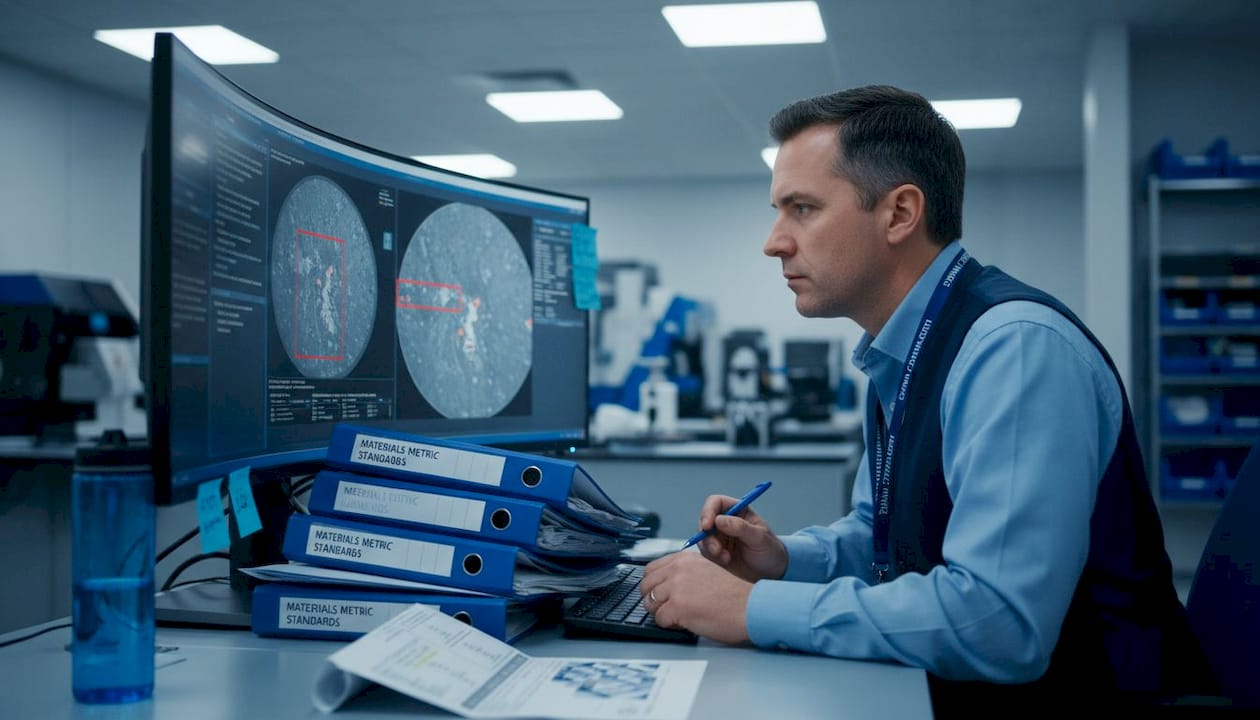
Regulatory bodies have become increasingly specific about what they expect from microstructural characterization. Vague surface descriptions no longer satisfy reviewers who understand what SEM can resolve. Your documentation needs to demonstrate not just that a test was run, but that it was run with appropriate parameters, on a representative sample, with interpretive rigor.
Here is how SEM integrates into a structured compliance workflow:
- Sample selection and traceability: Choose samples that represent your full production range, not just idealized test coupons, and document batch origin, processing history, and storage conditions.
- Instrument qualification: Ensure the SEM is calibrated against certified reference standards before critical characterization work. Calibration records must be audit-ready.
- Imaging protocol standardization: Define working distance, accelerating voltage, and magnification ranges in a written procedure. Consistency across sessions and operators is essential for valid comparison data.
- Image analysis and measurement: Apply validated software tools to measure grain sizes, coating thicknesses, crack lengths, and other reportable parameters. Avoid manual estimation where automated methods are available.
- Data interpretation and reporting: Pair images with narrative interpretation. Raw images alone are insufficient. Your report must explain what is shown and why it matters to safety and performance.
The practical impact of rigorous SEM practice is well supported by published data. In aerospace-relevant Al6061-B4C composites, 10wt% B4C addition yields a 50.8% reduction in wear rate compared to the base alloy, with SEM directly linking microstructural changes to that performance outcome. Similarly, SEM imaging of Ti-6Al-4V fatigue striations reveals crack propagation rates critical for device life prediction and regulatory justification.
| Application area | SEM output type | Compliance relevance |
|---|---|---|
| Biomedical implants | Surface topography, coating uniformity | FDA device submission documentation |
| Aerospace composites | Fracture surface mapping, porosity | Structural certification substantiation |
| Pharmaceutical particles | Morphology and size distribution | ICH Q1 and Q6A product characterization |
| Failure investigation | Crack initiation and propagation imaging | Root cause analysis and corrective action |
Our team supports testing for compliance across multiple regulatory frameworks, and our fatigue and wear assessment capabilities are specifically designed to generate the documentation your submissions require.
Pro Tip: When preparing compliance documentation, include SEM micrographs at multiple magnifications. A low-magnification overview paired with high-magnification detail gives reviewers context and specificity, which reduces back-and-forth during submission review.
Recognizing and managing SEM limitations and artifacts
While SEM is powerful, its results are only as good as your ability to recognize and control for its known limitations.
No technique is immune to error, and SEM has well-documented sources of artifact and distortion that, if unmanaged, can produce misleading data. For teams operating in regulated industries, an unrecognized artifact is far more dangerous than an acknowledged limitation. Misidentifying a charging artifact as a surface crack, for instance, could trigger an unnecessary design change. Failing to recognize beam damage in a biopolymer sample could produce a mischaracterized surface structure that ends up in a regulatory submission.
“Charging artifacts in non-conductive materials, beam damage in beam-sensitive biomedical samples, and drift or distortion affecting grain size measurements are well-established SEM limitations.” Managing these effectively requires both method literacy and protocol discipline, not just access to good instrumentation.
The most common SEM artifacts and their mitigation strategies include:
- Charging: Occurs in non-conductive materials such as ceramics, polymers, and biological tissue. The electron beam induces a buildup of negative charge on the surface, distorting the image with bright streaks or unstable contrast. Mitigation includes sputter coating with gold, platinum, or carbon prior to imaging, or using low-vacuum and environmental SEM modes that allow uncoated samples.
- Beam damage: High-energy electrons cause thermal damage in radiation-sensitive materials, particularly hydrated biological samples and some polymers. Mitigation involves reducing accelerating voltage to 1 to 5 kV, lowering beam current, and using cryo-SEM stages that preserve sample integrity at cryogenic temperatures.
- Drift and distortion: Mechanical drift during long imaging sessions or at high magnification introduces geometric distortion, which can skew grain size measurements or dimensional analysis. Drift correction algorithms and allowing the stage to thermally stabilize before imaging significantly reduce this effect.
- Surface contamination: Residual hydrocarbons from poor vacuum conditions or contaminated samples can deposit on the surface during imaging, altering observed morphology. Plasma cleaning the sample before imaging is standard practice in high-quality SEM workflows.
| Material type | Primary SEM challenge | Recommended mitigation |
|---|---|---|
| Non-conductive ceramics | Charging artifacts | Conductive sputter coating |
| Hydrated biological tissue | Beam damage and dehydration | Cryo-SEM or critical point drying |
| Soft polymers | Beam damage and charging | Low kV imaging, carbon coating |
| Metal alloys | Drift at high magnification | Stage stabilization, drift correction |
Our advanced microscopy pitfalls resource goes further into artifact identification and correction protocols. The key takeaway for R&D managers is that artifact management is not an optional add-on. It is a core part of generating defensible data, particularly when that data will be reviewed by a regulatory body.
Comparing SEM to alternative microscopy and analytical methods
A thoughtful assessment of when to use SEM versus other tools maximizes lab productivity and data value.
SEM is not the only answer for every materials characterization question. Knowing when to deploy transmission electron microscopy (TEM), atomic force microscopy (AFM), or micro-computed tomography (micro-CT) is a strategic skill for R&D managers. Each technique has a specific resolution range, sample preparation requirement, and data output that makes it more or less suitable depending on what you need to know.
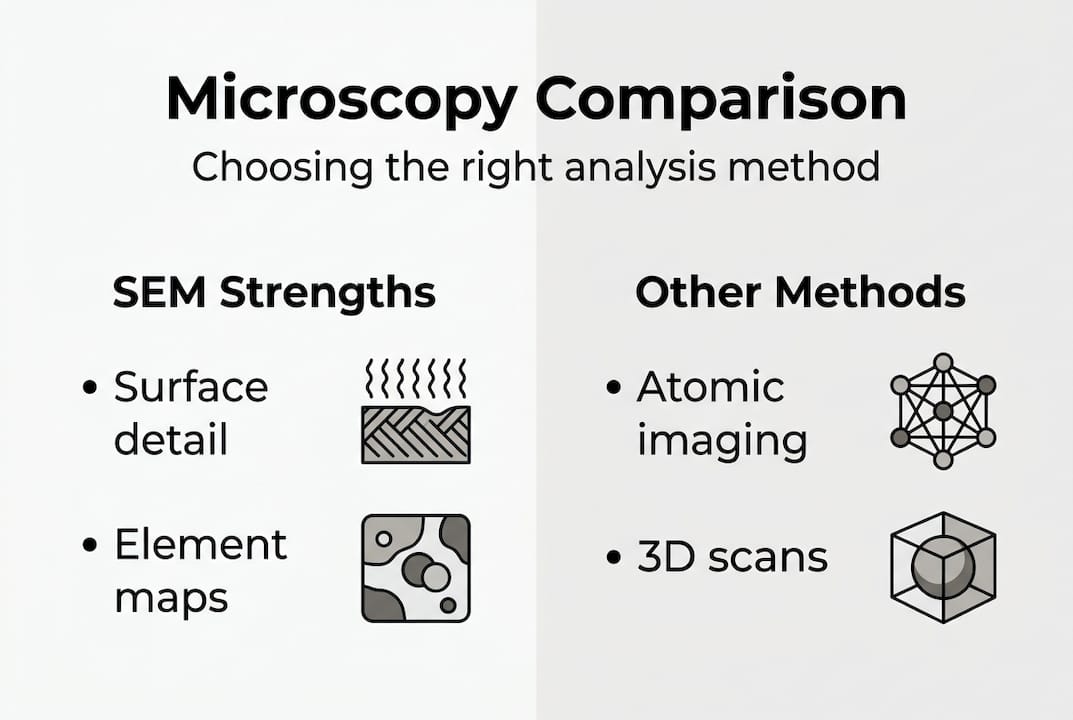
| Technique | Resolution range | Sample prep | Best use case |
|---|---|---|---|
| SEM | 1 nm to 100 µm practical | Moderate (coating for non-conductors) | Surface morphology, failure analysis, QC screening |
| TEM | Sub-angstrom to 1 nm | Intensive (ultra-thin sections) | Atomic structure, crystal defects, interface analysis |
| AFM | Sub-nanometer | Minimal | Surface roughness, nanoscale mechanical properties |
| Micro-CT | 1 µm to 100 µm | Minimal to none | Internal porosity, 3D reconstruction, non-destructive |
The decision between SEM and TEM typically comes down to whether you need surface or bulk information and whether atomic resolution is required. SEM vs TEM tradeoffs are well documented: SEM handles bulk samples with faster prep and is the clear choice for high-throughput industrial screening, while TEM demands ultra-thin sample preparation and delivers atomic-scale structural data best suited for fundamental research or specific interface characterization.
AFM is the preferred method when your question is about surface roughness at the nanoscale or when you need quantitative mechanical mapping of soft materials. It does not require a conductive sample and works in ambient conditions, making it particularly useful for pharmaceutical and biomedical polymer surfaces. However, AFM has a relatively small scan area and is slower than SEM for broad surface surveys.
Micro-CT fills the non-destructive, three-dimensional gap. When you need to visualize internal porosity in a sintered ceramic, map fiber distribution in a carbon composite, or verify internal geometry of a medical device without sectioning it, micro-CT is the right tool. Resolution is lower than SEM for surface detail, but the ability to generate volumetric data from intact components is highly valuable in both design validation and failure investigation.
Here is a practical decision framework for selecting the right technique:
- Define your primary data need: Surface morphology, internal structure, atomic-scale detail, or mechanical property mapping
- Assess sample constraints: Is destructive preparation acceptable? Is the sample conductive or beam-sensitive?
- Consider throughput requirements: SEM and micro-CT support higher-throughput workflows; TEM is resource-intensive per sample
- Match to regulatory evidence requirements: Confirm that your chosen technique generates the documented, traceable output your submission package requires
- Consider a multi-method approach: Many R&D programs combine SEM for screening with one targeted method for deep-dive characterization, which is both cost-effective and scientifically robust
Comparing microscopy methods systematically before committing analytical resources saves both time and budget, particularly in programs with constrained timelines.
What most guides miss about optimizing SEM in regulated industries
Most SEM guides focus on instrumentation and imaging modes. What they consistently underemphasize is the role of method literacy in protecting your program from regulatory setbacks.
We have seen teams generate technically adequate SEM images that still fail in submissions, not because the data was wrong, but because the assumptions behind the measurements were not documented or validated. Grain size distortion from drift, for example, is a minor effect in most well-run SEM sessions. The real vulnerability is misapplied intercept-to-grain-size conversion assumptions, where the mathematical model used to extract grain dimensions from image data does not match the sample’s actual grain morphology. That kind of error is invisible until a reviewer asks for your method justification.
The labs that consistently avoid regulatory delays are not necessarily using better equipment. They are applying structured, reviewed protocols, documenting every assumption in their measurement chain, and treating SEM best practices as a living quality document rather than a one-time setup exercise. Artifact awareness and protocol discipline are the real differentiators in regulated materials characterization.
Accelerate compliance and innovation with advanced SEM support
Ready to go beyond theory and ensure regulatory-ready results in your lab processes?
At Materials Metric, we function as an extension of your research team, providing specialized SEM analysis, artifact-controlled imaging, and compliance-aligned documentation across biomedical and aerospace programs. Our protocols are aligned with ISO 9001:2015 and GLP/GMP standards, so the data we generate is submission-ready from day one.
Whether you are building out your advanced characterization toolkit or need targeted support with integrated chemical analysis alongside your SEM program, we offer scalable, expert-led solutions that fit your project timeline and regulatory requirements. Contact us to discuss your specific characterization needs and let us help you move from data collection to compliant, confident submission.
Frequently asked questions
What types of artifacts are common in SEM and how can they be minimized?
Common SEM artifacts include charging in non-conductive samples, beam damage in sensitive biomedical materials, and geometric drift affecting dimensional measurements. Using conductive coatings, low accelerating voltage, cryo-stages, and established mitigation protocols keeps these effects within acceptable limits for regulated data.
How does SEM support compliance in regulated industries?
SEM provides high-resolution imaging and elemental data that serve as primary evidence in FDA and aerospace certification submissions. Published data shows that SEM-linked microstructural data, such as fatigue striations and wear surface analysis, directly supports performance validation and regulatory justification for both biomedical devices and structural aerospace components.
When should I use SEM instead of TEM, AFM, or micro-CT?
Choose SEM when you need fast, high-throughput surface imaging across bulk samples with moderate preparation requirements. As the SEM vs TEM guidance indicates, TEM is better suited for atomic-scale resolution, while AFM addresses nanoscale surface mechanics and micro-CT provides non-destructive internal 3D mapping.