
TL;DR:
- In-Process Controls monitor critical quality attributes in real time, preventing costly batch failures.
- Advanced techniques like PAT, digital twins, and multivariate analysis enhance process control and prediction.
- Effective IPC programs are dynamic, continuously updated to reflect evolving processes and materials.
Most manufacturing failures in pharmaceutical and biomedical production are not discovered at the end of the line. They develop quietly during the process, accumulating as small deviations in weight, blend uniformity, or seal integrity until they become costly, late-stage rejections. In-Process Controls (IPC) are real-time checks performed during manufacturing to ensure process control and product quality compliance with GMP (Good Manufacturing Practice) standards. When implemented correctly, IPC testing shifts your quality strategy from reactive to proactive, catching problems early enough to correct them without scrapping entire batches. This guide covers the fundamentals, regulatory context, core methodologies, advanced strategies, and practical risk management for IPC in biomedical and pharmaceutical settings.
Table of Contents
- What is IPC testing and why does it matter?
- Core IPC testing methodologies and instruments
- Regulatory requirements and compliance frameworks for IPC
- Advanced strategies: PAT, digital twins, and multivariate analysis
- Managing risk and edge cases in IPC: What most miss
- Our perspective: The IPC gap most organizations overlook
- How Materials Metric supports your IPC program
- Frequently asked questions
Key Takeaways
| Point | Details |
|---|---|
| IPC ensures process control | Real-time checks during manufacturing help prevent late-stage quality failures. |
| Modern tools boost compliance | Advanced analytical and digital solutions enhance regulatory adherence and product quality. |
| Regulation shapes IPC practice | Compliance with FDA, EU, and ICH guidelines is at the heart of IPC design. |
| Consider materials and edge cases | Customized IPC testing addresses advanced materials and high-risk parameters often overlooked. |
What is IPC testing and why does it matter?
IPC testing refers to In-Process Controls, a set of real-time checks performed at defined intervals or continuously during manufacturing. Unlike end-product testing, which evaluates a finished batch after production is complete, IPC testing monitors critical quality attributes while the process is still running. That distinction matters enormously. If a tablet press begins producing tablets that are 5% underweight, end-product testing will catch it after thousands of units are already made. IPC testing catches it within minutes.
The value of IPC extends beyond catching defects. It provides documented evidence that your process was in control throughout manufacturing, which is precisely what regulatory agencies expect to see. For analytical testing compliance, process data collected during production strengthens your overall quality dossier and supports faster regulatory submissions.
A common misconception is that IPC is simply a duplication of final quality control (QC) testing. In reality, IPC and final QC serve fundamentally different functions. IPC controls the process; final QC confirms the outcome. Both are necessary, but IPC is what prevents you from reaching final QC with a failing batch.
Here is where IPC testing adds the most value in regulated manufacturing:
- Early deviation detection: Identifies parameter drift before it cascades into batch failure
- Reduced waste: Corrective action during production is far less costly than batch rejection
- Regulatory documentation: Provides real-time process records required under GMP frameworks
- Process understanding: Builds a data-rich picture of how your process behaves under varying conditions
- Yield optimization: Consistent in-process monitoring supports higher batch acceptance rates
“In-process controls are not a substitute for final testing. They are the mechanism by which you ensure that final testing is rarely a surprise.”
For medical device and pharmaceutical manufacturers operating under tight timelines, IPC is one of the most cost-effective tools available for protecting product quality without slowing production.
Core IPC testing methodologies and instruments
Effective IPC programs rely on a combination of quantitative measurements and qualitative verifications. Quantitative and qualitative IPC checks include weights, temperatures, viscosities, pH, moisture content, appearance, and seal condition, using instruments like scales, torque monitors, NIR (Near-Infrared) spectroscopy, and PAT (Process Analytical Technology) for real-time monitoring.
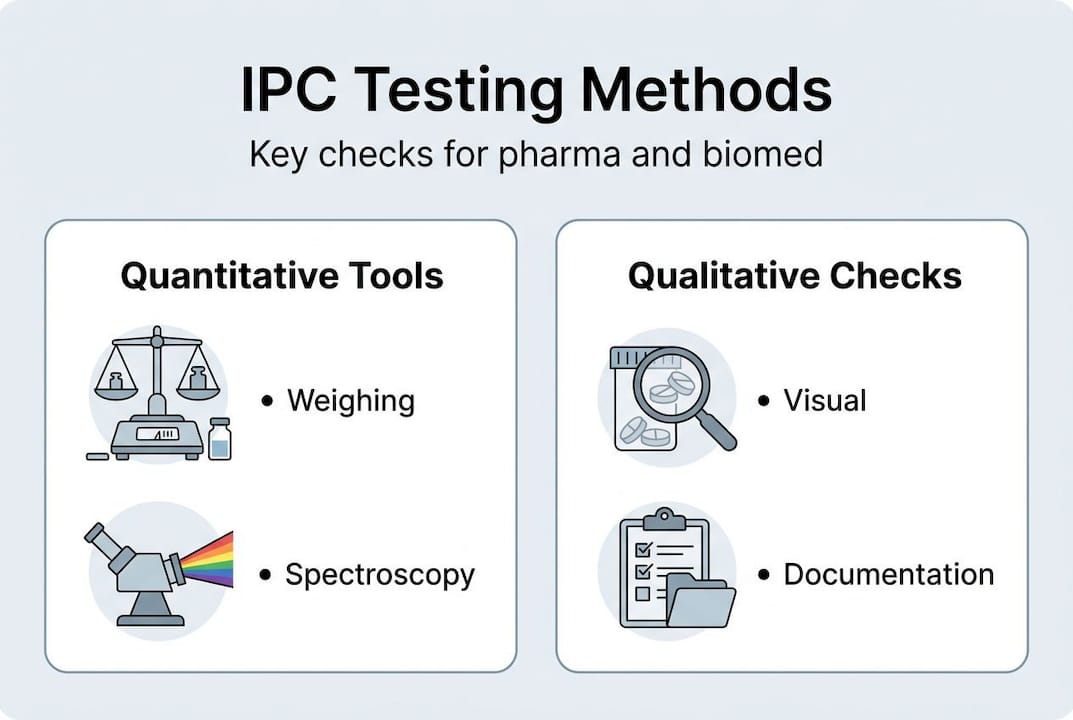
The specific tests you deploy depend on your product type and manufacturing process. Below is a summary of the most widely used IPC parameters and instruments:
| Parameter | Instrument | Application |
|---|---|---|
| Tablet weight | Analytical balance | Solid dose manufacturing |
| Tablet hardness | Hardness tester | Compression control |
| Friability | Friabilator | Tablet durability |
| Blend uniformity | NIR spectrometer | Powder mixing |
| Moisture content | Karl Fischer titrator | Lyophilization, granulation |
| Seal integrity | Vacuum decay tester | Sterile packaging |
| pH and viscosity | pH meter, viscometer | Liquid/semi-solid products |
| Torque | Torque monitor | Filling and capping lines |
For pharmaceutical solid dose products, the core IPC sequence typically follows this order:
- Verify raw material identity and moisture content before granulation
- Monitor blend uniformity at defined intervals using NIR or stratified sampling
- Check tablet weight, hardness, and thickness at regular press intervals
- Test friability on representative samples from each compression run
- Confirm coating uniformity and appearance before packaging
- Validate seal integrity on finished primary packaging
Pro Tip: NIR spectroscopy is one of the most powerful IPC tools available because it provides near-instantaneous, non-destructive chemical analysis without sample preparation. When paired with validated chemometric models, it can simultaneously monitor blend uniformity, moisture, and API (Active Pharmaceutical Ingredient) concentration in real time. Explore how chemical analysis methods integrate with IPC programs for a more complete picture.
For sterile medical devices and injectable products, atomic absorption spectroscopy and related elemental analysis techniques are increasingly used to monitor trace metal contamination during manufacturing, an often-overlooked IPC parameter with significant safety implications.
Regulatory requirements and compliance frameworks for IPC
IPC testing is not optional in regulated manufacturing. FDA 21 CFR 210/211 requires in-process monitoring of parameters affecting identity, strength, quality, and purity. EU GMP Annex 15, along with ICH Q8, Q9, and Q10 guidelines, further define how IPC must be designed, validated, and documented. These frameworks also support PAT for real-time release testing, reducing reliance on end-product batch testing.

Here is how the major regulatory frameworks compare in their IPC requirements:
| Regulatory body | Key requirement | IPC focus |
|---|---|---|
| FDA 21 CFR 211 | Mandatory in-process testing | Identity, strength, purity, quality |
| EU GMP Annex 15 | Validation and qualification | Process performance qualification |
| ICH Q8 | Design space definition | Pharmaceutical development |
| ICH Q9 | Risk-based approach | Quality risk management |
| ICH Q10 | Pharmaceutical quality system | Continual improvement |
Key compliance requirements your IPC program must address:
- Validated methods: Every IPC test must be validated before use in production
- Defined acceptance criteria: Specifications must be established and justified scientifically
- Complete documentation: All in-process data must be recorded in batch records
- Sampling plans: Statistical sampling strategies must be risk-based and justified
- Deviation management: Out-of-specification (OOS) results must trigger documented investigations
One area where manufacturers frequently fall short is microbial barrier integrity testing for sterile packaging. EU GMP guidance is explicit about the need for validated container closure integrity testing as an IPC parameter for sterile products. Many teams treat this as a final QC step rather than an in-process control, which increases risk exposure significantly.
For manufacturers developing novel sterile products or advanced delivery systems, our sterilization integrity tests provide the validated data needed to satisfy both FDA and EU GMP requirements at the IPC level.
Advanced strategies: PAT, digital twins, and multivariate analysis
Traditional IPC relies on periodic sampling and offline measurement. Advanced IPC strategies replace or supplement that approach with continuous, real-time data streams that enable immediate process adjustments. Comparing traditional IPC to advanced PAT and APC approaches, such as AEX-HPLC (Anion Exchange High-Performance Liquid Chromatography) for in vitro transcribed mRNA and real-time NIR, shows that IPC prevents defects upstream and reduces end-testing reliance, but requires validated methods and risk-based sampling strategies.
PAT goes further than standard IPC by integrating sensors directly into the process stream. Instead of pulling samples for offline analysis, PAT instruments measure critical quality attributes continuously and feed that data into automated control loops. This enables real-time release testing, where batch disposition decisions are made based on process data rather than end-product testing alone.
Digital twins represent the next evolution. A digital twin is a computational model of your manufacturing process that runs in parallel with actual production. It uses real-time sensor data to simulate process behavior, predict deviations before they occur, and recommend corrective actions. For complex bioprocesses or high-value batches, this predictive capability can prevent costly failures before any physical parameter exceeds its limit.
Multivariate data analysis on historical process data uncovers root causes such as particle size distribution and process parameters that drive out-of-spec results, enabling systematic process optimization and reduced OOS rates at industrial scale.
Pro Tip: The most common mistake teams make when adopting PAT is monitoring too many parameters without a clear strategy. Focus first on the two or three parameters that most directly predict your critical quality attributes. Use analytical testing impact data from development studies to identify which variables carry the most predictive weight.
Practical steps to modernize your IPC program:
- Audit your current IPC methods and identify which parameters are measured offline that could be monitored in real time
- Invest in chemometric model development for NIR or Raman-based PAT applications
- Build a historical process database to support multivariate analysis and batch consistency evaluations
- Establish a cross-functional team that includes manufacturing, QA, and data science expertise
- Validate digital tools under 21 CFR Part 11 requirements before deploying in GMP environments
- Use impurity tracking data to feed predictive models and refine acceptance criteria over time
Understanding the analytical testing importance in this context is critical. Advanced IPC is only as reliable as the underlying analytical methods that power it.
Managing risk and edge cases in IPC: What most miss
Standard IPC programs handle routine parameters well. Where teams struggle is in identifying and controlling the parameters that fall outside normal monitoring plans, particularly for high-risk products or novel materials. High-risk IPC parameters such as API potency and seal integrity require continuous or unit sampling. Sterile products need bioburden and environmental monitoring. Advanced materials like polycarbonate urethanes must be tested for mechanical properties including tensile strength and DMA (Dynamic Mechanical Analysis), as well as biocompatibility with cell viability thresholds above 70%.
For medical device testing, the IPC challenge is compounded by the diversity of materials involved. A single implantable device may incorporate metals, polymers, adhesives, and coatings, each with its own critical quality attributes and failure modes. Monitoring all of them effectively requires a structured, risk-based approach.
Key edge cases your IPC program should address:
- Continuous vs. batch sampling: High-risk parameters like API potency or seal integrity require 100% or continuous sampling, not periodic checks
- Environmental monitoring: Sterile manufacturing environments require real-time bioburden and particulate monitoring as IPC parameters
- Mechanical property testing: For polymer-based devices, tensile strength, elongation at break, and DMA data belong in your IPC plan
- Biocompatibility screening: Early-stage biocompatibility data should inform IPC thresholds for novel materials before scale-up
- Packaging integrity: Container closure integrity testing for sterile products must be validated as an IPC step, not deferred to final QC
Pro Tip: When working with novel polymers or composite biomaterials, do not assume that standard pharmaceutical IPC parameters are sufficient. Engage your materials testing partner early in development to map the unique critical quality attributes of your specific material system. Our material integrity measures services are designed to support exactly this kind of early-stage IPC planning.
Our perspective: The IPC gap most organizations overlook
After working with biomedical and pharmaceutical manufacturers across a wide range of product types, we have observed a consistent pattern. Organizations invest heavily in method development and final QC infrastructure, but underinvest in the IPC layer that sits between development and release. The result is a quality system that is technically compliant on paper but fragile in practice.
The real risk is not that teams ignore IPC. Most organizations have IPC procedures in place. The risk is that those procedures were designed for a previous product or process and were never critically re-evaluated when manufacturing conditions changed. A sampling plan that was appropriate for a 10,000-unit batch may be statistically inadequate for a 100,000-unit run. An IPC method validated for one polymer formulation may not transfer cleanly to a modified version.
We believe the most effective IPC programs are living systems, updated continuously as process knowledge grows. That requires treating IPC not as a compliance checkbox but as a core element of your process understanding strategy. When you connect IPC data to your development database, your deviation history, and your regulatory submissions, it becomes a strategic asset rather than an administrative burden.
How Materials Metric supports your IPC program
Building a robust IPC program requires more than a checklist. It requires validated analytical methods, specialized instrumentation, and experienced interpretation of in-process data across complex material systems.

At Materials Metric, we function as an extension of your quality and R&D teams, providing the testing infrastructure and scientific expertise to design, validate, and support IPC programs for pharmaceutical and biomedical applications. Our capabilities span NIR and Raman spectroscopy, mechanical and thermal testing, biocompatibility evaluation, and sterilization integrity testing, all aligned with ISO 9001:2015, GLP, and GMP requirements. Whether you are scaling a novel drug delivery system or qualifying a new biomaterial for implantable use, we provide the data you need to keep your process in control and your submissions on track.
Frequently asked questions
What is the main goal of IPC testing in pharmaceutical manufacturing?
The main goal is to detect and address process variations early, ensuring consistent quality and regulatory compliance during production. IPC real-time checks are specifically designed to maintain process control and prevent late-stage batch failures.
How does IPC testing differ from traditional end-product testing?
IPC is performed during manufacturing to control quality in real time, while end-product testing checks the final product after the process is finished. The two approaches are complementary, but in-process controls are what prevent you from arriving at final QC with a failing batch.
What are examples of advanced IPC technologies?
Examples include PAT (Process Analytical Technology), digital twins, multivariate data analysis, and real-time NIR and AEX-HPLC monitoring for complex biologics such as in vitro transcribed mRNA.
How do biocompatibility and mechanical tests factor into IPC for advanced materials?
For advanced polymer-based devices, mechanical and biocompatibility parameters such as tensile strength, DMA, and cell viability above 70% are critical IPC attributes that must be monitored to ensure materials meet biomedical safety and performance standards.