TL;DR:
- DMA measures viscoelastic properties like storage and loss modulus, revealing insights static tests miss.
- Proper DMA protocols align with standards like ISO 6721 and ASTM D4065 for regulatory compliance.
- Advanced DMA techniques improve data accuracy, supporting faster regulatory approval and product development.
Many advanced medical devices and pharmaceutical innovations hinge on a single test that most development teams overlook. Dynamic Mechanical Analysis (DMA) testing reveals viscoelastic properties that standard tensile or compression tests simply cannot capture, yet it remains underutilized in many biomedical and pharma workflows. When regulatory submissions stall or implant materials underperform, the missing data often traces back to incomplete mechanical characterization. This guide covers what DMA measures, how to execute it correctly, which standards apply, and how it directly supports FDA compliance, ISO alignment, and faster product development cycles across biomedical and pharmaceutical applications.
Table of Contents
- What is DMA testing and why does it matter?
- DMA test methods, standards, and workflow essentials
- DMA in biomedical and pharmaceutical applications
- Nuances, best practices, and advanced DMA protocols
- Why DMA data quality matters more than you think
- Get expert DMA support for your next breakthrough
- Frequently asked questions
Key Takeaways
| Point | Details |
|---|---|
| DMA reveals unique properties | Only DMA uncovers viscoelastic and damping traits that traditional tests miss, ensuring deeper material insight. |
| Essential for compliance | Regulatory agencies increasingly expect DMA data for device, implant, and drug delivery material validation. |
| Protocols impact accuracy | Using the right method and interpreting DMA results carefully can make or break R&D and regulatory outcomes. |
| Advanced applications require nuance | Complex materials like high-fill composites or 3D-printed structures demand advanced DMA strategies for valid data. |
What is DMA testing and why does it matter?
With a foundation set, let’s break down what DMA actually measures and why it outperforms many standard tests.
DMA applies an oscillating mechanical force to a material sample across a defined range of temperatures or frequencies. The instrument records how the material responds, separating the elastic (stored energy) component from the viscous (dissipated energy) component. This dual measurement is what makes DMA fundamentally different from a simple tensile test, which only captures a snapshot of behavior at one condition.
The three core outputs are:
- Storage modulus (E’): Reflects the elastic, recoverable energy stored in the material. This tells you how stiff the material is under dynamic loading.
- Loss modulus (E’’): Captures the energy dissipated as heat. High loss modulus values indicate a more viscous, energy-absorbing material.
- Tan delta (tan δ): The ratio of loss to storage modulus. It quantifies damping behavior and is especially sensitive to phase transitions, including the glass transition temperature (Tg).
As viscoelastic properties are characterized by applying oscillatory stress, DMA captures material behavior under real-world dynamic conditions rather than static loading alone. This is critical for biomedical polymers, hydrogels, and drug delivery matrices where performance under cyclic or sustained loads directly affects patient outcomes.
DMA is significantly more sensitive than Differential Scanning Calorimetry (DSC) for detecting subtle transition regions in polymers and composites. Where DSC may miss a weak Tg, DMA’s tan delta peak will often reveal it clearly.
For teams working on implantable devices, controlled-release systems, or soft tissue analogs, this sensitivity is not optional. Our DMA test lab overview details the specific configurations we use for biomedical and pharmaceutical materials. When comparing DMA against other mechanical testing methods, the viscoelastic data DMA provides consistently fills critical gaps that static tests leave open.
The practical implication is straightforward. A polymer that passes a simple tensile test may still fail under the cyclic loading of an implant environment. DMA catches that failure mode before it reaches the clinic.
DMA test methods, standards, and workflow essentials
Knowing what DMA measures, it’s crucial to choose and execute the proper methods and standards for your material and application.
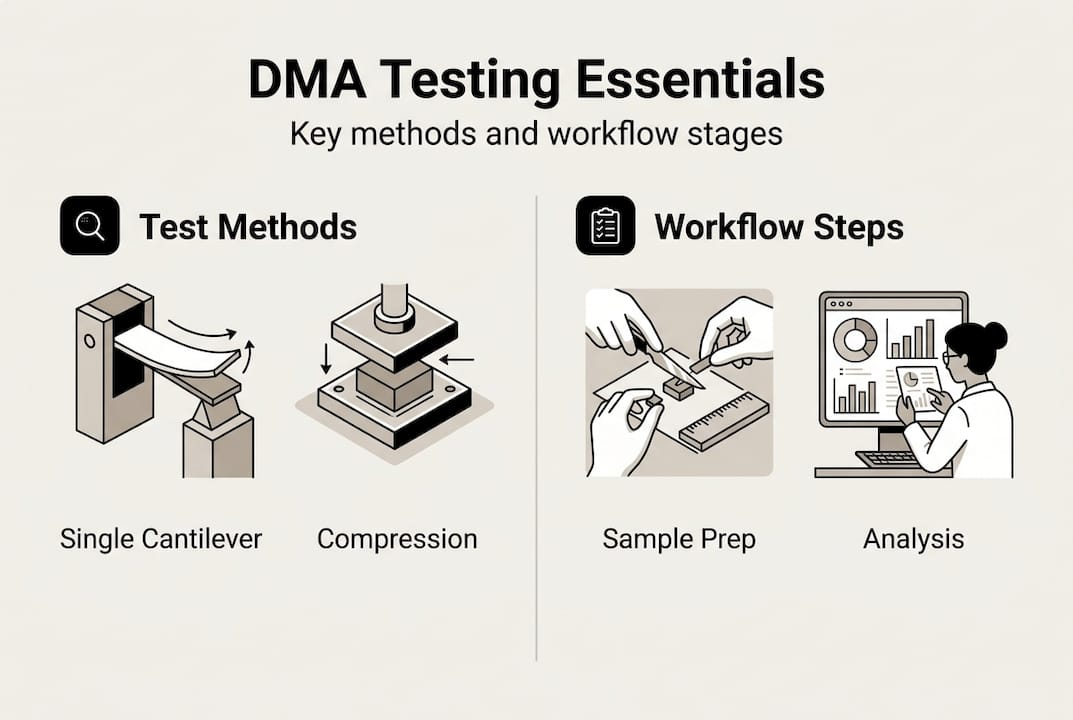
DMA supports multiple test configurations, each suited to different material geometries and stiffness ranges. Key DMA methodologies include tension, compression, shear, single and dual cantilever, and 3-point bending, with temperature sweeps used to determine Tg and frequency sweeps used for time-temperature superposition (TTS) modeling.
| Configuration | Best suited for | Typical application |
|---|---|---|
| Single cantilever | Stiff polymers, composites | Implant housings, structural components |
| Dual cantilever | Medium stiffness polymers | Drug delivery films, coatings |
| Tension | Films, fibers, soft gels | Sutures, membranes, hydrogels |
| Compression | Foams, soft tissues | Cartilage analogs, cushioning biomaterials |
| 3-point bending | Rigid rods, plates | Bone plates, stent materials |
For biomedical and pharma teams, the relevant standards include ISO 6721 (plastics), ASTM D4065 (plastics frequency sweep), and ISO 14801 (fatigue testing of implants). These standards define acceptable sample dimensions, strain amplitudes, and reporting requirements. Our tension and shear testing details page outlines how these configurations integrate with broader mechanical characterization workflows.
A standard DMA workflow for an implantable polymer follows these steps:
- Sample preparation: Machine or cast specimens to specification. Dimensional accuracy directly affects modulus calculations.
- Conditioning: Equilibrate samples at controlled humidity and temperature to eliminate moisture-driven variability.
- Temperature sweep: Run from below anticipated Tg to above the expected service temperature, typically at 1 to 5°C per minute.
- Frequency sweep: Apply multiple frequencies (0.1 to 100 Hz) at fixed temperatures to build TTS master curves.
- Data review: Identify Tg from tan delta peak, confirm modulus plateau in the glassy and rubbery regions, and flag unexpected secondary transitions.
Pro Tip: When comparing DMA results to DSC comparison data, expect the DMA-derived Tg to appear 5 to 15°C higher due to the dynamic nature of the measurement. Always report which method was used in regulatory submissions to avoid reviewer confusion.
For biomedical DMA applications, frequency selection matters more than many teams realize. Running only a single frequency misses the frequency-dependent stiffness behavior that implants experience during normal patient activity. Our thermal analysis services complement DMA by providing DSC and TGA data for a complete thermal and mechanical profile.
DMA in biomedical and pharmaceutical applications
Once set up with the right DMA approach, here’s how DMA directly impacts biomed and pharma workflows.
In biomedical R&D, DMA characterizes the mechanical behavior of polymers, hydrogels, and composites used in implants, drug delivery systems, and soft tissue analogs. The storage modulus profile across temperature tells engineers whether a material will remain mechanically stable at body temperature (37°C) and under the mechanical loads it will experience in service.

For pharmaceutical applications, DMA is particularly valuable for analyzing polymer excipients, tablet coatings, and controlled-release matrices. Changes in storage modulus or tan delta during stability studies can signal moisture uptake, crystallization, or phase separation before these changes become visible through other analytical methods.
| Application | Key DMA parameter | What it signals |
|---|---|---|
| PLGA implants | Tg stability | Degradation rate and structural integrity |
| Hydrogel scaffolds | Storage modulus at 37°C | Tissue-matching compliance |
| Tablet coatings | Tan delta shift | Moisture sensitivity, film integrity |
| Drug delivery films | Loss modulus profile | Release rate correlation |
Regulatory relevance is real. DMA is recommended by FDA and ISO 10993 for medical device and implant testing, even when it is not explicitly mandated. Including DMA data in a 510(k) or PMA submission strengthens the mechanical characterization package and reduces the likelihood of reviewer requests for additional data.
Key benefits DMA delivers in these workflows include:
- Detecting the storage modulus drop at Tg that signals the boundary of a material’s safe operating window
- Supporting batch consistency evaluations by flagging lot-to-lot variability in crosslink density or cure state
- Validating crosslinking protocols and phase separation in polymer blends
- Providing stability data for thermal analysis in QA packages submitted to regulatory agencies
A documented example: DMA for implants has demonstrated an 18% improvement in PLGA glass transition temperature stability when processing parameters were optimized based on DMA feedback. That kind of data-driven refinement is what separates successful regulatory submissions from costly resubmissions.
Nuances, best practices, and advanced DMA protocols
DMA delivers powerful insights, but achieving trustworthy data means understanding advanced techniques and edge case management.
Not all materials behave predictably in a DMA instrument. Highly filled composites, 3D-printed parts, and anisotropic materials require protocol adjustments and nuanced interpretation that standard single-strain methods cannot always provide.
For highly filled composites with filler content above 80%, the standard strain amplitude may be too large, causing nonlinear viscoelastic behavior that distorts modulus values. Reducing strain amplitude and verifying linearity with a strain sweep before the main test is essential. Similarly, 3D-printed parts exhibit direction-dependent stiffness, so testing must be performed along multiple print orientations to capture the full anisotropic profile.
The tan delta peak and the loss modulus peak do not always occur at the same temperature. Reporting only one without the other can lead to incorrect Tg assignment, which is a common source of regulatory reviewer questions.
Key best practices for advanced DMA protocols include:
- Strain sweep first: Always confirm you are operating within the linear viscoelastic region before running temperature or frequency sweeps.
- Multi-strain methods: For materials with extreme modulus transitions (greater than three decades of change), use monotonic loading alongside oscillatory methods to capture the full transition.
- Replicate testing: Run a minimum of three replicates per condition. Protocol-driven reproducibility can approach less than 10% coefficient of variation with rigorous sample prep and instrument calibration.
- Interpret both peaks: Record both the tan delta peak and the loss modulus peak temperature and report them separately in your data package.
Pro Tip: For DMA edge cases involving soft hydrogels or biological tissue analogs, the compression geometry with a parallel plate fixture often outperforms cantilever modes. These materials are too compliant for bending modes and can slip or buckle, producing unreliable data.
Our DMA testing guidance covers protocol selection in detail, and our custom materials testing capabilities extend to non-standard geometries and challenging material classes that require bespoke fixture design.
Why DMA data quality matters more than you think
With these nuances in mind, a strategic mindset toward DMA unlocks far greater regulatory and commercialization success.
We have reviewed enough regulatory submissions and R&D data packages to recognize a consistent pattern. Teams that treat DMA as a routine checkbox generate data that raises more questions than it answers. Teams that invest in protocol rigor and expert interpretation generate data that accelerates review timelines and reduces costly rework cycles.
The uncomfortable truth is that most DMA-related failures in regulatory submissions trace back to two specific errors: using the wrong test configuration for the material geometry, and reporting only the tan delta peak without the loss modulus peak. Both are avoidable with proper protocol design.
Standard single-strain DMA can fail for materials with extreme modulus change, and advanced protocols provide substantially better accuracy in these cases. This is not an edge case. Many biomedical polymers and pharmaceutical excipients undergo modulus changes spanning multiple decades across their service temperature range.
We also see teams underestimate how much DMA complements other analytical methods. When DMA data is interpreted alongside DSC, TGA, and spectroscopic results, the combined picture supports far stronger best mechanical testing strategies for regulatory filings. DMA alone is powerful. DMA integrated with a full characterization package is decisive.
Get expert DMA support for your next breakthrough
Ready to put DMA testing to work? Here’s how our lab and consulting can accelerate your product pipeline.
At Materials Metric, we provide DMA testing and interpretation as part of a fully integrated materials characterization service. Our team works directly with your R&D and regulatory affairs groups to design protocols that align with your submission requirements and product development goals.

From analytical testing compliance support to advanced characterization techniques including spectroscopy, microscopy, and thermal analysis, we function as an extension of your research team. Our chemical and microscopy analysis capabilities pair directly with DMA to build the complete data packages that regulators and quality teams expect. Contact us today to discuss your project requirements and get a tailored testing plan.
Frequently asked questions
What does DMA testing measure that other tests miss?
DMA reveals viscoelastic property profiles including storage modulus, loss modulus, and damping behavior across temperature and frequency ranges that standard static mechanical tests cannot capture.
Which standards apply to DMA testing for medical and pharmaceutical materials?
DMA standards include ISO 6721 for plastics, ASTM D4065 for frequency sweep testing, and ISO 14801 for fatigue and mechanical testing of medical implants.
Is DMA testing required for FDA approval of medical devices?
FDA and ISO 10993 recommend DMA for certain device materials to demonstrate mechanical performance, though it is not always explicitly mandated in every submission pathway.
How does DMA assist pharmaceutical R&D?
DMA optimizes polymer stability and performance for drug delivery systems by detecting changes in viscoelastic properties that indicate moisture uptake, crystallization, or phase separation during formulation development and stability studies.
What is an example of a DMA-driven improvement in biomaterials?
DMA improved PLGA Tg stability by 18% in biomedical implant applications when processing parameters were refined based on DMA feedback during development.