Most R&D teams working in biomedical, pharmaceutical, and aerospace sectors already know that electron microscopy sits at the core of serious materials characterization. What’s less understood is exactly which tool does what, under which conditions, and at what cost to your timeline and budget. Scanning electron microscopy (SEM) and transmission electron microscopy (TEM) are not interchangeable. Choosing the wrong approach, or misunderstanding what each can realistically deliver, leads to wasted sample prep effort, inconclusive data, and delayed product development cycles. This guide breaks down both techniques with clarity, so your team can make confident, evidence-based decisions.
Table of Contents
- How scanning and transmission electron microscopes work
- Sample preparation: the real-world bottleneck
- Strengths, weaknesses, and edge cases in advanced industries
- Resolution, limitations, and the future: pushing the boundaries
- Why practical constraints matter more than theoretical limits
- Connect your team to advanced materials characterization
- Frequently asked questions
Key Takeaways
| Point | Details |
|---|---|
| SEM vs TEM core roles | SEM specializes in surface structure while TEM reveals nanoscale interior details, each suiting different research needs. |
| Sample preparation scope | Effective microscopy starts with tailored, sometimes challenging sample prep that directly impacts what you can see. |
| Industry-driven applications | Advanced sectors like aerospace, pharma, and biomedical rely on both SEM and TEM for reliable materials R&D. |
| Innovation in resolution | New approaches such as ptychography are raising the practical resolution bar for mainstream electron microscopes. |
| Choose tools for workflow fit | The best results come from matching your project’s realities—sample, prep, and outputs—to the right electron microscopy approach. |
How scanning and transmission electron microscopes work
With the context set, let’s decode the fundamentals of how these powerful microscopes operate and what distinguishes their imaging capabilities.
At the most basic level, SEM operation basics involve directing a focused electron beam across the sample surface in a raster pattern. The instrument detects the electrons that are either scattered back or emitted from the surface as a result. SEM mechanically operates by rastering/14%3A_Surface_Characterization_by_Spectroscopy_and_Microscopy/14.02%3A_Scanning_Electron_Microscopy) a focused beam over a surface and forming images from detected emissions, notably secondary and backscattered electrons. The result is a detailed topographical map of the sample’s exterior with excellent depth of field.
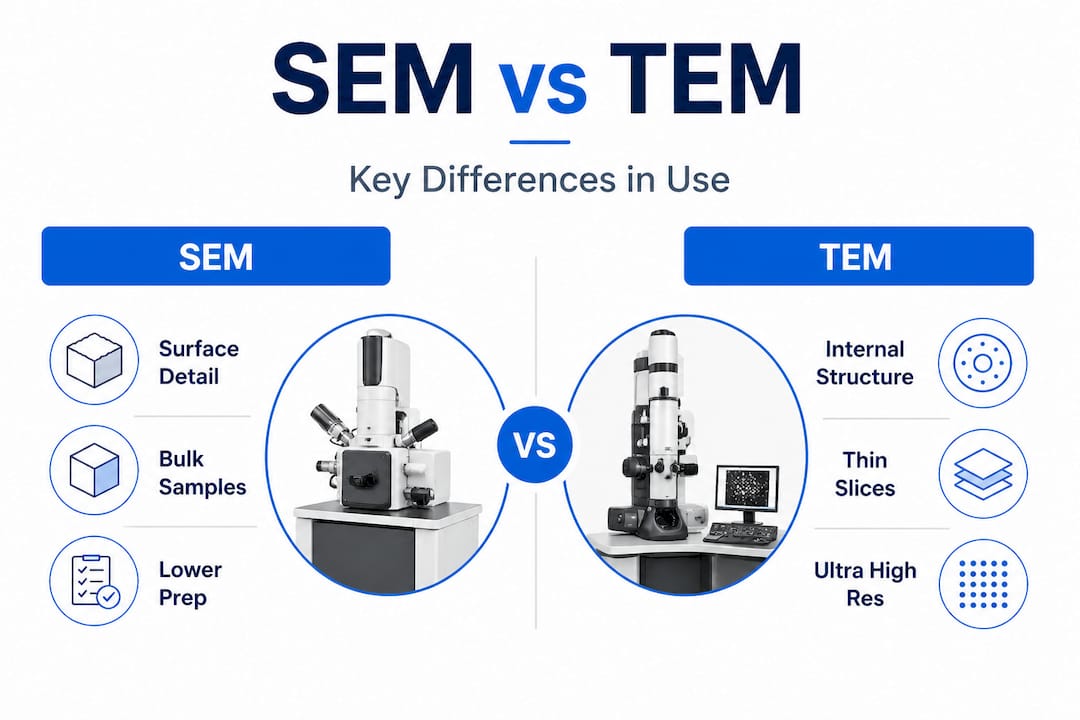
TEM works on a fundamentally different principle. TEM imaging principles involve passing a high-energy electron beam directly through the specimen. What the detector captures on the other side reveals the internal structure of the material at near-atomic resolution. This is where the technique excels for resolving crystallographic features, grain boundaries, precipitates, and defects buried within the bulk material.
The specimen requirements diverge sharply between the two techniques. SEM accommodates relatively large, bulk specimens with minimal modification in many cases. TEM is far more demanding.
TEM and STEM require electron-transparent specimens/14%3A_Surface_Characterization_by_Spectroscopy_and_Microscopy/14.2.02%3A_Transmission_Electron_Microscopy); typical guidance is approximately 100 nm or below in thickness. For hard materials like metals and ceramics, this demands precision thinning techniques such as focused ion beam (FIB) milling or ion polishing.
Here is a practical side-by-side comparison to anchor your decision-making:
| Parameter | SEM | TEM |
|---|---|---|
| Primary imaging | Surface topography | Internal/bulk nanostructure |
| Typical resolution | 1 to 20 nm | 0.05 to 0.2 nm |
| Specimen thickness | Bulk (up to cm scale) | ~100 nm or less |
| Accelerating voltage | 0.1 to 30 kV | 60 to 300 kV |
| Sample prep complexity | Low to moderate | High |
| Analytical add-ons | EDS, EBSD, CL, WDS | EDS, EELS, SAED |
| Field of view | Wide | Narrow |
Key imaging contrasts worth keeping in mind:
- SEM excels at surface morphology, fracture analysis, particle size distribution, and coating inspection.
- TEM is the tool for resolving dislocations, stacking faults, phase boundaries, and nanoscale precipitates.
- STEM (scanning transmission electron microscopy) combines both, using a scanned beam in transmission mode for simultaneous structural and chemical data.
- Both techniques can integrate energy-dispersive X-ray spectroscopy (EDS) for elemental mapping, but the spatial resolution of EDS is far superior in TEM.
Understanding these distinctions up front saves your team from investing weeks of sample preparation into the wrong technique.
Sample preparation: the real-world bottleneck
Understanding core microscope operation sets the stage for a crucial reality: even the world’s best microscope can’t make up for poor or inappropriate sample prep.
Sample preparation is consistently the most time-intensive and failure-prone step in electron microscopy workflows. Biomedical and pharma electron microscopy workflows explicitly emphasize both TEM and SEM capabilities alongside practical constraints such as tedious sample preparation and static-imaging limitations. These are not minor inconveniences. For biological specimens in particular, poor fixation, dehydration artifacts, or insufficient contrast staining will render even the highest-resolution instrument incapable of producing interpretable data.
Standard SEM preparation sequence for biological or soft materials:
- Fix the specimen using chemical fixatives (glutaraldehyde, osmium tetroxide) to preserve ultrastructure.
- Dehydrate through a graded series of ethanol or acetone washes to remove water without collapsing structure.
- Apply critical point drying (CPD) to transition from liquid to gas phase without surface tension damage.
- Mount on an aluminum stub and apply conductive adhesive or carbon tape.
- Sputter-coat with a thin layer of gold, gold-palladium, or platinum to prevent charge buildup during imaging.
Standard TEM preparation sequence for similar specimens:
- Fix with primary and secondary fixatives (glutaraldehyde, then osmium tetroxide for membrane contrast).
- Dehydrate and infiltrate with epoxy resin (e.g., Epon or LR White).
- Cure the resin block in an oven for 24 to 48 hours.
- Ultramicrotome sections to 60 to 100 nm thickness using a diamond knife.
- Collect sections on copper grids and stain with heavy metal stains such as uranyl acetate and lead citrate.
- Allow sections to dry completely before loading into the microscope.
For hard materials like aerospace alloys or ceramic coatings, the TEM preparation route involves FIB-SEM lift-out, mechanical polishing, and ion milling, each step carrying its own risk of introducing artifacts or damaging the very features you need to resolve.
You can explore advanced sample prep workflows to understand how proper sequencing and fixation choices influence downstream data quality.
Pro Tip: Before committing to TEM, ask whether your research question genuinely requires sub-nanometer internal resolution, or whether a high-resolution SEM with EDS could answer the same question in half the time. In our experience, many projects default to TEM out of habit when SEM delivers entirely sufficient data for the regulatory or R&D objective at hand.
Preparation effort also shapes the statistical validity of your results. TEM images represent extremely small sample volumes. If you need population-level data on particle size or porosity distribution, SEM or X-ray techniques often provide more representative sampling with far less preparation burden.
Strengths, weaknesses, and edge cases in advanced industries
With an appreciation for sample preparation, let’s examine how scanning and transmission microscopy are put to work in R&D-heavy industries and where their distinct value emerges.
Both SEM and TEM are deployed across aerospace, pharmaceutical, and biomedical sectors, but their roles differ substantially. Aerospace materials characterization commonly uses SEM with EDS and EBSD for microstructure analysis, defect mapping, and coating inspection, while TEM resolves fine precipitates, dislocations, and phase boundaries. FIB-SEM serial sectioning can extend this further into 3D reconstructions for subsurface crack and porosity networks.
| Industry | SEM best use cases | TEM best use cases |
|---|---|---|
| Aerospace | Fracture surface analysis, coating adhesion, grain mapping via EBSD | Dislocation networks, precipitate morphology, oxidation layer interfaces |
| Pharmaceutical | Particle size and shape, API crystallinity (surface), excipient distribution | Nanoparticle internal structure, drug carrier membrane architecture, lattice confirmation |
| Biomedical | Implant surface characterization, cell morphology, scaffold architecture | Membrane ultrastructure, viral particle morphology, biomaterial-cell interface |
In aerospace applications, SEM with EDS and EBSD provides a powerful combination: EDS identifies elemental composition at the microstructural level, while EBSD maps crystallographic orientation across grain populations. This is critical for validating heat treatment outcomes and predicting fatigue behavior in high-temperature aerospace materials. FIB-SEM further enables targeted cross-sectioning without damaging adjacent microstructure.
You can see how SEM supports aerospace defect analysis across coating systems and fatigue fracture surfaces, connecting microscopy data directly to compliance documentation.
Key strengths and weaknesses for each technique:
SEM strengths:
- Large field of view for statistical relevance
- Minimal sample prep for conductive, hard materials
- Multi-modal analytical capability (EDS, EBSD, cathodoluminescence)
- Flexible vacuum modes including variable-pressure for hydrated or non-conductive samples
SEM weaknesses:
- Limited to surface information (typically top 1 to 5 nm for secondary electrons)
- Non-conductive samples require coating or variable-pressure mode, which reduces resolution
- Cannot resolve atomic columns or lattice planes directly
TEM strengths:
- Sub-angstrom resolution possible with aberration-corrected instruments
- Direct imaging of crystal lattice, defects, and interfaces
- EELS (electron energy loss spectroscopy) provides bonding and oxidation state data at atomic scale
TEM weaknesses:
- Extremely small sample volumes, limiting statistical coverage
- Lengthy and artifact-prone sample preparation
- High instrument cost and operational expertise requirements
- Static images that don’t capture dynamic or in-situ material behavior without specialized holders
Pro Tip: For pharmaceutical nanoparticle characterization, cryo-TEM is one of the most powerful techniques available. It preserves hydrated specimens in vitreous ice, avoiding fixation and drying artifacts that would otherwise collapse or restructure soft nanocarrier architectures. If your product involves lipid nanoparticles, liposomes, or polymer-based drug carriers, cryo-TEM is often the definitive characterization method required before regulatory submission.
Resolution, limitations, and the future: pushing the boundaries
Understanding established applications, let’s look at the technical frontiers and the opportunities they unlock for ambitious teams.
Conventional resolution limits for mainstream platforms are well established:
- Standard SEM: 1 to 10 nm lateral resolution, depending on accelerating voltage and detector type
- FEG-SEM (field emission gun): approximately 1 nm under optimal conditions
- Conventional TEM: 0.2 to 0.5 nm resolution in phase contrast mode
- Aberration-corrected TEM: below 0.1 nm, approaching the sub-angstrom scale
- STEM with HAADF detector: atomic-column resolution with Z-contrast sensitivity
These numbers define what’s achievable on well-maintained instruments under ideal conditions. In practice, thermal drift, vibration, electromagnetic interference, and sample contamination routinely erode resolution below these theoretical maxima. Your lab environment and specimen quality matter at least as much as the instrument spec sheet.
What’s genuinely new and significant is how advanced SEM and STEM techniques are being extended through algorithmic innovation. Specifically, ptychography, a phase-retrieval computational method originally associated with high-end TEM, is now being applied in low-energy SEM/STEM configurations.
A 2025 study in Nature Communications demonstrated sub-angstrom resolution using 20 keV SEM in transmission mode combined with ptychographic reconstruction. This finding is significant because low-energy SEM platforms are far more accessible and widely deployed than aberration-corrected TEM instruments. The implication is that advanced detectors and reconstruction algorithms can extract resolution once considered exclusive to the most specialized instruments.
This development has practical consequences for R&D teams working with modest instrument budgets. You don’t necessarily need a $5 million aberration-corrected instrument to approach atomic-scale imaging if your sample and analytical workflow are optimized for ptychographic reconstruction. The caveat is that these techniques still require specialized detectors (such as direct electron detectors or segmented detectors) and computational expertise that not all facilities can provide.
For teams working on beam-sensitive materials, including organic pharmaceuticals, polymers, and biological tissues, low accelerating voltage approaches carry an additional benefit: reduced radiation damage. Preserving specimen integrity during imaging is often more limiting than instrument resolution in these applications.
Why practical constraints matter more than theoretical limits
Stepping back from those technical extremes, the most pivotal insight for real-world teams is this: instrument specification sheets don’t close regulatory submissions or validate material performance. Rigorous, reproducible workflows do.
We work with many teams that arrive fixated on obtaining the highest possible resolution image, without first asking whether that resolution is achievable given their specimen type, or whether it actually answers the project’s core question. A sub-angstrom TEM image of a nanoparticle is scientifically impressive, but if the preparation process introduced deformation artifacts, the image is misleading rather than informative.
The most impactful materials characterization work we support shares a common thread: goals are defined before instruments are selected. When teams start from the data requirements and work backward to technique selection, the results are faster, cleaner, and more defensible.
The same principle applies to integrating analytical strategies across techniques. Many characterization challenges are best addressed by combining SEM for population-level screening with TEM for targeted high-resolution follow-up on specific features of interest. This staged approach is more resource-efficient than defaulting immediately to TEM for every project.
We’ve also seen how institutions chasing the newest instrument capability overlook the analytical infrastructure, sample prep expertise, and data interpretation competency needed to extract value from it. A cryo-TEM or aberration-corrected STEM instrument sitting in a facility without the technical depth to support complex workflows delivers far less value than well-supported, mid-tier platforms operated by experienced analysts. Instrument acquisition and analytical capability are not the same investment.
Practically speaking, your team’s most valuable decision is not which microscope to use, but how to align technique, sample preparation, and data interpretation strategy with your specific material system and regulatory context.
Connect your team to advanced materials characterization
Equipped with this clarity, see how your team can transform knowledge into practical innovation with support from advanced materials characterization services.
At Materials Metric, we operate as an extension of your research team, providing expert-driven SEM, TEM, and correlative microscopy services designed specifically for biomedical, pharmaceutical, and aerospace applications. From cryo-TEM of drug nanocarriers to FIB-SEM analysis of turbine blade coatings, we align technique selection, sample preparation, and analytical interpretation to your project requirements and regulatory timelines.
Our advanced microscopy solutions support the full project lifecycle, from feasibility screening through final data packages for regulatory submission. We combine microscopy with integrated chemical and microscopy support to deliver multi-modal datasets that answer complex material questions efficiently. If your team is evaluating a new characterization strategy or scaling an existing workflow, we’re ready to support that conversation.
Frequently asked questions
What is the main difference between SEM and TEM?
SEM scans the surface with a focused electron beam for topographical information, while TEM transmits electrons through an ultra-thin sample to reveal internal nanoscale details. The fundamental operating difference/14%3A_Surface_Characterization_by_Spectroscopy_and_Microscopy/14.02%3A_Scanning_Electron_Microscopy) means each technique answers a distinct class of structural question.
Why are SEM and TEM sample preparations so different?
SEM typically requires less complex prep because it images the surface of bulk specimens, while TEM demands electron-transparent specimens/14%3A_Surface_Characterization_by_Spectroscopy_and_Microscopy/14.2.02%3A_Transmission_Electron_Microscopy) at approximately 100 nm or thinner, requiring precision sectioning and careful handling that can introduce artifacts.
How does SEM handle non-conductive samples?
SEM imaging of non-conductive materials can cause charge accumulation on the surface, generating artifacts that distort the image. Mitigation methods include variable-pressure SEM or conductive coating, though both approaches involve trade-offs in achievable spatial resolution.
Can advanced techniques reveal more detail than traditional SEM/TEM setups?
Yes. Emerging methods like ptychography combined with low-energy SEM can surpass conventional resolution limits. Sub-angstrom resolution via ptychography has been demonstrated at 20 keV, though specialized detectors and advanced reconstruction algorithms are required to achieve it in practice.
Recommended
- Advanced analysis with transmission scanning electron microscopy
- SEM analysis: unlocking material insights for compliance
- Transmission Electron Microscopy (TEM) | Materials Metric | R&D
- Scanning Electron Microscope | SEM | Materials Metric | R&D Lab
- Simulation Electromagnétique – eMag – Ohmycad | Partenaire SOLIDWORKS