TL;DR:
- Accurate particle size analysis relies on proper optical model selection, dispersion, and interpretation.
- Mie theory is preferred for sub-micron, transparent, or complex particles; Fraunhofer for larger, opaque ones.
- Rigorous dispersion validation and expert judgment are essential for regulatory compliance and reliable data.
Particle size analysis is often treated as a routine checkbox in material characterization workflows, but the method you choose and how you execute it can determine whether a regulatory submission holds up or a batch gets rejected. Laser diffraction particle size analysis measures particle size distributions spanning 0.1 μm to 3 mm by capturing how a laser beam scatters when it passes through dispersed particles. That breadth and speed are unmatched by most competing techniques. Yet instrument capability alone does not guarantee accurate, defensible results. Optical model selection, dispersion quality, and metric interpretation all carry equal weight. This guide walks through the science, the decision points, and the best practices that separate reliable data from costly errors.
Table of Contents
- How laser diffraction particle size analysis works
- Fraunhofer vs. Mie theory: Choosing the right optical model
- Dispersion, agglomeration, and error sources in real-world analysis
- Applications in material characterization and compliance
- Why optical nuance beats automation: A practitioner’s perspective
- Advance your material analysis with expert support
- Frequently asked questions
Key Takeaways
| Point | Details |
|---|---|
| Covers broad size range | Laser diffraction accurately measures particles from 0.1 μm to 3 mm in seconds. |
| Model selection matters | Fraunhofer is for large/opaque particles, while Mie is required for small or transparent particles. |
| Proper dispersion is critical | Ensuring particles are fully dispersed avoids agglomeration errors and regulatory issues. |
| Compliance needs documentation | Following standards like ISO 13320 ensures reliable, auditable particle sizing for R&D and QA. |
| Expertise enhances automation | Effective analysis combines robust methods, careful model selection, and hands-on validation practices. |
How laser diffraction particle size analysis works
With a sense of what’s at stake, let’s break down the fundamental workings of laser diffraction particle size analysis.
At its core, laser diffraction exploits a well-established physical principle: particles scatter light at angles that are inversely related to their size. Large particles scatter light at narrow angles; small particles scatter at wide angles. A collimated laser beam passes through a dispersed sample, and an array of detectors captures the angular intensity pattern of the scattered light. Software then converts that pattern into a particle size distribution using optical theory.
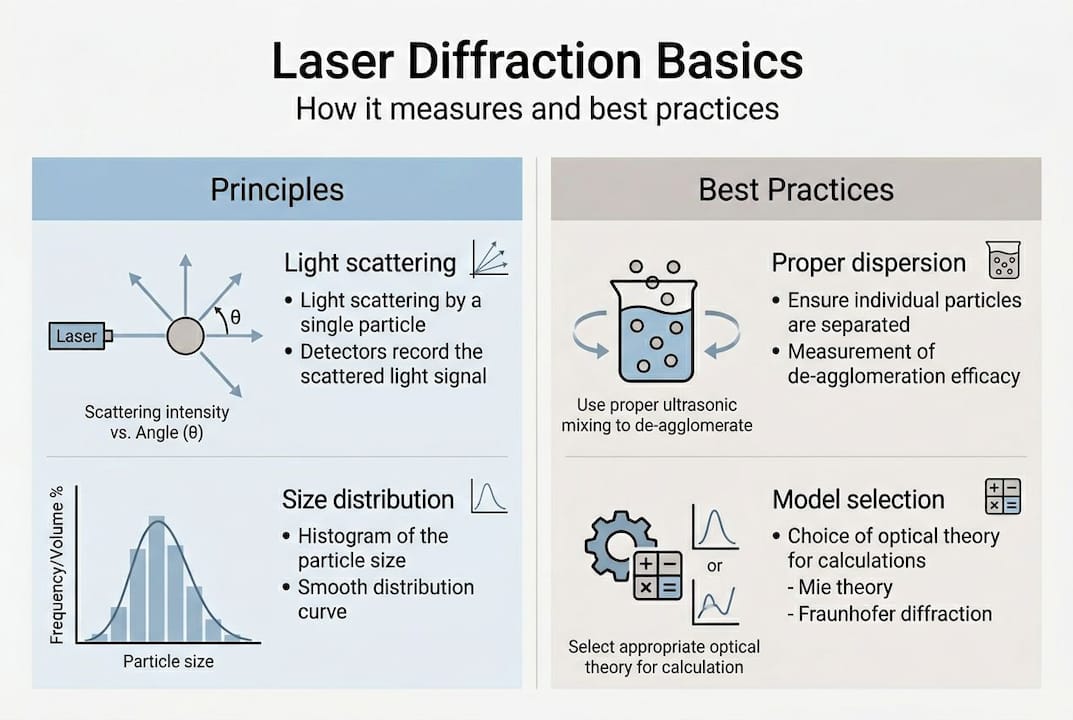
Our laser diffraction overview details the full instrumentation setup, but the key hardware components are the laser source, a sample dispersion unit (wet or dry), a Fourier lens, and a multi-element detector array. The entire measurement cycle, from sample introduction to result output, typically completes in under two minutes per run, making it highly practical for both R&D screening and high-throughput QC environments.
The measurement process follows a consistent sequence:
- Sample dispersion: Particles are dispersed in a liquid medium or air stream to prevent agglomeration and ensure representative sampling.
- Laser illumination: The dispersed sample passes through the laser beam, generating a unique scattering pattern.
- Detector capture: Detectors positioned at multiple angles record scattered light intensity simultaneously.
- Data inversion: Software applies an optical model to convert intensity data into a volume-weighted particle size distribution.
The primary outputs are volume-weighted distributions with key metrics including D50 (the median diameter), D10, D90, and span, where span is calculated as (D90 minus D10) divided by D50. These metrics tell you far more than a single average. D10 and D90 define the lower and upper tails of the distribution, while span quantifies how broad or narrow the distribution is. A tight span signals a monodisperse population; a wide span flags heterogeneity that may affect product performance.
| Metric | Definition | Practical relevance |
|---|---|---|
| D10 | 10% of volume below this size | Fine particle fraction, inhalation risk |
| D50 | Median particle size by volume | Core formulation parameter |
| D90 | 90% of volume below this size | Coarse fraction, filter/screen sizing |
| Span | (D90-D10)/D50 | Distribution breadth, batch uniformity |
For particle size and morphology characterization in regulated sectors, understanding these outputs in context is non-negotiable. A D50 shift of even a few micrometers in an inhaled drug product can alter aerodynamic behavior and clinical efficacy.
Statistic callout: Laser diffraction covers a size range of 0.1 μm to 3 mm, a dynamic range that no single sieve or sedimentation method can match, and delivers results in under two minutes per measurement cycle.
Fraunhofer vs. Mie theory: Choosing the right optical model
Understanding the measurement is only half the battle. Choosing the right optical model is where expertise makes a direct impact.
Every laser diffraction instrument must convert a raw scattering pattern into a size distribution using one of two optical frameworks. The choice between them is not cosmetic. It directly affects the accuracy of your reported PSD and, by extension, your regulatory submissions.
Fraunhofer and Mie theories represent fundamentally different levels of physical rigor. Fraunhofer is an approximation. It assumes particles are large relative to the laser wavelength (generally greater than 10x), opaque, and that forward scattering dominates. It requires no knowledge of the material’s optical properties. Mie theory is the exact electromagnetic solution. It accounts for refraction, absorption, and scattering at all angles, requiring the complex refractive index (n minus ik) of both the particle and the dispersant.
| Feature | Fraunhofer | Mie theory |
|---|---|---|
| Required inputs | Particle size only | Complex refractive index (n, k) |
| Accuracy for sub-micron | Poor | High |
| Accuracy for opaque/large | Acceptable | High |
| Regulatory fit (ISO 13320) | Limited for fine particles | Preferred |
| Use case | Cement, metal powders, coarse APIs | Nanoparticles, liposomes, transparent excipients |
For most pharmaceutical, biomedical, and aerospace applications involving fine or transparent particles, Mie theory is preferred over Fraunhofer, and ISO 13320 sets the validation expectations for both models. Applying Fraunhofer to a sub-micron liposomal formulation, for example, will systematically overestimate particle size in the fine fraction, producing a D10 that appears compliant when the actual distribution is finer and potentially more problematic.
Here is a practical decision framework:
- Identify particle size range. If D50 is below 10 μm, Mie is mandatory.
- Assess optical properties. Transparent or semi-transparent particles require Mie regardless of size.
- Source refractive index data. Use literature values, Abbe refractometry, or supplier data sheets.
- Validate the model. Run reference standards and compare with orthogonal methods.
- Document everything. Auditors will ask which model was used and why.
Pro Tip: If you are unsure of the refractive index for a new material, run the analysis with two plausible n values and assess sensitivity. A large shift in D50 signals high model dependency and warrants further optical characterization before finalizing your SOP.
Wrong model selection is one of the most common and least visible sources of systematic error in laser diffraction. It does not trigger an instrument alarm. It simply produces a distribution that looks plausible but is wrong.
Dispersion, agglomeration, and error sources in real-world analysis
With an optical model selected, success hinges on the integrity of sample preparation and error identification.
Even a perfectly calibrated instrument running the correct optical model will generate unreliable data if the sample is not properly dispersed. Dispersion is the step where most real-world errors originate, and it is the step most frequently underestimated in routine QC environments.
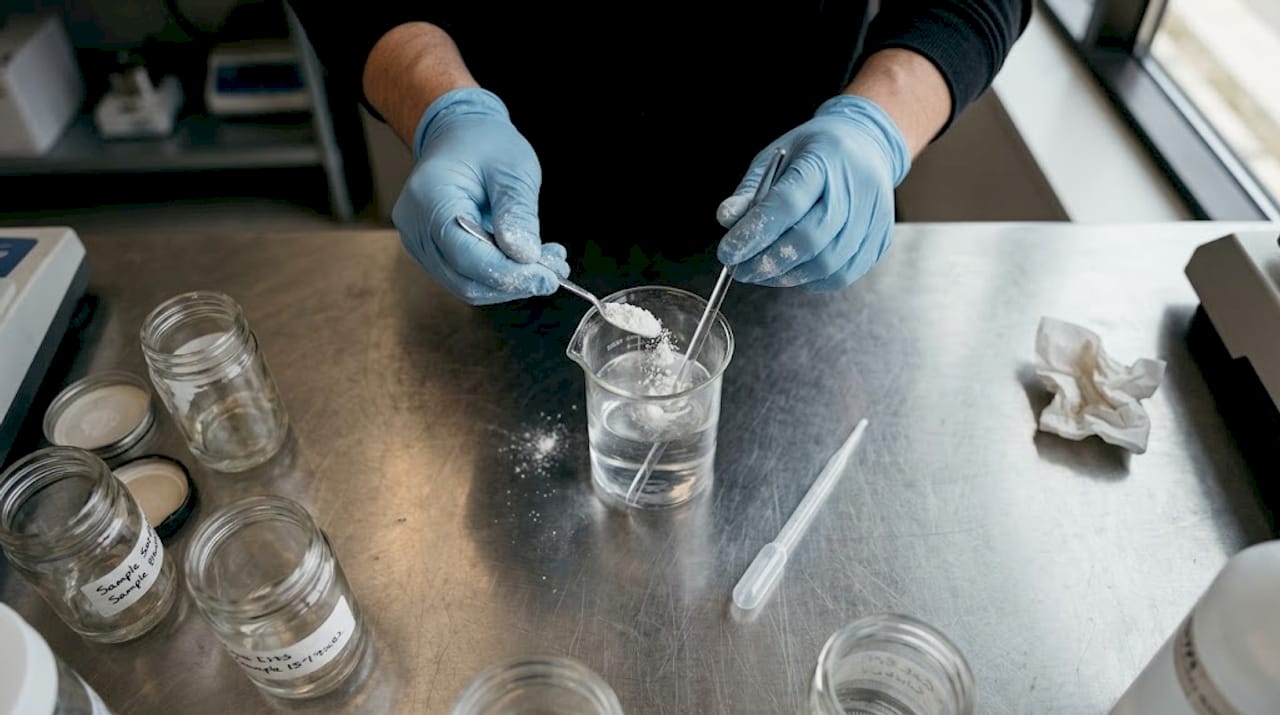
Wet dispersion suspends particles in a liquid medium, typically water or a non-solvent, with a surfactant to prevent reagglomeration. Dry dispersion uses compressed air or nitrogen to aerosolize particles. Wet methods generally offer better control for fine particles; dry methods suit materials that react with liquids or require rapid throughput. Poor dispersion leads to agglomeration errors, meaning your instrument measures clusters rather than individual particles, and every key metric shifts upward artificially.
Common error sources in laser diffraction analysis include:
- Concentration too high: Multiple scattering occurs, distorting the angular intensity pattern and broadening the apparent distribution.
- Concentration too low: Insufficient signal-to-noise ratio produces unstable, irreproducible results.
- Refractive index mismatch: Incorrect optical constants in Mie calculations introduce systematic bias across the full distribution.
- Inadequate cleaning: Residual particles from a previous sample contaminate the next measurement, inflating D90 values.
- Agglomeration: Undispersed clusters register as large particles, masking the true fine fraction and skewing D50 upward.
- Temperature fluctuations: Viscosity changes in the dispersant alter particle settling behavior during wet measurement.
Pro Tip: Always validate dispersion by running a concentration series (obscuration sweep) and confirming that D50 remains stable across the acceptable range. If D50 drops as you dilute further, you are still breaking up agglomerates at your working concentration.
Overlooked agglomeration in a regulated product can mean the difference between a batch release and a costly investigation. If your reported D90 is artificially elevated because of agglomerates, you may be releasing product outside its validated design space without realizing it.
For batch consistency implications, rigorous dispersion validation is not optional. It must be part of your method development record and referenced in your SOP.
Applications in material characterization and compliance
It’s in the application across industries, during batch release and compliance, that the real value and risk of this method is revealed.
Laser diffraction is embedded in quality workflows across multiple high-stakes sectors, and the consequences of getting it wrong vary by industry but are consistently serious. Optical model selection is critical in every application context, and that principle holds whether you are characterizing a drug substance, a titanium alloy powder, or a contrast agent.
Here are five industry scenarios where accurate PSD is mission-critical:
- Inhaled drug products (pharma): Aerodynamic particle size directly determines lung deposition. A D50 error of 1 to 2 μm can shift a product from the respirable fraction to upper airway deposition, affecting both efficacy and safety.
- Injectable nanoparticles (biomedical): Sub-micron carriers must meet tight size specifications for circulation time and tissue targeting. Laser diffraction combined with size and morphological methods provides the full characterization picture.
- Metal additive manufacturing powders (aerospace): Powder flowability and packing density are direct functions of PSD. Deviations in D10 or span affect layer uniformity and final part integrity in selective laser sintering.
- Excipient lot release (pharma/biomedical): Incoming material testing requires fast, reproducible PSD data. Laser diffraction delivers results in minutes per sample, supporting high-volume lot acceptance testing.
- Regulatory filings (all sectors): Method documentation must include the optical model, refractive index values, dispersion protocol, and validation data. Auditors routinely scrutinize these records, and incomplete documentation can delay or derail submissions.
The analytical testing importance of getting PSD right extends beyond compliance. Failed batch releases, product recalls, and reformulation cycles all trace back to measurement errors that were avoidable with proper method development.
Statistic callout: With a measurement range of 0.1 μm to 3 mm and cycle times under two minutes, laser diffraction can process dozens of samples per hour, making it one of the most efficient tools available for both R&D and production QC.
Why optical nuance beats automation: A practitioner’s perspective
With the essentials in hand, let’s cut through the prevailing automation hype and share what actually works best in practice.
The industry has invested heavily in automated laser diffraction platforms, and that investment is justified. Automated sample handling, integrated SOPs, and real-time trending reduce operator variability and accelerate throughput. But automation creates a specific risk that is easy to overlook: it makes wrong results look right.
We have seen two laboratories running nominally identical SOPs on the same instrument platform produce diverging D50 values for the same transparent nanoparticle formulation. The difference traced back to one team using Fraunhofer by default because the software’s automated mode selected it, while the other team had manually assigned Mie parameters based on the material’s optical constants. Both runs completed without errors. Both generated clean reports. Only one was accurate.
Automation handles repetition well. It does not handle edge cases, novel materials, or ambiguous optical properties. For those situations, expert judgment in laser diffraction method development is what separates defensible data from data that looks defensible. Regulatory reviewers are increasingly asking for optical model justification, not just SOP references. That shift rewards laboratories that invest in practitioner expertise alongside instrument capability.
Advance your material analysis with expert support
Ready to strengthen your analytical pipeline and compliance posture? Here’s how we can help.
At Materials Metric, we integrate laser diffraction with multi-method characterization workflows to give your team the data confidence that regulatory submissions and product decisions demand. Our experts support method selection, refractive index determination, SOP development, and inter-lab consistency studies, all documented to ISO 9001:2015 and GLP/GMP standards.
Whether you are developing a new formulation, troubleshooting a batch failure, or preparing for an audit, we function as an extension of your research and QA team. Explore how analytical testing methods and advanced material characterization techniques connect to your compliance goals. For a fully integrated approach, our chemical microscopy characterization services pair laser diffraction with morphological and compositional analysis. Contact our technical team to schedule an analytical review.
Frequently asked questions
What particle size range does laser diffraction cover?
Laser diffraction measures particles from 0.1 μm to 3 mm, covering the vast majority of R&D screening and production QC requirements across pharmaceutical, biomedical, and aerospace applications.
When should I use Mie theory instead of Fraunhofer?
Apply Mie theory whenever particles are sub-micron, transparent, or have complex optical properties; Fraunhofer is an approximation suited only for large, opaque particles where optical constants are unknown or irrelevant.
How does improper dispersion affect results?
Poor dispersion causes agglomeration, which registers as artificially large particles and inflates D50 and D90 values, creating compliance risk by misrepresenting the true particle size distribution.
What are the main compliance standards for laser diffraction analysis?
ISO 13320 is the primary standard governing laser diffraction method validation, specifying requirements for optical model selection, instrument qualification, and documentation that regulatory bodies expect during audits.
Which metrics are most important in laser diffraction reports?
D50, D10, D90, and span are the core reporting metrics; volume-weighted distributions using these values capture both the central tendency and the breadth of the particle population, which are critical for formulation and process decisions.