TL;DR:
- Biocompatibility encompasses more than just material toxicity, covering various biological effects.
- Proper documentation and justified test strategies are crucial to avoid regulatory delays and deficiencies.
- Future evaluations will increasingly consider mechanical properties and material behavior over time.
Biocompatibility testing is far more than a regulatory formality. For QA and regulatory affairs professionals, it represents one of the most technically demanding and documentation-intensive phases of medical device development. The ISO 10993 series anchors biological evaluation within ISO 14971 risk management, creating a tightly integrated framework where gaps in evidence or poor test selection can trigger costly FDA or MDR submission delays. This guide walks through what biocompatibility truly requires, from standards context to practical test selection and risk file integration, so your team can move forward with confidence.
Table of Contents
- Understanding biocompatibility: What it actually means
- Key standards and frameworks: ISO 10993-1:2025 and beyond
- Types of biocompatibility tests and choosing the right methods
- Integrating risk management and biological evaluation
- Why the future of biocompatibility is more than just chemical safety
- Biocompatibility testing solutions tailored for you
- Frequently asked questions
Key Takeaways
| Point | Details |
|---|---|
| ISO 10993-1:2025 is central | Compliance starts and ends with integrating ISO 10993-1:2025 into your risk management system. |
| Choose your tests wisely | Selecting the right biocompatibility tests and justifying them is essential for regulatory success. |
| Documentation matters | Thorough, rationale-based documentation prevents regulatory delays and test repetition. |
| Mechanical aspects matter too | Mechanical compatibility is emerging as a required dimension beyond traditional chemical safety. |
Understanding biocompatibility: What it actually means
Biocompatibility is widely misunderstood, even among experienced device professionals. The most common misconception is that it simply means a material is free from toxicity. In regulatory terms, it means far more. According to ISO 10993-1:2025, biocompatibility refers to the ability of a device to perform its intended function without eliciting any unacceptable local or systemic effects in the patient or user. That definition spans cytotoxicity, sensitization, irritation, systemic toxicity, genotoxicity, implantation effects, and more, depending on the nature of the device.
The ISO 10993 framework is not a static checklist. It is a process, one that requires you to evaluate risk based on patient contact level (surface, external communicating, or implant), duration of contact (limited, prolonged, or permanent), and the specific patient population. A device with the same material composition but different contact categories can require an entirely different test matrix.
Some critical considerations that shape your evaluation strategy:
- Biological endpoints vary by device type and contact duration, not just material chemistry
- Chemical characterization must precede or accompany biological testing to justify endpoint selection
- Existing clinical or literature data can substitute for some in vivo tests when properly documented
- Sterilization and processing may alter extractable profiles, requiring updated evaluations
“Missing or poorly justified endpoints in your biological evaluation report is a leading reason for FDA/MDR delays.”
Documentation is not a secondary concern. The Biological Evaluation Report (BER) is a core submission artifact. Our biocompatibility testing complete guide covers how to structure a defensible BER from the ground up. Regulatory reviewers expect a logical, traceable narrative connecting material identity, chemical characterization data, endpoint selection rationale, and test results. Anything less creates openings for requests for additional information, which slow your timeline.
For teams sourcing ISO 10993 materials testing, knowing exactly what evidence regulators expect is the first step to avoiding rework.
Key standards and frameworks: ISO 10993-1:2025 and beyond
Navigating the regulatory landscape requires understanding not just ISO 10993-1:2025, but how it intersects with FDA guidance and EU MDR requirements. The good news is that these frameworks share significant common ground. The challenge is in the details.
ISO 10993-1:2025 represents the most current evolution of biological evaluation practice. Its major update integrates the evaluation process directly within ISO 14971 risk management, meaning your biological evaluation is not a standalone document but a component of the broader device risk file. The standard also strengthens requirements around chemical characterization as a precondition to test selection, and it formalizes the use of New Approach Methodologies (NAMs) as valid alternatives to animal-based testing.
| Framework | Basis for evaluation | Animal testing stance | Key documentation |
|---|---|---|---|
| ISO 10993-1:2025 | Risk-based, endpoint-driven | NAMs preferred where validated | BER, chemical characterization report |
| FDA guidance | ISO 10993 aligned, additional guidance | Reduction encouraged | 510(k)/PMA biocompatibility section |
| EU MDR | ISO 10993 recognized, MDCG guidance | NAMs increasingly accepted | Technical file, clinical evaluation |
One area where frameworks diverge is submission format and the level of justification required for test waivers. FDA reviewers tend to scrutinize waiver rationale closely, particularly for implantable devices. The cytotoxicity testing reliability data shows that about one-third of 510(k) submissions face biocompatibility-related deficiencies, which makes thorough documentation a competitive advantage.
Key documentary evidence you cannot afford to miss:
- Chemical characterization report with toxicological risk assessment
- Justified endpoint selection matrix
- Biocompatibility test reports with GLP compliance statements
- Reference to any waived tests and the scientific rationale
- Sterilization validation data where applicable
Proper biocompatibility testing preparation before you engage a testing lab saves significant time at the submission stage. Getting your material specifications, processing history, and contact category clearly defined upfront allows test selection to proceed with precision.
Types of biocompatibility tests and choosing the right methods
Test selection is where many teams encounter their first significant pitfalls. There are dozens of individual tests within the ISO 10993 series, and choosing the wrong combination, or executing valid tests with inadequate supporting data, leads directly to regulatory deficiencies.
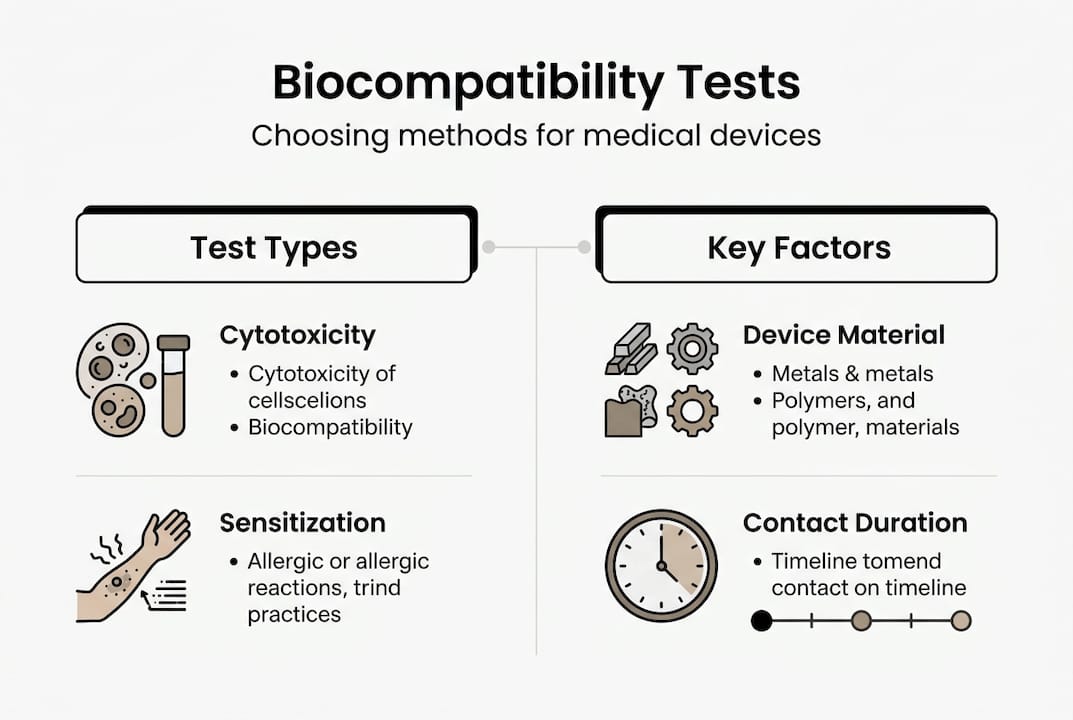
The three foundational test categories are cytotoxicity, sensitization, and irritation. These apply to virtually every device category with patient contact. Beyond this baseline, you layer in additional endpoints based on contact level, duration, and device-specific risk factors.
Core biocompatibility test workflow:
- Define device contact category and duration
- Complete chemical characterization and extractables/leachables profiling
- Conduct toxicological risk assessment to identify testing gaps
- Select in vitro or in vivo methods based on justified endpoint requirements
- Execute tests under GLP-compliant conditions with validated methods
- Integrate results into the BER with traceable rationale
For step two, our E&L testing services provide the chemical profile your toxicologist needs to make defensible decisions. Skipping or rushing this step is one of the most common causes of downstream failures.
| Common failure cause | Estimated frequency | Impact |
|---|---|---|
| Inadequate supporting data | ~1/3 of 510(k) submissions | Deficiency letters, resubmission |
| Solvent effects causing undetected residuals | Frequently cited in cytotoxicity studies | False negative results |
| Extract concentration errors | <40% for Zn alloys | Unreliable cytotoxicity data |
| Unvalidated test methods | Common in novel material submissions | Rejection of test results |
For in vitro versus in vivo decisions, the guidance is clear: use validated in vitro methods when available, particularly for irritation and sensitization. NAMs are gaining acceptance and can significantly reduce animal use when properly justified. Proper method validation in biocompatibility is non-negotiable for both regulatory acceptance and scientific reliability.
New device materials, including biodegradable polymers and metal alloys, present additional complexity. Research into mechanical compatibility importance shows that physical properties like stiffness and wear can affect biocompatibility outcomes independently of chemical composition.
Pro Tip: Prioritize chemical characterization and NAMs early in development. This not only reduces animal testing burden but also accelerates your endpoint justification, which regulators increasingly expect as standard practice.
Integrating risk management and biological evaluation
Once testing is complete, your data must be integrated into the device risk management file in a way that satisfies both ISO 14971 and the biological evaluation requirements of ISO 10993-1:2025. This is where many BERs fall short, not in the testing itself, but in the narrative connecting results to risk conclusions.

A structured approach to integration looks like this: chemical characterization results inform the hazard identification step. Toxicological risk assessment assigns severity and probability estimates to identified chemical risks. Biological test results either confirm acceptable risk levels or provide additional evidence for unresolved hazards. Residual risk conclusions are then documented with clear acceptance criteria.
What regulators look for in a well-constructed BER:
- Clear device description including materials, processing history, and contact category
- Chemical characterization summary with identified extractables mapped to toxicological thresholds
- Justified endpoint selection with explicit rationale for both tested and waived endpoints
- Test reports with method details, GLP statements, and results interpretation
- Risk conclusions that directly address each endpoint and link to the ISO 14971 risk file
- Reviewer-ready organization so the logic flows without requiring the reviewer to connect dots independently
Our chemical analysis methods article explains how analytical chemistry data feeds directly into this documentation chain. For devices that have undergone sterilization, sterilization impact on materials is a variable that must be addressed, since processing can alter extractable profiles significantly.
Justifying test waivers requires the same rigor as justifying tests themselves. The chemical characterization plus toxicological assessment approach allows teams to minimize redundant studies, but only when the underlying data is thorough and traceable.
Pro Tip: Document your rationale clearly at every decision point. Regulators expect evidence-based justifications, not assertions. If you waive a test, explain why the chemical characterization and risk assessment make that waiver scientifically defensible.
Why the future of biocompatibility is more than just chemical safety
The field is moving beyond the traditional chemistry-focused paradigm, and QA/RA professionals need to anticipate what that means for submission strategy and test planning. Chemical safety remains foundational, but it is no longer sufficient on its own.
Mechanical compatibility is emerging as a critical consideration. Research into new biocompatibility paradigms points to stiffness mismatch between device materials and surrounding tissue as a driver of adverse biological responses that chemical tests simply cannot detect. This is particularly relevant for flexible implantables, cardiovascular devices, and neural interfaces where mechanical properties directly affect tissue response.
There is also the issue of assay bias. Advanced polymers and polyphenol-based materials interact with standard assay reagents in ways that produce misleading results. In vitro and in vivo data for biodegradable materials frequently diverge, signaling that current test models were not designed for these material classes.
Our perspective is direct: contextual biocompatibility is where the science and regulation are heading. “Fit for purpose” will demand not just chemical characterization but a full account of how material properties, mechanical behavior, and biological environment interact over time. Teams that build this into their chemical and microscopy integration strategies now will be better positioned for the next generation of regulatory expectations.
Biocompatibility testing solutions tailored for you
If your team is navigating biocompatibility submissions or preparing a device for regulatory review, partnering with an experienced analytical testing provider makes the difference between a streamlined submission and a cycle of deficiency responses.
At Materials Metric, we support QA and regulatory affairs teams with chemical characterization, extractables and leachables profiling, method validation, and integrated data packages that map directly to BER requirements. Our analytical testing for compliance capabilities are designed to generate the evidence regulators expect. We also offer integrated chemical and microscopy characterization to address both chemical and structural material properties in a single workflow. Think of us as an extension of your regulatory team, built for precision and designed for defensibility.
Frequently asked questions
What is the main purpose of biocompatibility testing for medical devices?
Biocompatibility testing ensures that medical device materials will not cause harmful biological reactions when in contact with the body. The ISO 10993 series provides the governing framework for how this evaluation is structured and documented.
What standards must be followed for biocompatibility tests?
ISO 10993-1:2025, FDA guidance, and EU MDR requirements are the primary standards governing biocompatibility testing, with ISO 14971 providing the risk management integration layer.
What is a common cause of biocompatibility test failure?
Inadequate supporting data affects approximately one-third of 510(k) submissions, and solvent effects causing undetected chemical residuals are a frequently cited source of unreliable cytotoxicity results.
When can in vitro New Approach Methodologies (NAMs) replace in vivo animal tests?
NAMs can replace animal tests for irritation and sensitization when properly validated and justified. Regulators increasingly accept them as part of risk-based biological evaluation under ISO 10993-1:2025.
Why is mechanical compatibility now a key consideration?
Mechanical compatibility addresses stiffness mismatches between device materials and tissue, which research shows can drive adverse biological responses independently of chemical composition, particularly in implantable and flexible device categories.