
TL;DR:
- Differential Scanning Calorimetry (DSC) provides critical thermal property data for pharmaceuticals and devices when properly designed and interpreted.
- Artifacts from heating rates, sample prep, and thermal history can compromise data quality; best practices and complementary techniques mitigate these issues.
- Integrating DSC with XRPD and FTIR offers comprehensive insights into polymorphism, crystallinity, and material interactions for informed development decisions.
Differential Scanning Calorimetry sounds straightforward on paper: heat a sample, measure the energy flow, and read the results. In practice, many research teams treat DSC testing as a checkbox exercise, expecting clean, self-interpreting data from every run. That assumption leads to missed polymorphic transitions, misleading purity assessments, and flawed formulation decisions that cost time and regulatory credibility. DSC is one of the most information-rich tools available for pharmaceutical and medical device material characterization, but only when the methodology is designed thoughtfully and the outputs are interpreted with appropriate nuance. This guide covers the fundamentals, common pitfalls, and practical strategies to help your team extract genuine value from every DSC study.
Table of Contents
- What is DSC testing and why does it matter?
- How DSC reveals material properties in pharma and device development
- Limitations, common pitfalls, and best practices in DSC testing
- Integrating DSC with complementary techniques for advanced insights
- Our perspective: What most labs miss about extracting true value from DSC
- Connect with DSC and material characterization experts
- Frequently asked questions
Key Takeaways
| Point | Details |
|---|---|
| DSC is essential in R&D | Differential scanning calorimetry provides critical insights for pharmaceutical and medical device material selection. |
| Method sensitivity matters | Factors like heating rate and moisture can cause significant artifacts if not carefully controlled during DSC testing. |
| Integration yields clarity | Combining DSC with techniques like XRPD and FTIR offers the most robust material characterization. |
| Practice robust protocols | Adhering to best practices and using advanced methods ensures reliable and interpretable DSC data. |
What is DSC testing and why does it matter?
Differential Scanning Calorimetry measures the difference in heat flow between a sample and an inert reference as both are subjected to a controlled temperature program. When a material undergoes a thermal event, such as melting, crystallization, or a glass transition, it either absorbs or releases heat relative to the reference. That energy difference is recorded as a function of temperature or time, producing a thermogram that reveals the material’s thermal behavior.
For pharmaceutical and medical device R&D, the value of this signal is significant. DSC detects a range of critical material properties:
- Glass transition temperature (Tg): Indicates amorphous content and polymer mobility, critical for solid dispersion stability
- Melting point and enthalpy: Confirms identity, polymorphic form, and purity
- Crystallization behavior: Reveals processing history and storage effects
- Miscibility and compatibility: Identifies drug-polymer or excipient interactions
- Decomposition onset: Flags thermal stability limits for processing and storage conditions
In pharmaceutical development, DSC assesses crystallinity, polymorphism, and miscibility in solid dispersions, making it indispensable during both early formulation screening and late-stage process validation. For medical device polymers, DSC informs material selection by confirming that a candidate polymer maintains its structural and mechanical integrity across the expected service temperature range.
Typical applications span stability testing, excipient compatibility screening, purity determination, and processing parameter optimization. A single DSC run can flag whether an amorphous drug form is converting to a thermodynamically stable but less soluble crystalline polymorph, information that is directly actionable in formulation refinement. Our DSC analysis for R&D capabilities are designed specifically to address these complex questions with the precision and turnaround your programs demand.
Pro Tip: Always run at least two heating cycles on your sample. The first cycle reveals the as-received thermal history; the second, after controlled cooling, reveals the intrinsic material properties. Conflating the two is a very common source of data misinterpretation.
How DSC reveals material properties in pharma and device development
Understanding DSC’s foundation, the next step is exploring its specific outputs and the insights it provides for pharmaceutical and device research.
Each thermal event captured by DSC corresponds to a specific material behavior. Glass transitions appear as subtle step changes in heat flow and indicate the temperature at which an amorphous material transitions from a glassy to a rubbery state. Melting endotherms are sharper peaks that confirm crystalline structure. Crystallization exotherms during cooling or reheating indicate the tendency of an amorphous material to recrystallize, a critical stability risk for many drug products.

| Thermal event | DSC signal type | Pharmaceutical relevance |
|---|---|---|
| Glass transition (Tg) | Step change (endothermic) | Amorphous stability, polymer behavior |
| Melting | Endothermic peak | Purity, polymorph identity |
| Crystallization | Exothermic peak | Recrystallization risk, processing history |
| Decomposition | Exothermic or endothermic | Stability limits, safety assessment |
| Miscibility | Tg shift or single Tg | Drug-polymer compatibility in dispersions |
Practical examples reinforce why the technique matters. In amorphous solid dispersion development, a single Tg above the predicted value confirms drug-polymer miscibility, while two distinct Tg values signal phase separation. For purity assessment, the sharpness and onset temperature of a melting peak are compared against reference standards; a broadened endotherm frequently indicates impurities or mixed polymorphic content.
Data quality, however, is never automatic. DSC is sensitive to heating rates, sample preparation, residual moisture, and thermal history, all of which can produce artifacts if not controlled. A heating rate that is too fast will broaden peaks and shift event temperatures; one that is too slow may allow real-time phase changes that obscure the true thermogram. Sample mass and pan selection further influence data quality in ways that are easy to overlook.
To obtain representative data, follow this sequence:
- Equilibrate the sample environment to remove adsorbed moisture before analysis
- Select sample mass between 2 and 10 mg for most pharmaceutical solids to balance sensitivity and resolution
- Choose a scan rate matched to the complexity of the expected transitions (typically 10°C/min as a starting point)
- Run baseline calibration with the same pan type and purge gas used for samples
- Apply consistent thermal history conditioning before comparative runs
Our DSC precision analysis work follows these protocols rigorously, ensuring the data your team receives is both reproducible and defensible under regulatory scrutiny.
Limitations, common pitfalls, and best practices in DSC testing
While DSC is powerful, it is only as reliable as the methodology behind it. Let’s break down the real-world limitations and how best to address them.
The most frequent pitfalls encountered in DSC studies fall into three categories: instrument parameters, sample handling, and data interpretation. Non-optimal scan rates remain the leading cause of artifactual peaks. Running too fast compresses overlapping events, making two separate transitions appear as one broad feature. Running too slow can induce phase changes during the scan itself.
Sample preparation errors are equally consequential. Inconsistent particle size, air gaps within the pan, and incorrect pan crimping all affect heat transfer and produce irreproducible baselines. Residual solvent or moisture introduces endothermic events that can be mistaken for genuine thermal transitions.
“The practical solution to overlapping thermal events is Modulated DSC (MDSC), which separates reversing heat flow (thermodynamic events like Tg) from non-reversing heat flow (kinetic events like crystallization and decomposition), delivering cleaner resolution where standard DSC cannot.”
Key best practices to implement in your DSC workflow:
- Condition samples consistently: Dry under controlled conditions before analysis to eliminate moisture-related artifacts
- Document thermal history: Note any prior processing, storage, or mechanical treatment that could influence the thermogram
- Use MDSC for complex systems: Artifacts from heating rates and moisture are best addressed by MDSC for overlapping events and complementing with XRPD for structural confirmation
- Calibrate frequently: Use certified melting point standards covering the temperature range of your application
- Replicate runs: A minimum of three replicates establishes reproducibility and identifies outliers before reporting
For studies where thermal events are particularly complex, pairing DSC with orthogonal techniques is not optional; it is essential. Our advanced DSC strategies and broader thermal analysis services are structured to support exactly these scenarios, from method development through final data interpretation.
Pro Tip: If your DSC thermogram shows an unexpected exotherm just before the melting endotherm, do not dismiss it as noise. This pattern often signals recrystallization of an unstable amorphous phase, a critical stability signal that warrants immediate investigation with XRPD.
Integrating DSC with complementary techniques for advanced insights
Recognizing DSC’s limits makes it clear why integrating multiple material characterization tools is essential. Here is how top labs approach this challenge.
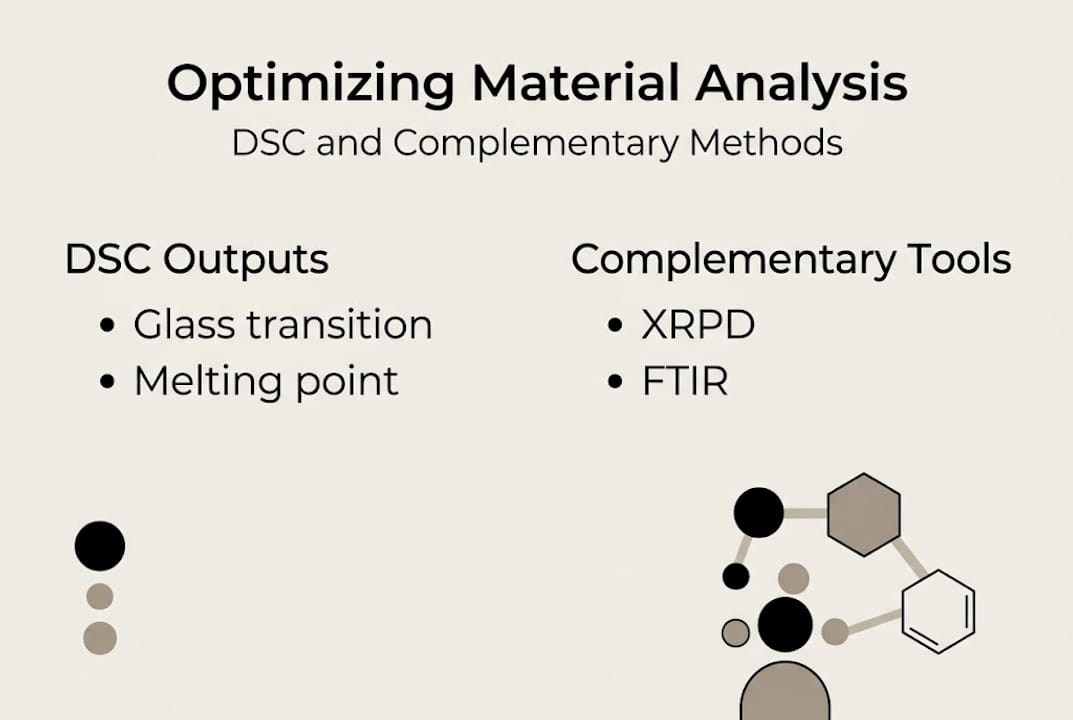
DSC provides thermal event data but cannot directly confirm crystal structure or identify specific molecular interactions driving those events. This is where DSC paired with XRPD and FTIR resolves method limitations and confirms structural details that DSC alone cannot definitively establish.
Consider a scenario where two polymorphic forms of an active pharmaceutical ingredient have similar melting temperatures. DSC will show overlapping endotherms that are difficult to deconvolute, especially at standard heating rates. X-ray diffraction analysis resolves this by providing a direct crystallographic fingerprint for each form. Similarly, when DSC data suggests drug-polymer miscibility via a single Tg shift, FTIR spectroscopy can confirm or refute this by identifying specific intermolecular hydrogen bonding interactions at the molecular level.
| Technique | Primary output | Best used when |
|---|---|---|
| DSC | Thermal events, Tg, melting, enthalpy | Initial screening, stability, purity |
| XRPD | Crystal structure, phase identification | Polymorph confirmation, amorphous quantification |
| FTIR | Molecular interactions, functional groups | Miscibility, compatibility, degradation profiling |
| TGA | Mass loss vs. temperature | Moisture content, decomposition, residual solvent |
A practical framework for selecting complementary methods:
- Start with DSC for rapid thermal profiling across candidate materials
- Add XRPD when DSC suggests polymorphism or phase separation
- Add FTIR when miscibility or specific intermolecular interactions need confirmation
- Add Thermogravimetric Analysis (TGA) when moisture or volatiles are suspected contributors to DSC signals
Building this integrated approach early in your development timeline prevents costly late-stage surprises. Single-method reliance is one of the most common reasons material characterization packages fail regulatory review, because reviewers increasingly expect orthogonal data to support thermal findings.
Our perspective: What most labs miss about extracting true value from DSC
With methods and pitfalls in mind, it is worth sharing the hard-won lessons most guides do not discuss.
The real failure mode we see is not poor instrument calibration or bad sample prep, though both occur. It is the “just run the test” mentality, where a DSC study is initiated without a clearly defined scientific question. A thermogram without a hypothesis is just a curve. You cannot extract meaningful formulation or stability decisions from data that was not designed to answer a specific question.
The most valuable DSC studies we conduct are hypothesis-driven. The researcher arrives with a specific question: Is this API converting forms during wet granulation? Does this polymer blend phase-separate at processing temperature? Those questions dictate the scan parameters, the number of replicates, the need for MDSC, and the complementary techniques required. Explore deeper DSC applications and you will find that the analytical design is always what separates actionable insight from ambiguous data.
We also find that teams underestimate how much context surrounding the sample matters. Thermal history, storage conditions, and even lot-to-lot variability in excipients can shift Tg values by several degrees, which is meaningful for amorphous solid dispersion stability predictions. Treating every run as an isolated data point, rather than part of a material story, is where real value is lost.
Connect with DSC and material characterization experts
If you want the most reliable, actionable results from DSC and related tools, expert support makes the real difference.
At Materials Metric, we design DSC studies around your specific research questions, not generic scan protocols. Our team integrates DSC with XRPD, FTIR, TGA, and other analytical platforms to deliver data packages that hold up under regulatory scrutiny and inform real formulation decisions. Whether you are characterizing a novel solid dispersion, qualifying a device polymer, or building a stability dataset, we function as an extension of your research team. Review our analytical testing insights, explore chemical characterization services, or see the full scope of our advanced material characterization offerings to find the right fit for your program.
Frequently asked questions
What does a DSC test measure in pharmaceutical applications?
A DSC test measures how a pharmaceutical material absorbs or releases heat, revealing properties like melting point, crystallinity, purity, and phase transitions. In pharmaceutical development, DSC assesses crystallinity, polymorphism, and miscibility, making it directly applicable to solid dispersion characterization and stability testing.
Why do artifacts occur in DSC testing, and how can they be reduced?
Artifacts often result from incorrect heating rates, poor sample preparation, residual moisture, or uncontrolled thermal history. Mitigating them requires optimized scan protocols, proper sample conditioning, and sometimes advanced methods like MDSC, which separates overlapping events more effectively than standard DSC.
When should DSC be combined with XRPD or FTIR in research?
DSC should be paired with XRPD or FTIR when structural confirmation is needed or when DSC data alone cannot distinguish between similar thermal events. DSC combined with XRPD/FTIR resolves method limitations and confirms structural details, particularly for polymorphism and drug-polymer miscibility studies.
How does DSC testing impact device polymer selection?
DSC helps select polymers with optimal stability, purity, and performance by revealing phase transitions and thermal behaviors relevant to medical device durability. Knowing a polymer’s Tg and melting behavior relative to processing and service temperatures is foundational to qualifying any device material.