TL;DR:
- Thermal analysis reveals critical material behaviors impacting bioavailability and device integrity.
- Core techniques include DSC, TGA, and DMA, each providing unique thermal and mechanical insights.
- Combining methods and advanced hyphenated techniques ensures robust, regulator-ready data for pharmaceutical development.
Thermal analysis is widely misunderstood as a routine check for melting points. In reality, it is one of the most strategically powerful toolsets available to product developers and regulatory affairs teams working in biomedical and pharmaceutical sectors. From detecting polymorphic transitions that affect bioavailability to generating the stability data regulators expect in submissions, thermal analysis techniques span a broad and critical role in modern material characterization. This article walks through the core methods, regulatory expectations, and advanced strategies that separate compliant, high-confidence submissions from those that stall in review.
Table of Contents
- Why thermal analysis matters: Beyond melting points
- Core techniques: DSC, TGA, and DMA explained
- Regulatory and quality considerations: USP, method validation, and common pitfalls
- Advanced strategies: Hyphenated and orthogonal techniques for confident decisions
- What most experts miss about thermal analysis in pharma and biomedical R&D
- Expert support for thermal analysis and advanced characterization
- Frequently asked questions
Key Takeaways
| Point | Details |
|---|---|
| Broader impact | Thermal analysis is essential for more than melting point—it drives regulatory compliance, formulation, and product quality. |
| Technique selection | Choosing the right method (DSC, TGA, DMA) depends on the property and regulatory context you need to address. |
| Validation is critical | Proper method validation and using orthogonal techniques are vital for confident, compliant results. |
| Advanced tools | Hyphenated approaches like TG-MS/FTIR are invaluable for proving material identity and purity. |
Why thermal analysis matters: Beyond melting points
Think of thermal analysis services not as a single test but as an integrated toolkit that reveals how materials behave across a range of temperatures and conditions. For product developers, this means understanding phase transitions, glass transition temperatures, decomposition onset, and crystallinity changes. For regulatory teams, it means having defensible, reproducible data that satisfies agency expectations.
The practical stakes are high. A drug compound that exists in two polymorphic forms may have dramatically different solubility profiles, directly affecting bioavailability and therapeutic performance. A biomedical polymer that softens at a temperature lower than expected can compromise device integrity during sterilization. These are not edge cases. They are routine challenges that thermal analysis is specifically designed to surface before they become costly failures.
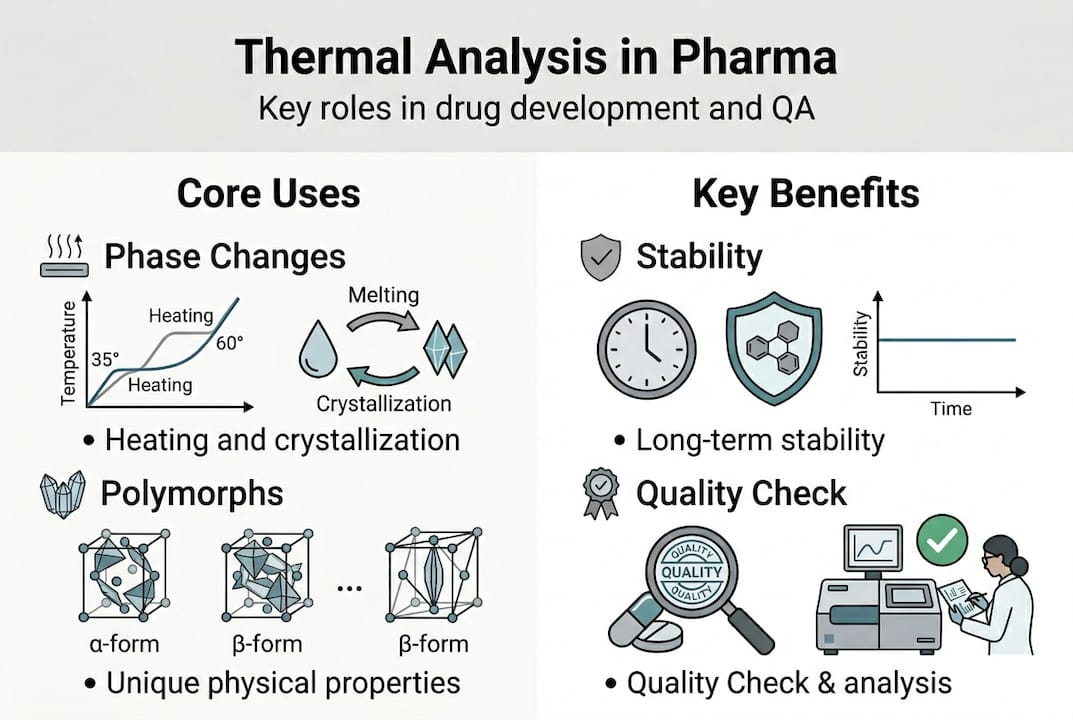
Thermal analysis is crucial for stability, bioavailability, and process decisions across pharmaceutical and biomedical development. The data generated informs formulation choices, packaging specifications, storage conditions, and shelf-life predictions.
Here is what thermal analysis actually delivers beyond a melting point:
- Glass transition temperature (Tg): Critical for amorphous solids, polymers, and lyophilized products
- Polymorphism screening: Identifies crystalline forms that affect solubility and regulatory classification
- Decomposition profiling: Establishes safe processing windows and storage limits
- Enthalpy of fusion: Quantifies purity and crystallinity for excipient and API characterization
- Moisture and solvent content: Detected through weight loss events in thermogravimetric analysis
Regulatory agencies increasingly expect thermal characterization data as part of IND, NDA, and 510(k) submissions. Incomplete thermal profiles are a common reason for information requests that delay approval timelines.
Pro Tip: Run thermal analysis early in formulation development, not just at the end. Catching polymorphic instability or unexpected Tg values during early-stage screening saves significant time and cost downstream.
Core techniques: DSC, TGA, and DMA explained
With that foundational context, dig into each pivotal technique. DSC, TGA, and DMA form the backbone of modern thermal analysis, and each serves a distinct purpose in your characterization strategy.

Differential scanning calorimetry (DSC) measures heat flow into or out of a sample as a function of temperature. It identifies melting points, glass transitions, crystallization events, and enthalpy changes. In pharmaceutical contexts, a DSC overview shows it is the primary tool for polymorphism screening and purity assessment.
Thermogravimetric analysis (TGA) tracks changes in sample mass as temperature increases. It quantifies moisture content, residual solvents, decomposition onset, and filler content. TGA applications are especially valuable for excipient characterization and for establishing safe processing temperatures.
Dynamic mechanical analysis (DMA) applies an oscillating force to a sample and measures its mechanical response. DMA detects subtle transitions missed by DSC and is vital for polymers, composites, and biomedical device materials. It quantifies storage modulus, loss modulus, and tan delta, providing a full viscoelastic profile. A DMA explained resource helps teams understand when this technique is the right choice over DSC alone.
| Technique | Primary output | Best use case | Sensitivity |
|---|---|---|---|
| DSC | Heat flow vs. temperature | Polymorphism, purity, Tg | High for thermal events |
| TGA | Mass loss vs. temperature | Decomposition, moisture, solvents | High for mass changes |
| DMA | Viscoelastic modulus vs. temperature | Polymers, composites, device materials | High for mechanical transitions |
Here is a practical sequence for pharma and biomedical characterization:
- Begin with DSC to map thermal events and identify phase transitions
- Follow with TGA to quantify mass loss events and confirm decomposition onset
- Apply DMA when the material is a polymer, elastomer, or composite requiring mechanical property data
- Cross-reference all three datasets to build a complete thermal profile
Using all three techniques together eliminates the blind spots that any single method leaves. A DSC alone cannot tell you whether a thermal event involves mass loss. TGA alone cannot distinguish between melting and crystallization. DMA fills in the mechanical picture that neither DSC nor TGA can provide.
Regulatory and quality considerations: USP, method validation, and common pitfalls
Techniques alone are not enough. Teams must also navigate compliance and validation requirements with precision. USP <891> and <1058> regulate thermal analysis procedures and instrument qualification standards that directly affect submission readiness.
Method validation for thermal analysis typically includes the following steps:
- Calibration verification: Temperature and enthalpy calibration using certified reference standards (indium, zinc)
- Precision and repeatability: Demonstrating consistent results across multiple runs and operators
- Linearity and range: Confirming the method performs reliably across the expected measurement range
- Specificity: Verifying the method distinguishes the target transition from artifacts or overlapping events
- System suitability: Documenting instrument performance before and after each analytical sequence
Auditors reviewing thermal data look for documented calibration records, traceable reference materials, and clearly defined integration limits for each thermal event. Ambiguous baseline selections and undocumented sample preparation steps are among the most common findings during audits.
Common pitfalls that compromise data integrity and regulatory acceptance include:
| Pitfall | Risk | Mitigation |
|---|---|---|
| Unverified sample preparation | Artifacts from moisture or grinding | Standardize and document prep protocols |
| Improper reference materials | Inaccurate temperature calibration | Use certified NIST-traceable standards |
| Single-technique reliance | Misinterpretation of overlapping events | Confirm with orthogonal methods |
| Insufficient baseline definition | Incorrect enthalpy calculations | Define baseline rules in the method SOP |
Pro Tip: When preparing regulatory submissions, treat your thermal analysis data package as a standalone document. Include raw data, calibration certificates, integration parameters, and a brief narrative explaining each thermal event. Reviewers appreciate clarity, and it reduces the likelihood of information requests.
For teams working toward analytical testing for compliance, building a robust thermal analysis data package from the start is far more efficient than retrofitting documentation after a review cycle.
Advanced strategies: Hyphenated and orthogonal techniques for confident decisions
Beyond core techniques and compliance, leading labs raise the bar with advanced strategies that increase data confidence and reduce regulatory ambiguity. Hyphenated techniques and orthogonal validation reduce ambiguity in pharma submissions involving complex samples or novel materials.
Hyphenated techniques couple a thermal method with a spectroscopic or mass spectrometric detector. The most widely used combinations in pharmaceutical and biomedical work are:
- TG-MS (thermogravimetric analysis coupled with mass spectrometry): Identifies the exact chemical species released during mass loss events, distinguishing water from residual solvents from decomposition gases
- TG-FTIR (thermogravimetric analysis coupled with Fourier transform infrared spectroscopy): Provides molecular identity of evolved gases in real time, useful for confirming degradation pathways
- DSC-XRPD (simultaneous DSC with X-ray powder diffraction): Captures crystallographic changes at the exact moment a thermal event occurs, directly linking thermal behavior to structural transformation
Orthogonal methods, meaning independent techniques that measure different physical properties, add a second layer of confirmation. Using XRPD alongside DSC to confirm polymorphic identity, or FTIR alongside TGA to characterize evolved gases, is now considered best practice for complex regulatory submissions.
Prioritize hyphenated techniques for regulatory clarity when your sample involves multiple overlapping thermal events or when the identity of a decomposition product is in question.
For teams working on advanced material characterization, these combined approaches are especially valuable during stability studies, forced degradation testing, and compatibility screening. When a single thermal event could represent either a polymorphic transition or a decomposition artifact, hyphenated data removes the guesswork entirely. Explore thermal degradation studies to see how this plays out in practice for complex biomedical and pharmaceutical materials.
What most experts miss about thermal analysis in pharma and biomedical R&D
Step back and consider a bigger-picture lesson: most teams treat thermal analysis as a checkbox rather than a strategic decision-making tool. The data gets generated, filed, and rarely revisited. That is a significant missed opportunity.
The teams that extract the most value from thermal analysis are those that integrate it into a broader data strategy. They compare thermal profiles across formulation batches, track Tg shifts as a leading indicator of stability issues, and use DMA data to inform mechanical design decisions before prototypes are built. They also validate every ambiguous result with a second, orthogonal method rather than accepting a single dataset as definitive.
We have seen projects accelerate significantly when thermal analysis data is treated as a living dataset rather than a one-time deliverable. Cross-functional collaboration between formulation scientists, regulatory affairs, and analytical teams around shared thermal data is where the real gains happen. Explore advanced techniques in the lab to see how integrated characterization strategies support faster, more confident development decisions.
Expert support for thermal analysis and advanced characterization
With practical strategies in mind, discover how expert support can make all the difference for your next project.
At Materials Metric, we provide specialized thermal analysis services designed for the precision demands of pharmaceutical and biomedical product development. From DSC and TGA to hyphenated TG-MS and TG-FTIR studies, our team delivers validated, submission-ready data with expert interpretation. We work as an extension of your team, aligning every analysis with your regulatory timeline and quality requirements. Whether you are navigating a complex essential advanced material characterization challenge or need robust analytical testing compliance documentation, we are here to support your work with the depth and rigor it requires.
Frequently asked questions
What are the main differences between DSC, TGA, and DMA?
DSC, TGA, and DMA serve distinct roles: DSC measures heat flow for phase transitions, TGA tracks weight loss for decomposition and moisture, and DMA analyzes viscoelastic properties for mechanical transitions in polymers and composites.
How does thermal analysis support pharmaceutical regulatory compliance?
Thermal methods demonstrate material stability, support polymorphism screening, and validate instrument performance as required by USP <891> and <1058>, making them essential for IND, NDA, and 510(k) submissions.
Why use hyphenated or orthogonal techniques in thermal analysis?
Hyphenated and orthogonal techniques confirm findings from primary thermal methods, reduce interpretive ambiguity, and are increasingly preferred by regulatory reviewers for complex samples or novel materials.
What pitfalls should teams avoid in thermal analysis studies?
Major pitfalls include unvalidated sample preparation, artifacts from moisture or grinding, and over-reliance on a single technique without orthogonal confirmation, all of which can compromise data integrity and delay regulatory acceptance.