Most materials scientists assume that true nanoscale internal structure imaging requires a dedicated TEM facility, a six-figure capital investment, and months of instrument time negotiation. That assumption is increasingly outdated. Hybrid transmission scanning electron microscopy platforms now deliver TEM-like analytical power within an SEM architecture, making high-resolution transmission imaging accessible to R&D labs that previously had no viable path to this data. This article clarifies the technology, maps its real-world applications in biomedical and pharmaceutical research, and gives you a practical framework for integrating it into your characterization workflow.
Table of Contents
- What is a transmission scanning electron microscope?
- Key capabilities: What sets STEM-in-SEM apart
- Applications in biomedical and pharmaceutical material science
- Comparing STEM-in-SEM with traditional TEM: Advantages and trade-offs
- Getting started: Best practices and pitfalls to avoid
- Why “transmission” SEM is the game-changer labs underestimate
- Take your materials characterization to the next level
- Frequently asked questions
Key Takeaways
| Point | Details |
|---|---|
| Democratized high-res imaging | STEM-in-SEM delivers powerful transmission imaging without the need for expensive TEM infrastructure. |
| Versatility for sensitive samples | Low-dose modes and programmable detectors enable detailed analysis of delicate pharma and biomedical materials. |
| Cost-effective innovation | STEM-in-SEM offers a practical, scalable path for advanced analysis within modern R&D workflows. |
| Decision frameworks matter | Choosing between SEM, STEM-in-SEM, and TEM depends on your sample, budget, and imaging goals. |
| Adoption best practices | Integrating STEM-in-SEM into your lab requires proper calibration and workflow planning for optimal results. |
What is a transmission scanning electron microscope?
The term “transmission scanning electron microscope” covers two related but distinct platforms: dedicated Scanning Transmission Electron Microscopy (STEM) and STEM-in-SEM. Both merge transmission and scanning electron imaging into a single analytical approach, but they do so at different energy scales and with different infrastructure requirements. As NIST documents, these are hybrid techniques combining SEM and TEM capabilities for material characterization, not simplified approximations of either.
In a conventional SEM, a focused electron beam scans the sample surface and collects secondary or backscattered electrons. In STEM-in-SEM, a transmitted electron detector is placed beneath a thin sample, collecting electrons that pass through the material. This single modification opens up a fundamentally different contrast mechanism and a new class of structural information.
Understanding the imaging modes is essential before selecting a platform. The most commonly used modes include:
- Bright field (BF): Collects directly transmitted electrons. Sensitive to mass-thickness contrast and crystallographic features.
- Annular dark field (ADF): Collects electrons scattered at intermediate angles. Highlights density and compositional variations.
- High-angle annular dark field (HAADF): Strongly Z-contrast sensitive. Ideal for distinguishing elements in nanocomposites.
- 4D-STEM: Records a full diffraction pattern at every scan point, enabling strain mapping, phase identification, and orientation analysis at nanometer resolution.
“STEM-in-SEM is not a workaround. It is a purpose-built analytical modality that fills a genuine gap between surface SEM imaging and full-scale TEM analysis.”
For teams already familiar with SEM basics and TEM fundamentals, STEM-in-SEM represents a logical bridge. It extends your existing SEM investment without requiring a separate TEM facility. For labs exploring advanced microscopy methods, it opens access to internal microstructure data that surface imaging simply cannot provide.
Key capabilities: What sets STEM-in-SEM apart
Once the fundamentals are clear, it’s vital to dig into what unique features STEM-in-SEM offers modern labs. The most significant operational difference is energy. STEM-in-SEM operates at 20 to 30 keV, compared to the 80 to 300 keV range of conventional TEM. Lower accelerating voltage means substantially less beam damage, which is critical when working with beam-sensitive biological specimens, polymeric matrices, or organic pharmaceutical crystals.
Programmable detector configurations allow the same instrument to switch between BF, ADF, dark field, and 4D-STEM modes within a single session. This flexibility reduces the number of separate analytical runs needed and lets your team correlate complementary contrast mechanisms on the same sample region. The result is richer datasets with less total beam exposure.
Comparison of STEM-in-SEM vs. conventional TEM for R&D labs
| Parameter | STEM-in-SEM | Conventional TEM |
|---|---|---|
| Accelerating voltage | 20 to 30 keV | 80 to 300 keV |
| Resolution (practical) | 1 to 2 nm | Sub-angstrom |
| Beam damage risk | Low | Moderate to high |
| Capital cost | Lower (SEM add-on) | High (standalone) |
| Sample prep complexity | Moderate | High |
| Multi-mode flexibility | High (programmable) | High (dedicated) |
| Accessibility for R&D labs | High | Limited |
Pro Tip: If your lab already operates an FEG-SEM, retrofitting a STEM detector is often the fastest path to transmission imaging capability. Verify your accelerating voltage range and detector compatibility before specifying new equipment.
For labs evaluating their imaging services portfolio, STEM-in-SEM delivers measurable value in nanoparticle sizing, defect detection in thin films, and organic matrix imaging. When you compare it to confocal microscopy for internal structure work, STEM-in-SEM consistently provides superior spatial resolution for sub-100 nm features. The microscopy advancements driving detector programmability have made this comparison even more favorable in recent years.
Applications in biomedical and pharmaceutical material science
Armed with an understanding of unique STEM-in-SEM capabilities, let’s look at how they are driving innovation in applied R&D. The biomedical and pharmaceutical sectors present some of the most demanding imaging challenges: beam-sensitive organics, hydrated biological structures, and nanoscale drug carriers that degrade under conventional electron doses.
One of the most compelling recent advances is scanning moiré fringe bright field STEM (SMF-BF-STEM). Low-dose SMF-BF-STEM images organic crystals such as felodipine at approximately 3 electrons per square angstrom fluence, revealing crystallographic defects without inducing radiation damage. For pharmaceutical solid-state characterization, this is a significant capability. Polymorphic form identification and defect mapping at this resolution were previously inaccessible without high-end cryo-TEM.
Cryo-based STEM-in-SEM is equally transformative for biological imaging. A recently developed approach called tilt-corrected bright field STEM (tcBF-STEM) is five times more dose-efficient than EFTEM at 800 nm sample thickness, enabling intact cell and organelle imaging without sectioning artifacts. This is particularly valuable for studying drug-cell interactions and nanoparticle uptake mechanisms in their near-native state.
“The ability to image intact biological structures at low dose, without the sectioning artifacts that plague conventional cryo-TEM workflows, changes what questions you can realistically ask in a single experiment.”
Key application areas where transmission scanning electron microscopy is delivering measurable impact include:
- Nanoparticle-based drug delivery: Size distribution, core-shell architecture, and aggregation state of lipid nanoparticles, polymeric micelles, and inorganic carriers.
- Pharmaceutical solid-state analysis: Polymorph identification, crystal defect mapping, and amorphous domain localization in API formulations.
- Cellular and organelle imaging: Membrane integrity, vesicle structure, and intracellular nanoparticle trafficking in cryo-preserved specimens.
- Biomaterial microstructure: Fiber alignment, porosity, and interface characterization in scaffolds and implantable devices.
- Thin film and coating analysis: Layer thickness, interfacial diffusion, and defect density in biomedical device coatings.
Pairing STEM-in-SEM with integrated chemical microscopy adds elemental and compositional context to structural images. Elemental mapping via EDS in the same session allows you to correlate morphology with chemistry, which is essential for regulatory submissions requiring full material characterization packages. Our advanced microscopy workflows are designed to integrate these modalities efficiently.
Comparing STEM-in-SEM with traditional TEM: Advantages and trade-offs
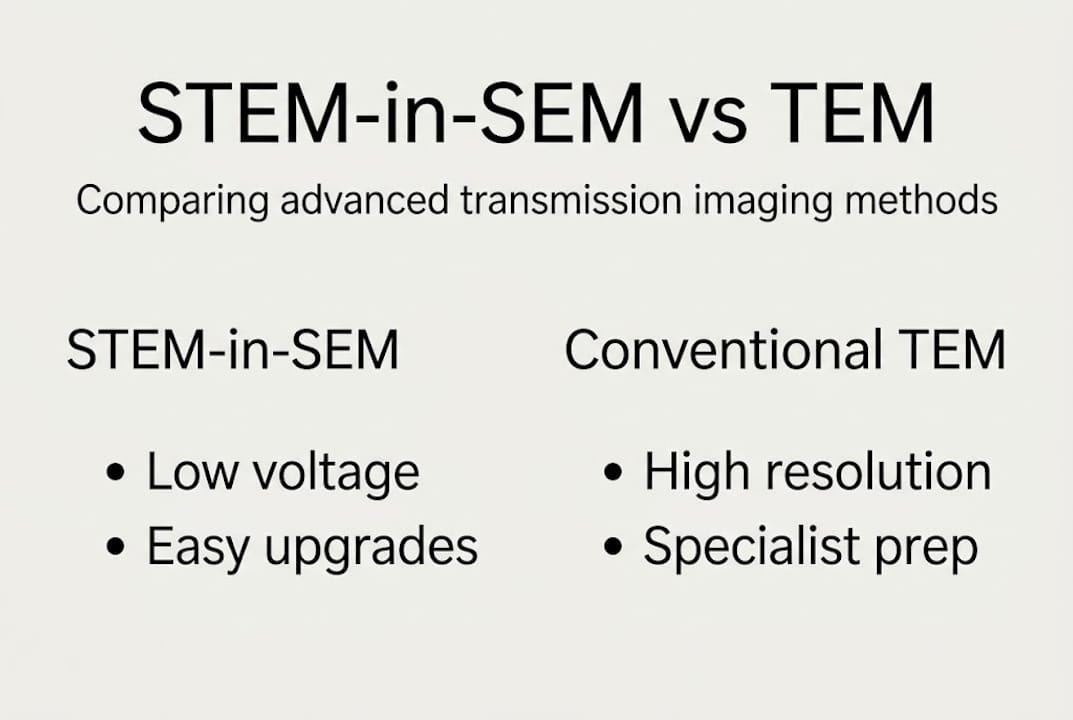
Before you select a method for your next analysis, it’s smart to see how these platforms stack up side by side. The choice is rarely absolute. It depends on your resolution requirements, sample sensitivity, throughput needs, and available infrastructure.
Decision framework: STEM-in-SEM vs. TEM
| Decision factor | Favor STEM-in-SEM | Favor conventional TEM |
|---|---|---|
| Resolution requirement | 1 to 5 nm sufficient | Sub-angstrom needed |
| Sample beam sensitivity | High (organics, biologics) | Low (metals, ceramics) |
| Throughput | High (faster sessions) | Lower (complex alignment) |
| Budget | Constrained | Flexible |
| Existing infrastructure | FEG-SEM available | Standalone TEM available |
| Crystallographic detail | Phase ID, strain mapping | Atomic column imaging |
STEM-in-SEM democratizes high-resolution transmission imaging for R&D labs without TEM infrastructure, making it ideal for biomaterial and nanoparticle analysis in pharma. This is not a minor operational convenience. For many pharmaceutical and biomedical R&D teams, the absence of on-site TEM has historically meant outsourcing critical characterization steps with weeks of turnaround. STEM-in-SEM changes that timeline fundamentally.
That said, conventional TEM comparison remains the right choice when atomic-resolution imaging is required, when selected area electron diffraction needs to resolve subtle polymorphic distinctions, or when energy-filtered TEM (EFTEM) for elemental mapping at atomic scale is part of the analytical protocol. Consult our characterization toolkit to map these requirements before committing to a platform.
Steps for choosing the right platform for your application:
- Define your minimum resolution requirement. If 1 to 2 nm is sufficient, STEM-in-SEM is viable.
- Assess sample beam sensitivity. Organic, biological, or polymeric samples favor lower-energy STEM-in-SEM.
- Evaluate throughput needs. High-volume screening benefits from faster SEM-based workflows.
- Inventory existing infrastructure. An FEG-SEM with a STEM detector is a lower-barrier entry point.
- Identify complementary techniques. Plan for EDS, EBSD, or correlative light microscopy integration from the start.
- Consult your analytical partner early. Platform selection decisions made before sample prep save significant time and cost.
Getting started: Best practices and pitfalls to avoid
After weighing the options, here’s how you can successfully integrate STEM-in-SEM into your characterization workflow. The most common failure point is not the instrument itself. It is inadequate sample preparation and insufficient calibration before data collection begins.
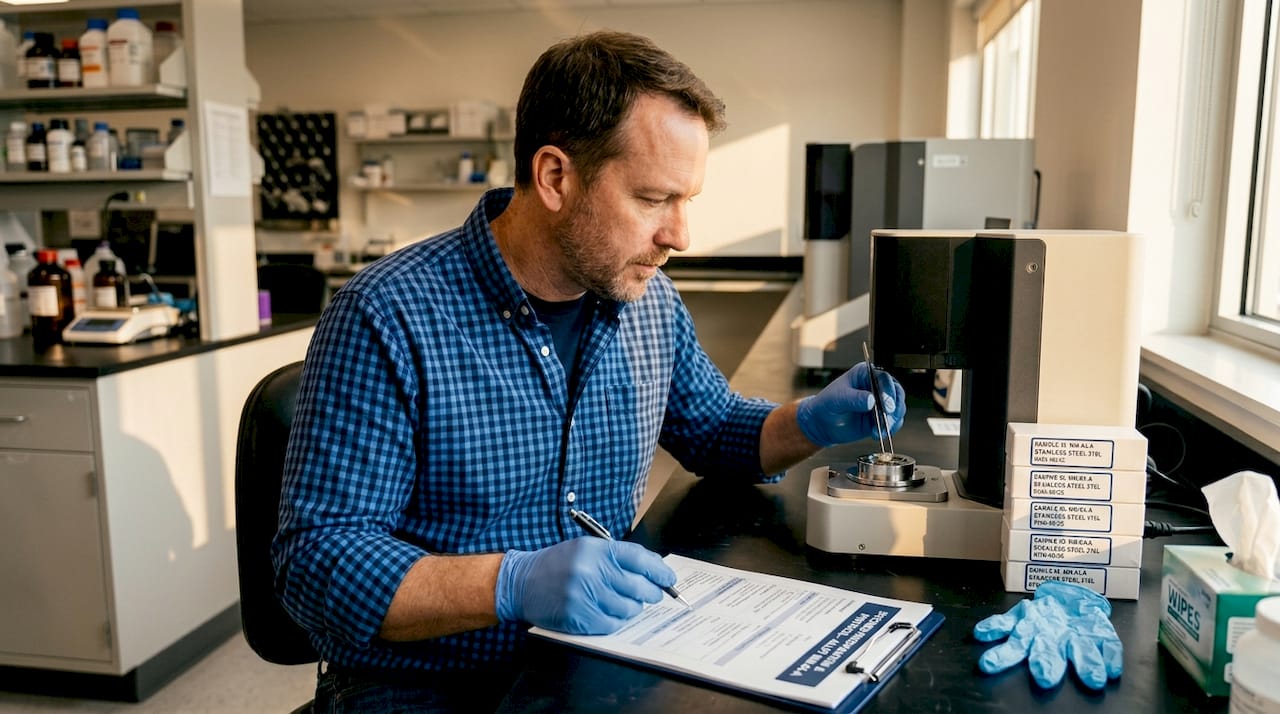
Thin sample sections are non-negotiable for transmission imaging. For most inorganic materials, focused ion beam (FIB) milling to 50 to 100 nm is standard. For biological and pharmaceutical specimens, ultramicrotomy with cryo-preservation is often preferred to minimize structural artifacts. Matching your section thickness to your accelerating voltage is critical: thicker sections at lower keV produce excessive multiple scattering and degrade contrast.
Key best practices for STEM-in-SEM implementation:
- Calibrate detector geometry before each session. Detector misalignment shifts the BF/ADF boundary and corrupts contrast interpretation.
- Use reference standards for resolution verification. Gold nanoparticles or silicon cross-sections with known lattice spacings provide reliable benchmarks.
- Optimize beam current for your sample. Beam-sensitive specimens require lower current and faster scan speeds to stay within safe dose limits.
- Document all imaging parameters. Accelerating voltage, working distance, detector configuration, and dwell time must be recorded for reproducibility and regulatory traceability.
- Validate with complementary techniques. Cross-check STEM-in-SEM structural findings with EDS and EPMA data to confirm compositional assignments.
Pro Tip: Always run a dose-rate test on a sacrificial sample section before imaging your primary specimen. This identifies the damage threshold specific to your material and lets you set safe imaging parameters before exposing irreplaceable samples.
STEM-in-SEM provides high-resolution transmission imaging without requiring full TEM infrastructure, which means your team can iterate faster and at lower cost per experiment. Connecting this capability to your broader material analysis toolkit creates a characterization workflow that is both scientifically rigorous and operationally efficient.
Why “transmission” SEM is the game-changer labs underestimate
The most persistent misconception we encounter is that STEM-in-SEM is simply a budget TEM. It is not. It is a distinct analytical modality with specific strengths that conventional TEM cannot replicate at equivalent cost or throughput. The lower energy range is not a limitation. For beam-sensitive pharmaceutical materials and biological specimens, it is a genuine advantage that enables experiments that would destroy samples under TEM conditions.
What we find most significant in practice is how STEM-in-SEM changes the rhythm of R&D. When transmission imaging is accessible within your existing SEM workflow, your team can run structural characterization as a routine check rather than a milestone event. That shift from milestone to routine is where real iterative discovery happens. Formulation scientists can screen multiple nanoparticle batches in a single day. Device engineers can verify coating integrity across production variants without scheduling weeks in advance.
There is also a collaboration dimension that often goes unrecognized. Labs that adopt STEM-in-SEM become more attractive partners for academic and clinical collaborators, because they can offer transmission imaging data without the access barriers of a shared TEM facility. This expands the scope of what your team can contribute to multi-institutional projects and regulatory submissions. Exploring microscopy innovation at this level positions your lab as a capable, self-sufficient analytical partner rather than a consumer of external services.
The technology is not standing still either. 4D-STEM capabilities are moving into SEM-based platforms, and detector sensitivity continues to improve. Labs that build STEM-in-SEM expertise now will be well positioned to adopt these advances as they mature, rather than starting from scratch when the next generation of instruments arrives.
Take your materials characterization to the next level
Advanced transmission imaging is no longer a capability reserved for national labs or elite research institutions. STEM-in-SEM puts high-resolution internal structure analysis within reach of any R&D team with an FEG-SEM and the right analytical partner. The data quality, throughput, and sample compatibility advantages are real and measurable.
At Materials Metric, we integrate STEM-in-SEM into broader characterization services that include chemical and microscopy analysis and elemental testing solutions, giving your team a single point of contact for complete material characterization packages. Whether you are characterizing a novel drug delivery nanoparticle, validating a biomaterial scaffold, or supporting a regulatory submission, we are here to support your analytical objectives with precision and speed. Contact our team to discuss your project requirements and explore how we can function as an extension of your research team.
Frequently asked questions
How does STEM-in-SEM differ from conventional TEM?
STEM-in-SEM provides TEM-like imaging within an SEM platform at lower accelerating voltages and reduced cost, making it particularly well suited for nanoparticle characterization and beam-sensitive sample analysis without requiring dedicated TEM infrastructure.
Can STEM-in-SEM handle beam-sensitive pharmaceutical samples?
Yes. Innovations like low-dose SMF-BF-STEM can image organic crystals such as felodipine at approximately 3 electrons per square angstrom fluence, revealing crystallographic defects without inducing radiation damage to the specimen.
What are the primary detectors used in transmission SEM imaging?
Programmable detectors in STEM-in-SEM support bright field, annular dark field, dark field, and 4D-STEM imaging modes, allowing multiple contrast mechanisms to be accessed within a single analytical session on the same instrument.
Does STEM-in-SEM require different sample preparation than traditional SEM?
Yes. Transmission imaging requires thin sample sections, typically 50 to 100 nm, to allow electrons to transmit through the material, which usually means FIB milling or ultramicrotomy rather than standard SEM surface preparation.