Summary
- Regulatory consulting provides strategic support to ensure device compliance across multiple jurisdictions.
- Choosing the correct pathway between FDA and EU MDR impacts clinical evidence, timelines, and costs.
- Integrating advanced materials testing with regulatory strategy reduces delays and enhances submission defensibility.
Choosing the wrong regulatory pathway can double your device’s time to market, yet many companies still treat submission planning as a simple checklist exercise. The reality is that medical device regulations span multiple jurisdictions, risk classifications, and evolving standards, each with its own evidence requirements and submission formats. A misstep early in the process can cost months of rework and significant budget. This article walks regulatory affairs teams and device companies through the consulting strategies, key regulatory pathways, and advanced materials testing roles that determine whether your device reaches market on time and on budget.
Table of Contents
- Why regulatory consulting is crucial for medical devices
- Navigating key regulatory pathways: U.S. FDA vs. EU MDR
- Expert methodologies: Gap analysis, mock audits, and regulatory strategy
- Integrating advanced materials testing with regulatory compliance
- What most regulatory consulting guides leave out
- Next steps: Connect with advanced regulatory and testing partners
- Frequently asked questions
Key Takeaways
| Point | Details |
|---|---|
| Consulting is essential | Expert regulatory consulting prevents costly delays and ensures devices meet the right standards the first time. |
| Regulatory pathways vary | FDA and EU MDR requirements differ greatly, making tailored strategies crucial for each market. |
| Methodology drives success | Gap analysis, mock audits, and tailored compliance planning significantly boost your approval odds. |
| Testing backs submissions | Advanced materials and biocompatibility testing are critical to supporting clinical and regulatory claims. |
| Stay proactive | Early expert guidance and up-to-date compliance systems help companies adapt to 2026’s evolving regulations. |
Why regulatory consulting is crucial for medical devices
Medical device regulation is not a single rulebook. It is a layered system of market-specific requirements, product risk classifications, quality management standards, and post-market obligations. The FDA, the European Commission, and international bodies like ISO each impose distinct demands, and those demands shift as regulations evolve. Navigating this environment without specialized guidance is one of the most common reasons device programs stall or fail.
Regulatory consulting fills that gap by providing structured support across the entire product lifecycle. A qualified consultant brings strategy, gap analysis, submission preparation, and ongoing compliance management under one roof. They identify where your documentation falls short before a regulator does, and they know which technical files need to be strengthened for a specific market or device class.
One of the most pressing reasons to engage current consulting expertise is the pace of regulatory change. The QMSR effective February 2026 harmonizes U.S. quality management requirements with ISO 13485, replacing the legacy 21 CFR Part 820 framework. Companies that have not updated their quality management systems to reflect this shift are already out of compliance. Our US FDA consulting overview outlines how we help teams adapt to exactly these kinds of regulatory transitions.
Here is what effective regulatory consulting covers:
- Regulatory strategy development tailored to your device class and target markets
- Gap analysis of existing technical documentation against current standards
- Submission preparation for 510(k), De Novo, PMA, CE marking, and other pathways
- Quality management system (QMS) alignment with ISO 13485 and QMSR
- Post-market surveillance planning to maintain ongoing compliance
- Lifecycle management for design changes and label updates
“Regulatory consulting is most valuable when it begins at the design stage, not after the prototype is built. Early engagement shapes evidence generation and prevents costly redesigns.”
Firms staffed by former FDA reviewers and Notified Body auditors bring a perspective that internal teams rarely have. They know how regulators think, what raises flags during review, and how to frame submissions for faster clearance. Engaging that expertise early, through our regulatory consulting strategies, is one of the highest-return investments a device company can make.
Pro Tip: Schedule a regulatory strategy session before locking your design inputs. Changes made after design freeze are exponentially more expensive to document and validate.
Navigating key regulatory pathways: U.S. FDA vs. EU MDR
With an understanding of why consulting matters, the next challenge is choosing and successfully navigating the right regulatory pathway. The choice between FDA and EU MDR routes is not simply geographic. It shapes your clinical evidence strategy, your timeline, and your total cost of market entry.
The FDA classifies devices into three risk classes. Class I devices carry the lowest risk and are generally exempt from premarket review. Class II devices, which represent the majority of marketed devices, typically require a 510(k) submission demonstrating substantial equivalence to a predicate device. Class III devices, those that sustain life or present significant risk, require a Premarket Approval (PMA), the most rigorous pathway. The De Novo pathway exists for novel low- to moderate-risk devices without a suitable predicate. FDA device classification and pathway selection directly affect submission timelines and clinical data requirements.

| Pathway | Device risk | Typical timeline | Clinical data required |
|---|---|---|---|
| 510(k) | Class II | 3 to 12 months | Usually not required |
| De Novo | Class II (novel) | 12 to 18 months | Sometimes required |
| PMA | Class III | 1 to 3+ years | Always required |
| EU MDR CE mark | Class I to III | 12 to 36 months | Required for most classes |
The EU MDR framework, which replaced the older MDD, demands clinical evaluation and stricter evidence for nearly all device classes, including many that previously required minimal documentation. Notified Body capacity constraints have extended timelines further, and 2025 EU proposals may reshape certain pathways going forward.
Here is where U.S. regulatory playbooks commonly break down in Europe:
- 510(k) substantial equivalence arguments do not transfer to EU MDR clinical evaluation logic
- Post-market clinical follow-up (PMCF) is mandatory under MDR, not optional
- Software as a Medical Device (SaMD) faces up-classification under MDR compared to FDA
- Economic operator obligations add supply chain compliance layers absent in U.S. submissions
Understanding FDA vs. EU MDR evidence requirements is essential before committing resources to either pathway. Our article on medical device safety compliance provides additional context on how testing requirements align with each framework.
Key insight: Companies that attempt to repurpose their 510(k) technical file for a CE mark submission routinely face major rework. The evidence structures are fundamentally different.
Expert methodologies: Gap analysis, mock audits, and regulatory strategy
Knowing the pathways, how do consulting experts guide you through the process? Let’s break down their proven methodologies.
Effective regulatory consulting follows a structured sequence, not a generic template. Each methodology builds on the previous one, creating a defensible evidence package that holds up under regulator scrutiny.
- Regulatory gap analysis. Consultants benchmark your current documentation, QMS, and clinical data against the specific requirements of your target pathway. MDR Consultants achieve an 80% reduction in documentation gaps through targeted QMS strategies, with ex-FDA reviewers leading the process. This step surfaces the most critical deficiencies before submission.
- QMS alignment and remediation. Once gaps are identified, consultants guide QMS updates to meet ISO 13485 and QMSR requirements. This includes procedure revisions, training records, and design control documentation.
- Pre-submission meetings (Pre-Sub). For FDA submissions, a Pre-Sub meeting lets you present your proposed testing plan and submission strategy to the agency before filing. Regulators provide written feedback, reducing the risk of a major deficiency letter after submission.
- Mock audits. Simulated Notified Body or FDA inspections expose process weaknesses before the real event. Teams that undergo mock audits consistently perform better during actual inspections.
- Submission preparation and review. Consultants draft, review, and finalize technical files, 510(k) summaries, and clinical evaluation reports to ensure completeness and regulatory alignment.
- AI-powered regulatory tools. Platforms like PureFDA now offer data-driven submission analysis and regulatory intelligence, complementing expert consulting with speed and pattern recognition.
Pro Tip: Use your gap analysis report as a living document throughout development. Updating it at each design stage prevents documentation debt from accumulating before submission.
| Methodology | Primary benefit | Typical time investment |
|---|---|---|
| Gap analysis | Identifies documentation deficiencies early | 2 to 4 weeks |
| QMS remediation | Aligns processes with current standards | 4 to 12 weeks |
| Pre-Sub meeting | Reduces post-submission deficiencies | 3 to 6 months lead time |
| Mock audit | Prepares team for real inspections | 1 to 2 weeks |
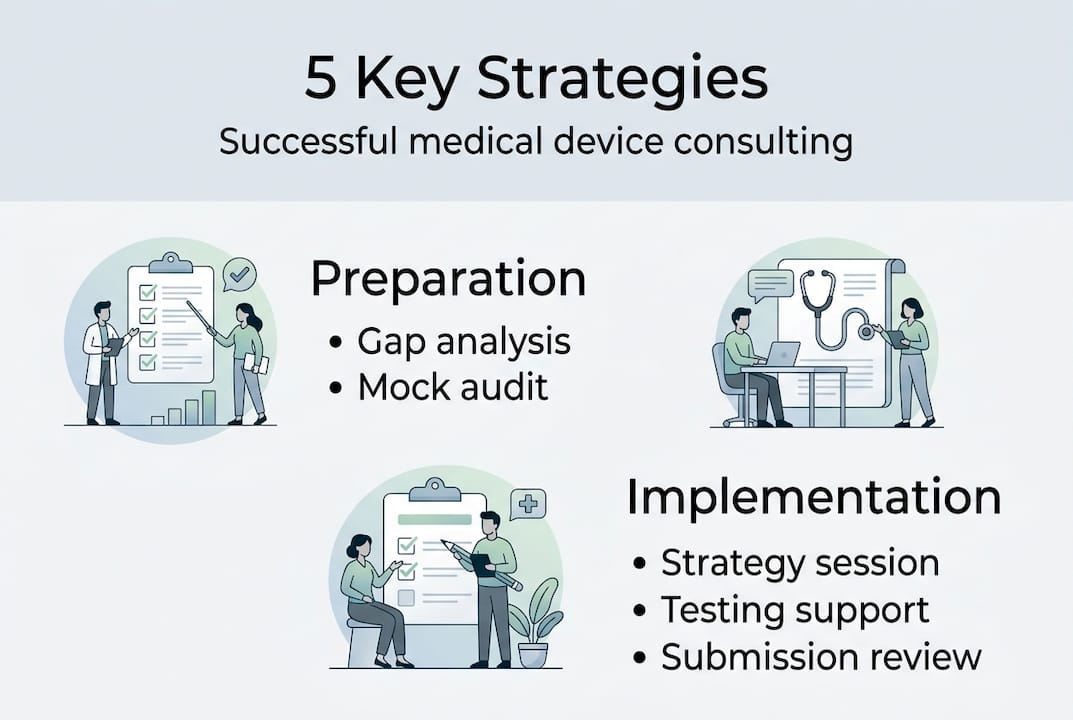
Consulting success depends on lifecycle support, ex-regulator expertise, and strategies tailored to your specific device and market. Generic approaches produce generic results. Our biocompatibility testing checklist is one practical resource for teams preparing their testing strategy alongside regulatory submissions.
Integrating advanced materials testing with regulatory compliance
With your regulatory strategy in place, the final piece is ensuring technical evidence meets global standards through materials testing. This is where many device programs encounter unexpected delays. Regulators expect chemical, elemental, and biological characterization data that is traceable, method-validated, and aligned with recognized standards.
Biocompatibility and ISO 10993 analysis are essential components of regulatory submissions for devices that contact the body. ISO 10993 defines the testing framework for evaluating biological risks, including cytotoxicity, sensitization, genotoxicity, and systemic toxicity. Missing or incomplete testing in any of these categories is a leading cause of 510(k) deficiency letters and MDR technical file rejections.
Here is how advanced materials testing supports your regulatory submission:
- Chemical characterization identifies extractables and leachables that could pose patient risk, a mandatory step for many device types under ISO 10993-18
- Elemental analysis quantifies trace metals and contaminants using ICP-MS and other high-sensitivity techniques
- Biocompatibility studies assess biological response across the full ISO 10993 series, generating data regulators require for clearance
- Surface characterization using SEM, XPS, and AFM provides morphological and compositional evidence supporting material selection decisions
- Mechanical and thermal testing validates that materials perform within specified limits under real-use conditions
“Missed or incomplete materials testing is consistently cited among the top reasons for regulatory delay and product recall. Selecting the right test methods and lab partners at the outset is a strategic decision, not an administrative one.”
Consulting teams that understand both the regulatory and the scientific dimensions of materials testing are best positioned to help you select appropriate methods, interpret results, and integrate data into your technical file. 510(k) compliance benchmarks confirm that complete materials characterization packages significantly reduce deficiency rates. Our medical device materials testing services are designed to generate exactly the kind of defensible, regulator-ready data your submissions require.
What most regulatory consulting guides leave out
Most regulatory guides focus on checklists and pathway comparisons. Those tools have their place, but they create a false sense of security. A completed checklist does not mean a defensible submission. It means you answered the questions that were asked, not necessarily the ones a regulator will ask.
We see this pattern repeatedly with emerging technologies. Software-driven devices, AI-enabled diagnostics, and novel biomaterials do not fit neatly into existing classification frameworks. Standard playbooks miss the nuances of software up-classification under MDR, cybersecurity documentation requirements, or the clinical evidence expectations for combination products. Relying on a template designed for a legacy device category is a real risk when your product sits at the edge of current regulatory definitions.
Our scientific consulting approach is built around the idea that regulatory evidence must withstand not just initial review but post-market audits and real-world performance scrutiny. That requires thinking beyond compliance checkboxes and building a technical narrative that is coherent, traceable, and scientifically defensible from design input to post-market surveillance.
Next steps: Connect with advanced regulatory and testing partners
Ready to transform your device strategy into regulatory and market success? Here’s how industry leaders take the next step.
The most effective device programs treat regulatory consulting and materials testing as integrated disciplines, not separate workstreams. When your submission strategy, your testing plan, and your technical documentation are aligned from the start, you reduce deficiency risk and accelerate review timelines.
At Materials Metric, we support regulatory affairs teams with advanced analytical testing methods and chemical and microscopy characterization services that generate regulator-ready data. Our elemental characterization capabilities cover the full range of ISO 10993 chemical analysis requirements. Contact us to discuss how we can serve as an extension of your regulatory and technical team.
Frequently asked questions
What is regulatory consulting for medical devices?
Regulatory consulting guides device companies through complex compliance and submission processes, tailoring strategies to each target market and device classification. Kapstone Medical provides full-service regulatory consulting for both U.S. and EU submissions, illustrating the breadth of support available.
How does the FDA QMSR update affect medical device compliance in 2026?
The QMSR effective February 2026 aligns U.S. quality management requirements with ISO 13485, requiring companies to update their QMS procedures, records, and training programs to maintain compliance.
What’s the difference between FDA 510(k), De Novo, and PMA?
510(k) applies to devices substantially equivalent to a predicate, De Novo covers novel low- to moderate-risk devices without a predicate, and PMA is required for high-risk Class III devices with the most rigorous clinical evidence demands. FDA pathway details outline timelines and cost differences for each route.
Why is advanced materials testing essential for regulatory approval?
Materials testing, including biocompatibility per ISO 10993, is mandatory for most devices that contact the body, and incomplete testing packages are among the top causes of submission deficiencies and clearance delays.
How do EU MDR requirements differ from the FDA’s?
EU MDR mandates clinical evaluation reports, Notified Body audits, and post-market clinical follow-up for most device classes, with stricter evidence standards than the FDA 510(k) substantial equivalence framework requires.