
TL;DR:
- Testing assays include cell-based, bioanalytical, and materials characterization methods with distinct regulatory roles.
- Proper workflow design, technique selection, and validation are crucial for regulatory approval and product safety.
- Early collaboration with regulatory teams and expert support streamline assay development and compliance.
Testing assays sit at the intersection of scientific rigor and regulatory expectation, yet they are frequently misunderstood as a single category of method. In reality, testing assays encompass cell-based biological activity measurements, analytical potency and biomarker methods, and materials characterization techniques that evaluate mechanical properties. Choosing the wrong assay type, or validating it inadequately, can derail a regulatory submission or compromise product safety. This guide walks through the major assay categories, how their workflows operate, what mechanical and imaging techniques bring to the table, and what validation really demands from your team.
Table of Contents
- What is a testing assay? Core concepts and classification
- How cell-based and analytical assays work: Workflows and optimization
- Mechanical characterization and imaging: Techniques and evaluation
- Validation and regulatory requirements: From method acceptance to compliance
- Expert perspective: What most guides miss about testing assay success
- Taking testing assays to the next level with expert support
- Frequently asked questions
Key Takeaways
| Point | Details |
|---|---|
| Assay types overview | Cell-based, bioanalytical, and mechanical assays each serve crucial roles in product development and compliance. |
| Optimization is essential | Tailoring workflows and validation to sample type and context reduces failure risk. |
| Regulatory validation matters | Aligning methods to FDA and ICH guidelines streamlines approval and ensures reliable results. |
| Mechanical testing’s unique value | Advanced mechanical and imaging methods reveal properties key to safety and performance in biomedical products. |
| Expert input prevents pitfalls | Consulting cross-functional teams early avoids common assay implementation and validation challenges. |
What is a testing assay? Core concepts and classification
A testing assay is any structured, reproducible method used to measure a specific property of a biological, chemical, or material sample. The term is broad by design. In pharmaceutical and biomedical R&D, it covers everything from measuring cell viability in response to a drug candidate to quantifying trace elemental contamination in a medical device coating.
Assay types span three core domains: cell-based assays for biological activity, bioanalytical assays for potency and biomarkers, and materials characterization assays for physical and mechanical properties. Each domain serves distinct scientific and regulatory functions.
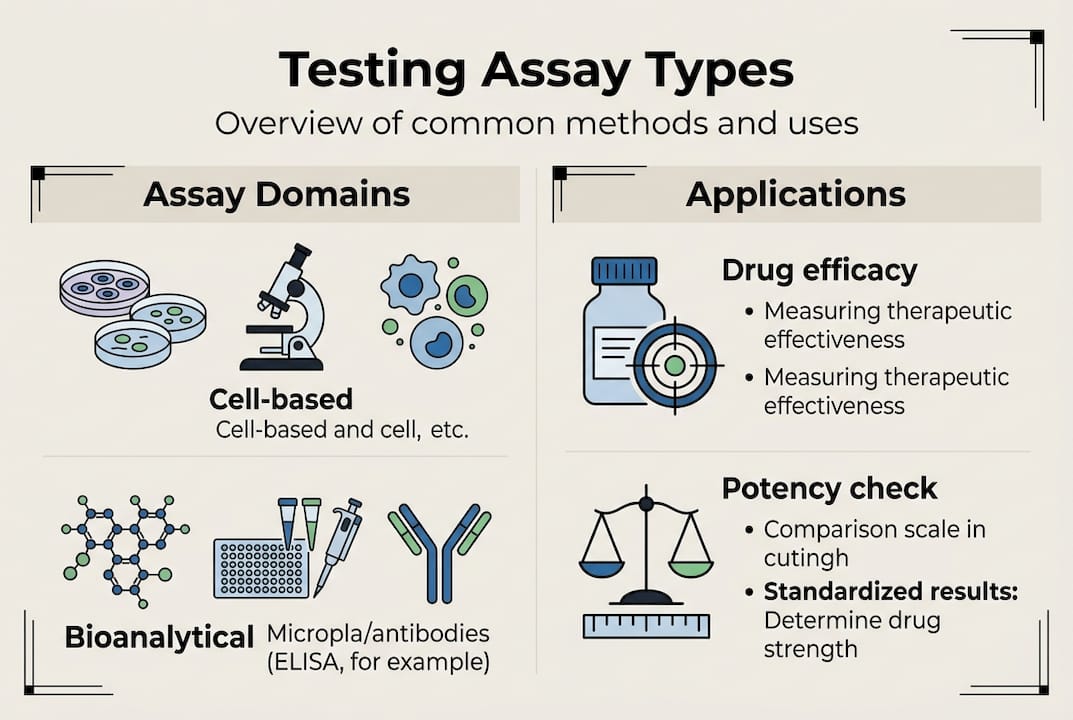
Cell-based assays measure how living cells respond to compounds, biologics, or environmental conditions. Examples include cytotoxicity screens, receptor binding studies, and in vitro tissue culture assays used to assess implant biocompatibility. These assays are central to early drug discovery and safety profiling.
Bioanalytical assays quantify molecules in biological matrices. Potency assays confirm that a drug product delivers its intended pharmacological effect at a defined dose. Biomarker assays track disease progression or treatment response. Immunological cell-based assays are a specialized subset used to detect immune responses to biologic therapies, and the FDA immunogenicity assay guidance outlines specific performance expectations for these methods.
Materials characterization assays evaluate physical, mechanical, and chemical properties of device components, excipients, or biomaterials. Techniques like tensile testing, indentation, and spectroscopic analysis fall here.
| Assay type | Application | Principles | Pros | Cons |
|---|---|---|---|---|
| Cell-based | Drug efficacy, toxicity, biocompatibility | Live cell response measurement | Biologically relevant | High variability, complex optimization |
| Bioanalytical (potency/biomarker) | Drug quantification, disease markers | Immunoassay, chromatography, mass spectrometry | High sensitivity, regulatory accepted | Matrix interference, method transfer risk |
| Materials characterization | Device properties, excipient behavior | Mechanical, thermal, spectroscopic | Objective, quantitative | Sample prep complexity, equipment cost |
Understanding which domain your question falls into is the first decision your team must make. Mixing up assay categories leads to mismatched validation strategies and wasted development time.
How cell-based and analytical assays work: Workflows and optimization
With assay types in mind, let’s break down how they actually operate in practice and what makes real-world workflows challenging.
Cell-based assay workflows are not linear pipelines. They include cell culture, viability testing, compound addition, toxicity testing, imaging, and transfection steps that can shift order depending on the sample type and scientific question. This flexibility is a strength, but it also introduces variability that must be controlled.
A typical cell-based workflow follows these steps:
- Cell selection and sourcing: Choose the appropriate cell line or primary/patient-derived cells based on the biological question and regulatory context.
- Culture and expansion: Maintain cells under defined conditions to ensure consistent passage number, morphology, and growth rate.
- Plating and treatment: Seed cells at validated densities, apply compounds or test articles at defined concentrations and timepoints.
- Endpoint measurement: Quantify viability, proliferation, cytokine release, or imaging-based morphological changes.
- Data analysis and QC: Apply statistical models, flag outliers, and confirm assay acceptance criteria are met.
For tissue culture functional assays using patient-derived material, each step carries additional complexity. Donor variability, limited sample availability, and unpredictable passage behavior all require protocol flexibility that standard cell lines do not demand.
Analytical assays for biomarkers and potency differ significantly. Sample preparation dominates the early workflow: protein precipitation, dilution, or extraction must be optimized to minimize matrix effects. Detection methods such as ELISA, LC-MS/MS, or flow cytometry then require calibration curves, internal standards, and system suitability checks before any sample result is accepted.
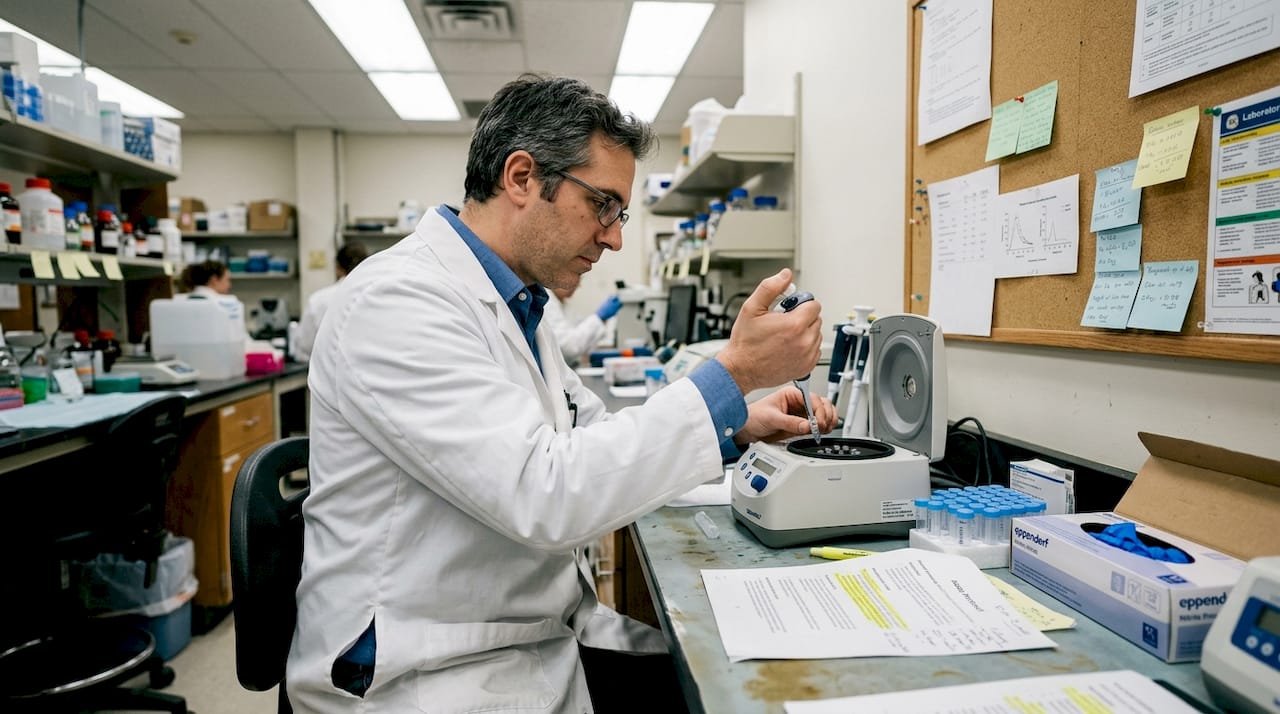
Biomarker validation follows ICH M10 fit-for-purpose principles, addressing accuracy, precision, sensitivity, and selectivity at a rigor level matched to the intended regulatory decision. An exploratory biomarker does not require the same validation depth as one supporting a primary efficacy endpoint.
Common pain points across both assay types include matrix effects that suppress or enhance signal, drug tolerance limitations in immunogenicity assays, and imaging-based toxicology challenges that affect quantification in complex tissue models.
Pro Tip: When working with primary or patient-derived cells, build protocol flexibility into your assay design from day one. Locking in rigid conditions early forces costly re-optimization later when sample behavior deviates from your reference cell line.
We also recommend exploring advanced in vitro models when standard 2D culture systems fail to replicate the physiological environment your product will encounter.
Mechanical characterization and imaging: Techniques and evaluation
While workflows drive how assays are executed, selecting the right tools for mechanical and imaging-based measurements is equally critical.
Soft biomedical material techniques span a wide range: optical imaging, interferometry, digital image correlation, optical coherence microscopy, acoustic imaging, indentation, cavitation rheology, and flow elastography. Each method interrogates material behavior at different length scales and with different levels of invasiveness.
Key categories to consider:
- Contacting methods (indentation, compression, tensile testing): Direct mechanical contact with the sample. High quantitative accuracy for modulus and toughness, but can alter soft or fragile specimens.
- Non-contact optical methods (digital image correlation, optical coherence microscopy): Measure surface strain and subsurface structure without touching the sample. Ideal for delicate hydrogels or live tissue constructs.
- Acoustic and ultrasound methods (shear wave elastography, acoustic microscopy): Penetrate tissue to map stiffness gradients. Ultrasound SWE reliability reaches ICC values of 0.70 to 0.99 in well-controlled conditions.
- Rheological methods (cavitation rheology, oscillatory shear): Characterize viscoelastic behavior in hydrogels, polymer networks, and biofluids.
| Technique | Invasiveness | Spatial resolution | Ideal use case |
|---|---|---|---|
| Indentation | Moderate | Micrometer scale | Tissue scaffolds, hydrogels |
| Digital image correlation | None | Surface strain mapping | Soft films, membranes |
| Shear wave elastography | Low | Millimeter scale | In situ tissue stiffness |
| Cavitation rheology | Moderate | Local point measurement | Injectable biomaterials |
| Optical coherence microscopy | None | Micrometer subsurface | Layered tissue constructs |
Method selection depends on tissue type, required throughput, and whether your regulatory context demands validated quantitative outputs or accepts semi-quantitative imaging data. Our mechanical testing methods resources provide further guidance on matching technique to application.
Pro Tip: Match your method to the scale of the biological question. A bulk rheology measurement will miss localized stiffness heterogeneity that indentation or optical coherence microscopy would resolve. Scale mismatch is one of the most common sources of misleading mechanical data in soft biomaterial studies.
For projects requiring both structural and chemical characterization, integrating mechanical data with chemical and microscopy characterization provides a more complete picture of material performance.
Validation and regulatory requirements: From method acceptance to compliance
With assay selection and technique in place, regulatory validation remains the final, often most challenging, barrier.
Validation is not a single standard applied uniformly. The FDA’s multi-tiered immunogenicity testing framework requires screening, confirmatory, titration, and neutralization assays with defined parameters including cut-point, sensitivity, specificity, drug tolerance, precision, and robustness. Each tier has distinct acceptance criteria, and failure at any stage requires documented investigation before advancing.
For biomarker assays, ICH M10 fit-for-purpose principles govern validation design. Full validation is required when assay results directly support regulatory decisions, while partial validation is acceptable for method modifications or cross-validation between platforms.
Key validation steps your team must address:
- Define the intended use: Exploratory, clinical decision-making, or batch release. This determines validation depth.
- Establish acceptance criteria: Set limits for accuracy, precision, sensitivity, and selectivity before running validation experiments.
- Conduct reference standard qualification: Confirm the identity, purity, and stability of your calibration and control materials.
- Run inter-laboratory transfer studies: Demonstrate that the method performs equivalently at receiving sites under GLP conditions.
- Document and archive: Maintain complete records aligned with your regulatory submission strategy.
“Fit-for-purpose validation means the rigor of the validation is matched to the intended use of the assay data. For assays supporting regulatory decisions, full validation addressing accuracy, precision, sensitivity, and selectivity is required.” FDA Biomarkers Guidance
Common barriers include GLP transferability for imaging-based assays, where spatial data must be converted to validated quantitative outputs, and matrix-specific interference that is not apparent until late-stage validation. Our advanced characterization toolkit and resources on why analytical testing matters address these gaps directly.
Expert perspective: What most guides miss about testing assay success
Stepping back from methods and requirements, let’s cut to what really drives or impedes success in assay adoption and regulatory clearance.
Most assay failures we observe are not caused by flawed science. They result from transfer gaps between R&D and QA, sample-specific interferences that were never stress-tested during development, or validation strategies that were designed for a reference cell line and then applied without adjustment to patient-derived material.
Assay optimization for patient-derived cells is genuinely non-linear. Drug tolerance windows shift, matrix composition varies by donor, and scale-dependent mechanical behavior in soft tissues means that a method validated at one sample size may not transfer cleanly to another.
The contrarian view worth stating plainly: investing in high-throughput platforms and cutting-edge imaging before your core assay workflow is locked and your validation strategy is agreed upon with regulatory affairs is a resource drain, not an accelerator. The fundamentals of basic chemical assays and method robustness must be solid before layering in complexity.
Pro Tip: Bring regulatory affairs and QA into assay design conversations at the protocol stage, not after the first failed submission. Early cross-functional alignment prevents the most expensive mistakes in assay development.
Taking testing assays to the next level with expert support
Equipped with a clearer picture of assay challenges, your team can make faster, more confident decisions about method selection, validation design, and regulatory strategy. We built our service portfolio specifically to fill the gaps that slow biomedical and pharmaceutical teams down.
From analytical testing compliance support to integrated chemical and microscopy services and elemental characterization solutions, we act as an extension of your research and regulatory team. Whether you need assay design consulting, method validation support, or advanced materials characterization, we are here to accelerate your path from development to submission.
Frequently asked questions
What are the main types of testing assays in pharmaceuticals?
Pharmaceutical testing assays fall into three primary categories: cell-based assays for biological activity, bioanalytical assays for potency and biomarkers, and materials characterization techniques for physical and mechanical properties. Each serves a distinct scientific and regulatory function.
How are testing assays validated for regulatory approval?
Assays are validated against defined criteria including accuracy, precision, sensitivity, and selectivity, following ICH M10 fit-for-purpose principles or FDA multi-tier protocols depending on the assay type and its intended regulatory role.
What challenges are common in cell-based assay workflows?
Cell-based workflows frequently encounter cell viability inconsistencies, matrix interference, drug tolerance limitations, and the need for non-linear protocol optimization, particularly when using primary or patient-derived cell sources.
Why are mechanical testing methods important in material assays?
Mechanical characterization techniques measure toughness, elasticity, and strain behavior in soft biomaterials, providing data that directly informs device function, safety assessment, and regulatory submission for implantable or contact materials.
What is fit-for-purpose validation?
Fit-for-purpose validation means aligning validation depth to the assay’s intended use. ICH M10 principles require full validation when assay results support regulatory decisions, while exploratory assays may qualify for a reduced validation scope.