
Fewer than 5% of drug candidates entering preclinical testing ever reach an Investigational New Drug application. This staggering attrition rate underscores a critical reality for biomedical and pharmaceutical executives: selecting the right preclinical contract research organization is not a procurement decision, it’s a strategic imperative that directly impacts your pipeline’s survival. The CRO you partner with determines the quality of your efficacy data, the rigor of your toxicology studies, and ultimately your regulatory submission’s credibility. This guide clarifies core CRO services, selection criteria, regulatory requirements, and collaboration strategies to help you make informed decisions that accelerate your path from discovery to clinical evaluation.
Table of Contents
- What is a preclinical contract research organization?
- Core preclinical CRO services: From efficacy to compliance
- Navigating regulatory requirements and quality assurance
- Selecting a partner: Generalist vs specialist CROs
- Benchmarking performance and ensuring reproducibility
- Best practices for collaborating with your preclinical CRO
- Partnering with Materials Metric for advanced preclinical support
- Frequently asked questions
Key Takeaways
| Point | Details |
|---|---|
| Preclinical CROs are critical | They bridge the gap between discovery and clinical trials, enabling regulatory and scientific success. |
| Compliance matters most | GLP, OECD, and ICH adherence protects your program and supports smooth submissions. |
| Specialization increases reproducibility | Specialist CROs deliver better outcomes for complex or high-risk studies. |
| Benchmark with data | Assess CROs with historical attrition rates and quantitative endpoints for performance assurance. |
| Collaboration drives results | Co-designing protocols and transparent communication speed progress and reduce development risks. |
What is a preclinical contract research organization?
A preclinical contract research organization conducts the animal and in vitro studies that bridge innovative discovery and clinical evaluation. These specialized partners assess efficacy, safety, and pharmacology before your compound ever enters human trials. Without their expertise, you face the daunting task of building internal infrastructure for complex in vivo models, GLP toxicology suites, and regulatory submission packages.
Preclinical CROs provide essential capabilities that most biotech and pharmaceutical companies cannot economically maintain in-house:
- In vivo efficacy models including cell-derived xenografts, patient-derived xenografts, and genetically engineered models
- Pharmacokinetic and pharmacodynamic studies that characterize absorption, distribution, metabolism, and mechanism of action
- Safety pharmacology evaluating cardiovascular, respiratory, and central nervous system effects
- GLP-compliant toxicology for regulatory submissions
- ADME profiling to predict human drug behavior
Leading preclinical CROs include Materials Metric, Charles River Laboratories, WuXi AppTec, Covance, and specialists like Veranex and Lovelace Biomedical. Each brings distinct capabilities, from high-throughput screening to rare disease models. The key is matching their strengths to your therapeutic area and development stage.
“The right CRO doesn’t just execute protocols. They become an extension of your research team, contributing scientific insight that shapes your regulatory strategy and clinical design.”
For compounds requiring specialized material characterization or biological interface analysis, consider partners offering advanced in vitro functional models that complement traditional in vivo work. This integrated approach provides mechanistic data that strengthens your IND package.
Core preclinical CRO services: From efficacy to compliance
Understanding what preclinical CROs offer helps you evaluate proposals and identify gaps in vendor capabilities. The most comprehensive providers deliver an integrated suite of services spanning discovery support through regulatory submission.
Essential methodologies form the backbone of preclinical evaluation:
| Service Category | Key Applications | Regulatory Relevance |
|---|---|---|
| In Vivo Efficacy | Tumor growth inhibition, disease progression models | Proof of concept for IND |
| PK/PD Studies | Dose selection, exposure-response relationships | Critical for first-in-human dosing |
| Safety Pharmacology | ICH S7A/B core battery, supplemental studies | Required for IND submission |
| GLP Toxicology | Single/repeat dose, reproductive, genotoxicity | Mandatory regulatory studies |
| ADME Profiling | Metabolite identification, drug-drug interactions | Informs clinical monitoring |
Core methodologies vary in complexity and regulatory weight. Your CRO should guide you on which studies are IND-enabling versus exploratory, helping you allocate budget to the highest-value experiments.
Specialty methods differentiate advanced CROs from basic service providers. Look for capabilities in custom model development, advanced dosing techniques like osmotic pumps or inhalation chambers, and multi-species comparative studies. These specialized approaches often provide the differentiated data that convinces regulatory reviewers of your compound’s promise.
For medical devices or combination products, cytotoxicity testing and comprehensive biocompatibility assessment become equally critical. Device developers should also evaluate CROs offering extractables and leachables testing to characterize potential chemical migration from materials. Some CROs provide integrated pharmacology services that combine efficacy and safety endpoints in single studies, reducing animal use and accelerating timelines.

Navigating regulatory requirements and quality assurance
Regulatory compliance separates credible preclinical data from studies that delay or derail your IND submission. The CRO you select must demonstrate mastery of Good Laboratory Practice standards, OECD frameworks, and ICH guidelines for all regulatory-facing work.
GLP compliance is non-negotiable for toxicology studies and most safety pharmacology work. This means:
- Validated methods with documented accuracy, precision, and reproducibility
- Quality assurance units that independently audit studies and report findings
- Standard operating procedures covering every aspect of study conduct
- Raw data integrity with complete audit trails and secure archiving
- Qualified personnel with documented training and competency assessments
Critical quality assurance steps extend beyond basic GLP compliance. Demand transparent reporting that includes individual animal data, not just group means.
For specialized applications, biological safety consulting can help you interpret complex toxicology findings and develop risk mitigation strategies before regulatory submission. This proactive approach often prevents costly study repeats or clinical holds.
Selecting a partner: Generalist vs specialist CROs
The preclinical CRO landscape spans from global full-service organizations to boutique specialists focused on specific disease areas or methodologies. Your choice between these models profoundly impacts study quality, cost, and timeline.
Generalist CROs offer comprehensive capabilities:
- End-to-end services from discovery through IND submission
- Global capacity enabling rapid study start and parallel execution
- Established regulatory relationships and submission experience
- Economies of scale that can reduce per-study costs
Specialist CROs provide focused expertise:
- Proprietary models with superior predictive validity
- Deep therapeutic area knowledge informing study design
- Higher reproducibility in complex endpoints
- Personalized scientific collaboration
| Consideration | Generalist CRO | Specialist CRO |
|---|---|---|
| Therapeutic expertise | Broad but shallow | Deep and focused |
| Model availability | Standard panels | Proprietary/custom |
| Timeline flexibility | High capacity | Limited slots |
| Cost structure | Competitive pricing | Premium for expertise |
| Scientific partnership | Protocol execution | Co-design collaboration |
Specialist CROs often deliver superior reproducibility in complex models because they’ve refined their methods through repeated application. This expertise becomes invaluable for rare diseases, novel mechanisms, or challenging endpoints where standard approaches fail.
“Expertise, not price, determines the reproducibility and relevance of complex in vivo studies. A failed study costs far more than the premium for specialized capability.”
For compounds requiring advanced material characterization, consider CROs offering skin and tissue equivalent models or computational modeling capabilities that integrate mechanistic understanding with empirical data. This systems approach often reveals insights that purely empirical testing misses.
Benchmarking performance and ensuring reproducibility
How do you know if your CRO is delivering value? Empirical benchmarks and reproducibility metrics provide objective measures of partnership quality.
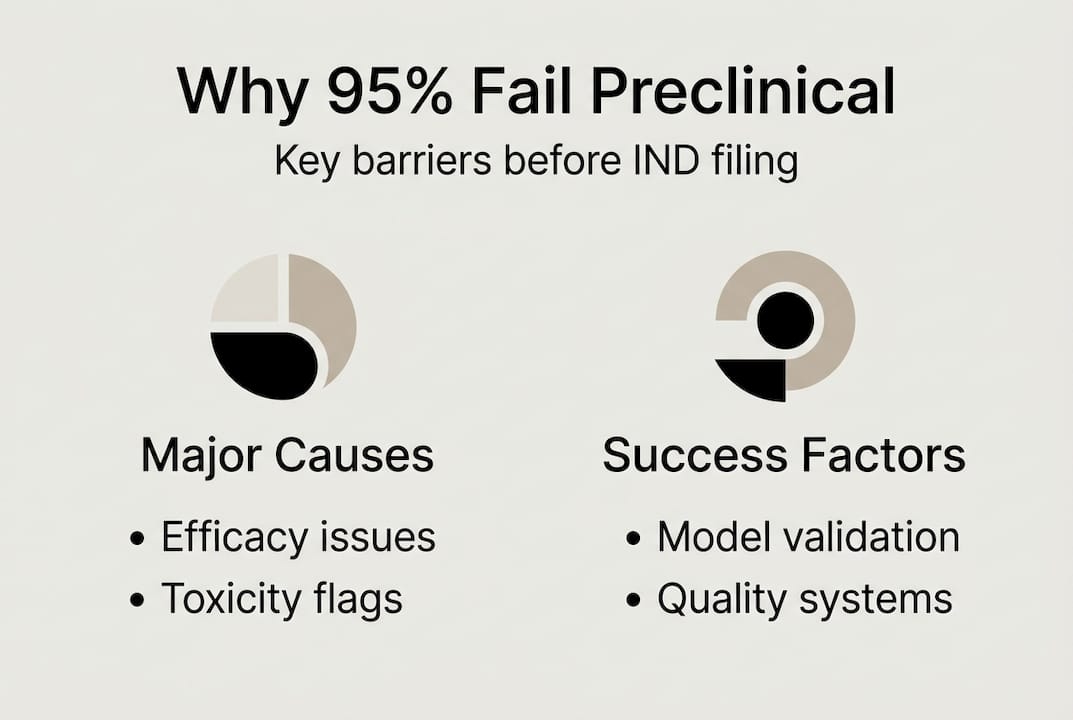
Industry attrition rates offer sobering context. Approximately 95-99% of preclinical candidates fail before IND filing. Of those reaching Phase I, only 47-70% successfully complete that stage. These statistics highlight the importance of rigorous preclinical evaluation, not as a hurdle to clear but as a filter that identifies truly promising candidates.
Essential performance benchmarks for CRO evaluation:
| Metric | Target Range | Red Flag Threshold |
|---|---|---|
| Study timeline adherence | >90% on-time delivery | <75% on-time |
| Protocol deviation rate | <5% per study | >10% per study |
| Data query resolution time | <5 business days | >10 business days |
| Repeat study rate | <3% of projects | >8% of projects |
| Regulatory acceptance | >95% of submissions | Any clinical hold |
Pro Tip: When reviewing CRO proposals, demand quantitative endpoints with power calculations and historical reproducibility data. Vague promises of “robust results” mean nothing without statistical backing.
Low attrition correlates with rigorous model validation and precise reporting, not just competitive pricing. A CRO that consistently delivers clean, reproducible data accelerates your program far more than one offering 20% cost savings but generating ambiguous results that require follow-up studies.
For manufacturing-related testing, batch-to-batch consistency evaluations become critical quality metrics. This is especially important for biologics and complex formulations where subtle manufacturing changes can impact preclinical outcomes.
Best practices for collaborating with your preclinical CRO
Even the most capable CRO delivers suboptimal results without effective collaboration. These strategies ensure productive partnerships that maximize the value of your preclinical investment.
Establish clear communication frameworks from day one:
- Define quantitative endpoints and success criteria before study start
- Set reporting cadence for interim data and milestone updates
- Create escalation pathways for protocol deviations or unexpected findings
- Schedule regular scientific review meetings with study directors
- Maintain open channels for real-time questions and clarifications
Co-design protocols with the CRO’s scientific leads rather than simply handing over your internal design. Their experience with model nuances and regulatory expectations often identifies optimization opportunities you’d miss. This collaborative approach also builds shared ownership of study success.
R&D collaboration should extend beyond protocol execution to strategic planning. The best CRO partnerships involve joint interpretation of emerging data, adaptive study designs that respond to early findings, and integrated regulatory strategy development.
Pro Tip: Insist on digital reporting platforms with real-time data access, not just final reports delivered weeks after study completion. Early visibility into trends allows you to make informed decisions about follow-up studies and resource allocation.
For specialized applications requiring advanced in vitro methods, ensure your CRO can integrate these approaches with traditional in vivo work. The synergy between complementary methodologies often provides mechanistic insights that strengthen regulatory submissions.
Partnering with Materials Metric for advanced preclinical support
Selecting the right preclinical CRO requires matching your specific needs to specialized capabilities. While large CROs excel at standard toxicology and pharmacology studies, complex material characterization and biological interface analysis demand focused expertise.
We support regulatory submissions with validated, GLP-compliant methods that meet FDA and EMA expectations. Our integrated chemical and microscopy analysis provides the material characterization data that strengthens IND packages for medical devices, combination products, and novel delivery systems. When your preclinical program requires understanding how materials interact with biological systems, our specialized approach delivers answers that generalist CROs cannot provide.
Our advantages for R&D leaders seeking preclinical excellence include comprehensive chemical and elemental testing that characterizes potential leachables before they become regulatory issues, and biological safety consulting that interprets complex toxicology findings in the context of your specific application. We work as an extension of your team, providing the specialized testing and expert interpretation that accelerates your path to clinical evaluation. Contact us to discuss how our capabilities can strengthen your preclinical program.
Frequently asked questions
What does a preclinical CRO do differently from a clinical CRO?
Preclinical CROs conduct in vitro and animal studies for efficacy, safety, and regulatory submissions before human trials, while clinical CROs manage patient recruitment and trial execution.
What red flags should I avoid when choosing a preclinical CRO?
Avoid CROs offering price-only proposals, those unwilling to share historical reproducibility data, or partners with poor transparency about timelines and methodology.
Why do so few preclinical projects succeed to IND?
Most leads fail preclinical testing due to inadequate efficacy, unexpected toxicity, poor pharmacokinetics, or insufficient model validation that fails to predict human outcomes.
How do specialist CROs add value for complex studies?
They offer proprietary models and deep expertise that increase reproducibility for challenging indications, often providing mechanistic insights that standard approaches miss.
Recommended
- November 2025 – Materials Metric | Advanced Materials Characterization, Analytical Testing and Scientific Consulting
- Preclinical Testing – Cornerstone of Safe Product Development
- Cytotoxicity Testing | Materials Metric | Research & Development
- Rapid Diagnostic & Screening Assays | Materials Metric | Research