Most regulatory affairs professionals associate contract research organizations (CROs) with Phase II clinical trials and pharmacokinetic studies. That association is understandable, but it misses a large portion of what modern CROs actually deliver. Today, CROs serve as technical and regulatory partners across the full product lifecycle, from early material characterization through submission-ready documentation. This article covers what CROs do beyond clinical work, how they support regulatory compliance, what advanced materials testing looks like in practice, how to handle edge cases, and how to select the right partner for your next project.
Table of Contents
- What is a contract research organization?
- How CROs support regulatory affairs and compliance
- Advanced materials testing: Mechanics, methodologies, and standards
- Dealing with edge cases: Custom tests and nuanced material behaviors
- How to choose the right contract research organization
- Get advanced CRO solutions for compliant materials testing
- Frequently asked questions
Key Takeaways
| Point | Details |
|---|---|
| CROs enable compliance | Contract research organizations help ensure ICH-GCP, FDA, and MDR/IVDR regulatory alignment for biomedical products. |
| Advanced testing expertise | CROs offer mechanical, chemical, and spectroscopic methods to support innovation and submission requirements. |
| Custom methods for challenges | When standards don’t exist, leading CROs design and validate tailored tests to eliminate regulatory barriers. |
| Choose CROs by fit | Evaluate CROs by their technical portfolio, regulatory strategy, and prior success with similar products. |
What is a contract research organization?
A contract research organization is an independent service provider that conducts research, testing, and regulatory support on behalf of pharmaceutical, biomedical, and device companies. The term covers a wide range of specializations. Clinical CROs manage trial design, patient recruitment, and data management. Regulatory CROs focus on submission strategy, agency interaction, and compliance documentation. Materials testing CROs, like Materials Metric, specialize in physico-chemical characterization, method validation, and analytical testing for substances and devices.
CROs provide specialized services in regulatory affairs, clinical trial management, and advanced materials testing across biomedical and pharmaceutical sectors. The scope of services has expanded significantly as product complexity has grown. The CRO market will reach $199B by 2034, with major players like ICON and IQVIA driving service diversification across therapeutic and materials domains.
For product developers and regulatory affairs teams, a materials-focused CRO typically provides:
- Regulatory submission support (IND, NDA, 510(k), CE marking)
- Compliance documentation (Clinical Evaluation Reports, Investigational Medicinal Product Dossiers)
- Materials and method validation aligned with ISO, ASTM, and USP standards
- Batch consistency evaluations for manufacturing quality assurance
- Custom analytical testing for novel or non-standard materials
- Gap analysis and pre-submission regulatory consulting
Understanding this breadth is the first step toward using CRO partnerships strategically rather than reactively.
How CROs support regulatory affairs and compliance
Navigating FDA, EMA, and MDR/IVDR frameworks simultaneously is one of the most resource-intensive challenges your team faces. CROs reduce that burden by acting as an extension of your regulatory function, not just a testing vendor.
Here is how a structured CRO engagement typically unfolds:
- Gap analysis: The CRO reviews your existing data package against target submission requirements, identifying missing studies, weak documentation, or non-compliant test methods.
- Submission preparation: The CRO compiles and formats the Common Technical Document (CTD), Investigator’s Brochure (IB), Clinical Evaluation Report (CER), or Investigational Medicinal Product Dossier (IMPD) based on the target agency.
- Agency interaction support: Experienced CROs draft responses to agency queries, prepare briefing documents, and coordinate pre-submission meetings with FDA or EMA.
- Compliance documentation: Ongoing support for post-market clinical follow-up (PMCF), periodic safety update reports, and MDR/IVDR technical file maintenance.
“CROs are strategic partners for compliance, conducting gap analysis and coordinating with regulatory authorities for complex materials projects.” Role of CROs in regulatory affairs
Recent MDR/IVDR enforcement timelines have tightened considerably, and many legacy devices now require updated biological risk assessment data to maintain market access. Our regulatory consulting and FDA consulting services are designed to address exactly these gaps.

Pro Tip: Engage your CRO during the design phase, not after prototype lock. Early involvement allows the CRO to align test protocols with submission requirements from the start, which reduces approval timelines and prevents costly documentation revisions later.
Advanced materials testing: Mechanics, methodologies, and standards
Materials testing for regulatory submissions is not a single test. It is a coordinated program of mechanical, chemical, and spectroscopic analyses, each selected to answer a specific regulatory question about safety, performance, or identity.
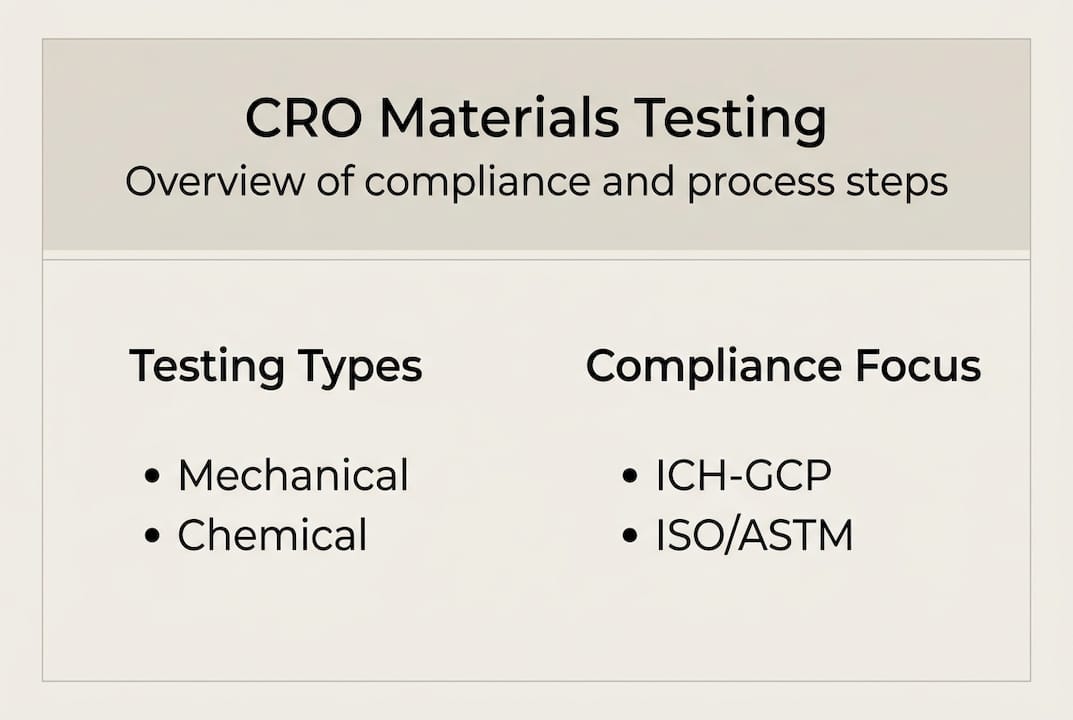
Our spectroscopic analysis services cover the full range of techniques that regulators expect to see in a well-supported submission. CROs apply mechanical, spectroscopic, and chemical analyses including tension, compression, indentation, NMR, Raman, XRD, HPLC, and GC-MS for advanced materials and custom biomechanical simulations.
| Test type | Standard | Application example |
|---|---|---|
| Tensile and compression | ASTM D638, ISO 527 | Polymer implant load bearing |
| Ceramic fracture strength | ASTM C1424 | Dental and orthopedic ceramics |
| Dissolution and release | USP <711>, USP <724> | Tablet and drug-eluting device |
| Elemental impurity | ICH Q3D, USP <232> | Leachables in parenteral devices |
| Surface spectroscopy (XPS, Raman) | ISO 18115 | Coating identity and uniformity |
| Thermal analysis (DSC, TGA) | ASTM E1356, ISO 11357 | Polymer stability and transitions |
Adherence to recognized standards matters beyond technical accuracy. Regulators at FDA and EMA expect test methods to be traceable to ASTM, ISO, or USP references. Submissions that rely on in-house methods without validation history face higher rates of information requests and delays.
Real-world biomedical testing examples include:
- Knee implant motion simulation under cyclic load per ISO 14243
- Tablet dissolution profiling under biorelevant media conditions
- Extractables and leachables screening for polymer-based drug delivery systems
- Surface chemistry mapping of antimicrobial coatings using XPS
Our custom analytical testing, assay design and validation, and method validation services are structured to produce data packages that hold up under regulatory scrutiny.
Pro Tip: Multi-technique approaches, where mechanical data is paired with spectroscopic and chemical evidence, significantly reduce the number of follow-up questions from regulatory reviewers. A single technique rarely tells the complete story.
Dealing with edge cases: Custom tests and nuanced material behaviors
Not every material your team develops has a published ASTM or ISO standard waiting for it. Novel biomaterials, hybrid composites, and next-generation drug delivery platforms often require custom test development before any regulatory data can be generated.
Custom test development is critical for novel materials without standards, and factors like humidity and pressure dramatically affect biomedical product performance. Our custom testing method development workflow follows a structured sequence:
- Scoping: Define the regulatory question the test must answer and identify the material properties most relevant to safety and performance.
- Method design: Select instrumentation, reference materials, and environmental conditions. For temperature-sensitive applications, our high-temperature material testing capabilities extend this to extreme-use scenarios.
- Validation: Demonstrate specificity, linearity, accuracy, precision, and robustness per ICH Q2(R1) or equivalent guidance.
- Documentation: Produce a method validation report formatted for inclusion in regulatory submissions.
Edge-case variables that frequently affect results include:
| Variable | Effect on results |
|---|---|
| Relative humidity | Alters powder flow, compaction, and dissolution |
| Compaction rate | Strain rate sensitivity affects tabletability more than dwell time |
| Porosity | Controls drug release kinetics and mechanical strength |
| Particle size distribution | Influences dissolution rate and content uniformity |
| Temperature cycling | Drives polymer crystallinity changes and coating delamination |
“Roller compaction can reduce granule wetting and dissolution, making early granule dissolution testing essential for Quality by Design process control.” Pharmaceutical compaction research
Static endpoint testing is rarely sufficient for materials that will experience dynamic loading, environmental cycling, or biological exposure. Lifecycle and dynamic testing protocols give regulators the evidence they need to assess real-world performance with confidence.
How to choose the right contract research organization
Selecting a CRO is a strategic decision, not a procurement exercise. The wrong partner can produce data that fails regulatory review, delays your timeline, and increases total project cost. Top CROs are evaluated by service scope, regulatory insight, technical platforms, and past performance.
Key selection criteria include:
- Sector experience: Has the CRO worked on similar device classes, drug types, or material categories? Relevant experience shortens the learning curve and reduces protocol errors.
- Regulatory engagement: Can the CRO demonstrate familiarity with your target agency’s current expectations? Ask for examples of successful submissions or agency correspondence.
- Technical portfolio: Does the CRO’s instrumentation and method library match your project’s analytical needs? Our analytical testing experience spans mechanical, spectroscopic, thermal, and chemical domains.
- Flexibility: Can the CRO scale resources up or down as your project evolves? Rigid service structures often create bottlenecks at critical milestones.
Red flags to watch for during CRO evaluation:
- Proposals that offer identical test panels regardless of your specific material or regulatory target
- Weak or absent documentation of method validation history
- No clear process for handling out-of-specification results or test failures
- Limited experience with the specific standards (ASTM, ISO, USP) relevant to your submission
- Inability to provide prior regulatory submission case studies or client references
Pro Tip: Before signing any agreement, request a sample protocol and a redacted example of a prior regulatory submission package. This single step reveals more about a CRO’s actual capabilities than any capability statement or sales presentation.
A structured onboarding checklist should include: confirming GLP/GMP compliance status, reviewing quality system certifications (ISO 9001:2015 is a baseline), establishing data ownership and confidentiality terms, and agreeing on milestone-based reporting schedules.
Get advanced CRO solutions for compliant materials testing
If your project requires regulatory-ready materials data, we are equipped to support you from protocol design through submission-ready reporting. Our multi-technique testing platform integrates mechanical, spectroscopic, chemical, and microscopy capabilities under one quality system, which means fewer handoffs and more coherent data packages for your regulatory team.
Explore our integrated chemical and microscopy services for surface and bulk characterization, or review our chemical and elemental characterization capabilities for leachables, impurity profiling, and composition verification. For a deeper look at how we approach analytical method selection, our chemical analysis methods resource provides practical context. Contact us to schedule a sample assessment and discuss how we can align our testing capabilities with your specific regulatory pathway.
Frequently asked questions
What distinguishes a materials-focused CRO from a clinical CRO?
A materials-focused CRO specializes in physico-chemical and mechanical testing, method development, and analytical characterization for devices and substances. Clinical CROs focus on trials and regulatory submissions, while materials CROs generate the technical evidence that supports those submissions.
Which test methods are most impactful for regulatory submission?
Multi-technique methods that combine mechanical, spectroscopic, and chemical analyses aligned with ASTM, ISO, or USP standards provide the strongest regulatory evidence and reduce the likelihood of agency information requests.
How do CROs handle projects for new materials lacking standards?
CROs develop custom assays and validate methods against ICH Q2(R1) or equivalent guidance, then simulate use scenarios to generate reliable, defensible data for regulatory acceptance.
Does granule or tablet testing matter more for QbD?
Early granule dissolution testing using USP Apparatus 4 offers better prediction of tablet performance and enables process adjustments before tablet compression, making it the more valuable tool under Quality by Design principles.
Recommended
- Quality & Compliance Support | Materials Metric | R&D Lab
- Regulatory Consulting & Strategic Planning | Materials Metric
- Custom Analytical & Materials Testing | Materials Metric | Lab
- Method Development & Validation Services | Materials Metric
- Drug Testing Terminology Explained: Compliance Matters
- RESEARCH COMPOUNDS POLICY – ElevateSupplements