ICP-MS vs ICP-OES: Which Technique Should You Choose for Elemental Analysis?
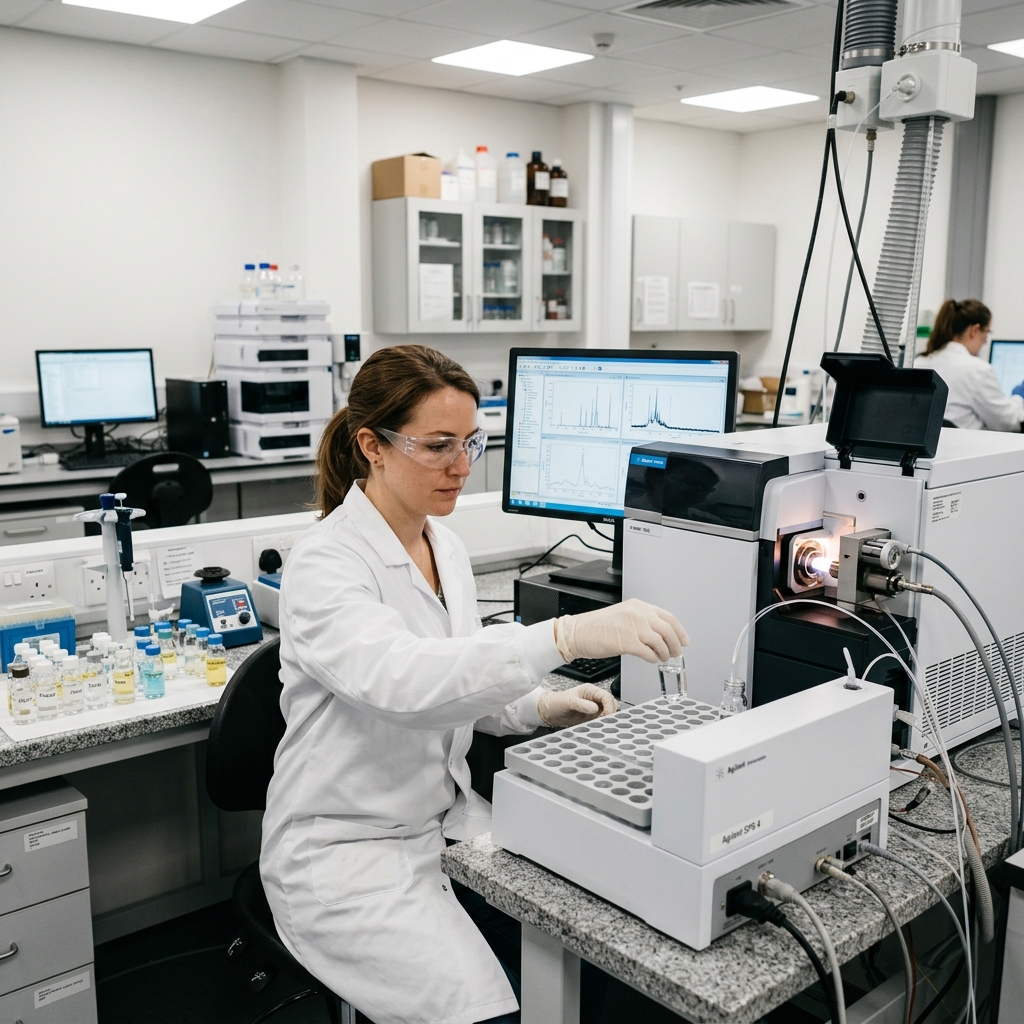
ICP-MS vs ICP-OES are the two most widely used plasma-based techniques for elemental analysis, and the right choice depends primarily on your required detection limits and sample matrix. Furthermore, ICP-MS delivers ultra-trace detection at the parts-per-trillion (ppt) level, while ICP-OES excels at measuring major and minor elements at parts-per-million (ppm) concentrations with greater tolerance for complex matrices. Understanding these differences helps engineers, scientists, and quality managers select the most appropriate method for their specific analytical needs. For more information on how Materials Metric supports elemental testing projects, explore our full range of services.
Both techniques use an inductively coupled plasma (ICP) source to atomize and ionize elements within a sample. However, they differ fundamentally in how they detect those ions. ICP-MS couples the plasma to a mass spectrometer, sorting ions by their mass-to-charge ratio. ICP-OES, by contrast, measures the light emitted by excited atoms as they return to their ground state. Consequently, each instrument has distinct strengths, limitations, and ideal applications.
Choosing between these two methods is rarely straightforward. Furthermore, many laboratories run both techniques in tandem to cover the full concentration range. This guide breaks down every key difference — from sensitivity and cost to regulatory compliance and matrix effects — so you can make a well-informed decision for your next project.
Key Takeaways
- ICP-MS achieves detection limits at the parts-per-trillion (ppt) level; ICP-OES typically works at parts-per-million (ppm) to parts-per-billion (ppb).
- ICP-OES handles high-matrix and high-concentration samples better, with less susceptibility to signal suppression.
- ICP-MS is the preferred technique for regulatory elemental impurity testing under USP General Chapter <232> Elemental Impurities.
- ICP-OES offers lower operating costs and higher sample throughput for routine multi-element screening.
- Many laboratories use both techniques together to cover a wide analytical dynamic range.
- The best choice depends on target elements, required detection limits, sample type, and budget.
ICP-MS vs ICP-OES: A comparison of two plasma-based elemental analysis techniques — inductively coupled plasma mass spectrometry (ICP-MS), which detects ions by mass-to-charge ratio for ultra-trace (ppt-level) sensitivity, and inductively coupled plasma optical emission spectrometry (ICP-OES), which measures atomic emission light for robust, high-throughput analysis at ppm-to-ppb concentrations.
Key fact: ICP-MS is widely recognized as one of the most sensitive elemental analysis techniques available, capable of detecting elements at concentrations several orders of magnitude lower than ICP-OES under standard operating conditions.
What Are ICP-MS and ICP-OES? Core Principles Explained
Before comparing the two techniques, it helps to understand how each one works. Both methods use a high-temperature argon plasma — typically reaching around 6,000–10,000 K — to break down samples into individual atoms and ions. Beyond that shared starting point, however, the detection mechanisms diverge significantly.
How ICP-MS Works
In ICP-MS, the plasma converts sample atoms into positively charged ions. These ions then pass through a series of interface cones into a high-vacuum mass spectrometer. The mass spectrometer separates ions by their mass-to-charge (m/z) ratio, allowing the detector to identify and quantify each element with exceptional precision. This approach enables detection of most elements at ppt concentrations, making it ideal for ultra-trace analysis.
Furthermore, ICP-MS can perform isotope ratio measurements. This capability is highly valuable in geochemistry, nuclear material testing, and provenance studies. Modern instruments also incorporate collision or reaction cells to reduce polyatomic interferences, extending their applicability to complex sample types.
How ICP-OES Works
ICP-OES — also called ICP-AES (atomic emission spectrometry) — works differently. When the plasma excites sample atoms, they emit light at element-specific wavelengths. A spectrometer then measures the intensity of this emitted light. Higher intensity corresponds to higher elemental concentration. This optical measurement approach is inherently robust and tolerates relatively high dissolved-solid concentrations.
Consequently, ICP-OES suits applications where major and minor elements need quantification in complex matrices. For example, alloy composition analysis, wastewater monitoring, and soil characterization frequently rely on ICP-OES. The technique’s wide linear dynamic range — typically spanning five to six orders of magnitude — also makes it highly versatile for routine laboratory work.
Key Hardware Differences
Understanding the hardware helps clarify performance differences. The table below summarizes the core architectural distinctions between the two platforms.
| Feature | ICP-MS | ICP-OES |
|---|---|---|
| Detection method | Mass spectrometry (m/z ratio) | Optical emission spectroscopy |
| Typical detection limits | Sub-ppt to low-ppt | Low-ppb to ppm |
| Isotope measurement | Yes | No |
| Matrix tolerance | Lower (requires more dilution) | Higher (handles complex matrices) |
| Instrument cost | Higher | Lower |
| Operating complexity | Higher | Moderate |
ICP-MS vs ICP-OES: Sensitivity and Detection Limits Compared
Sensitivity is often the first criterion analysts consider when choosing between these two techniques. For most projects, the required detection limit drives the decision more than any other factor. Therefore, understanding where each technique excels — and where it falls short — is essential before selecting a method.
Ultra-Trace Performance of ICP-MS
ICP-MS routinely achieves detection limits in the sub-parts-per-trillion range for many elements. For regulated industries such as pharmaceuticals, medical devices, and environmental monitoring, this sensitivity is frequently required. Specifically, elemental impurity limits under USP General Chapter <232> Elemental Impurities for oral daily dose products are set at levels that often demand ICP-MS sensitivity.
Moreover, ICP-MS can simultaneously screen for over 70 elements in a single run. This multi-element capability, combined with ultra-low detection limits, makes it the gold standard for trace and ultra-trace elemental analysis. Our Chemical & Elemental Characterization service leverages ICP-MS for precisely these high-sensitivity applications.
Detection Limits of ICP-OES
ICP-OES typically achieves detection limits in the low-ppb to high-ppt range, depending on the element and instrument configuration. For many industrial and environmental applications, this level of sensitivity is entirely sufficient. Additionally, ICP-OES performs well when sample concentrations are inherently higher, reducing the need for extensive sample preparation.
By contrast, when target analyte concentrations fall below a few ppb, ICP-OES may not provide the required measurement confidence. In those cases, ICP-MS becomes necessary. Nonetheless, for applications such as alloy grade verification, cement composition, or fertilizer nutrient quantification, ICP-OES delivers excellent results at a lower cost per sample.
Dynamic Range Considerations
Both techniques offer wide linear dynamic ranges, but their optimal zones differ. ICP-OES excels from ppm down to low-ppb concentrations — a range of roughly five to six orders of magnitude. ICP-MS, meanwhile, covers an even wider range, from ppt up to low-ppm levels, though high-concentration samples often require dilution to avoid detector saturation.
Consequently, laboratories analyzing samples with both major and ultra-trace constituents sometimes run ICP-OES for the high-concentration elements and ICP-MS for the trace components. This dual-technique strategy ensures accuracy across the full concentration spectrum. For guidance on selecting the right approach, our team offers Scientific & Technical Consulting to help match technique to application.
ICP-MS vs ICP-OES: Matrix Effects, Interferences, and Sample Preparation
Matrix effects and spectral interferences represent a critical practical difference between these two techniques. Analysts must understand them to design reliable methods and interpret results correctly. In addition, sample preparation strategies differ considerably depending on which instrument you use.
Spectral and Polyatomic Interferences in ICP-MS
ICP-MS faces two main types of interferences: isobaric overlaps and polyatomic interferences. Isobaric overlaps occur when two elements share the same nominal mass — for example, 40Ar16O+ interferes with 56Fe+. Polyatomic interferences arise from plasma gas species, solvent molecules, and matrix components combining to form ions at the same m/z as the analyte.
Fortunately, modern ICP-MS instruments equipped with collision-reaction cells (CRC) or dynamic reaction cells (DRC) largely eliminate these interferences. Helium collision mode, for instance, effectively removes common polyatomic species. Furthermore, high-resolution sector-field ICP-MS instruments can resolve isobaric overlaps mass-spectrometrically, providing an additional layer of confidence for complex samples.
Spectral Interferences in ICP-OES
ICP-OES encounters spectral line overlaps, where emission lines from different elements coincide at similar wavelengths. High-resolution spectrometers and careful wavelength selection minimize this issue. Moreover, software algorithms apply interelement correction (IEC) factors to compensate for known overlaps, improving accuracy in multi-element analyses.
Matrix-induced signal suppression or enhancement also affects ICP-OES, particularly at high dissolved-solid concentrations. However, internal standardization and matrix-matched calibration effectively control this. Overall, ICP-OES tolerates higher total dissolved solids (TDS) — typically up to 2–5% — compared with ICP-MS, which generally requires samples below 0.2% TDS to avoid cone clogging and signal instability.
Sample Preparation Requirements
Sample preparation is often more demanding for ICP-MS than for ICP-OES. For ICP-MS, acid digestion must achieve high purity levels, since contamination at the ppt level can compromise results. Therefore, laboratories use ultra-pure acids, class-100 clean rooms, and trace-metal-grade reagents when preparing samples for ICP-MS analysis.
ICP-OES sample preparation, by comparison, is generally less stringent. Standard laboratory-grade reagents and conventional fume hoods typically suffice for ppm-level work. Additionally, some solid samples can be analyzed by ICP-OES after simple dissolution, whereas ICP-MS may require more rigorous matrix removal steps. For complex or regulated samples, our Chemical Purity & Contaminant Screening service incorporates appropriate preparation protocols for both techniques. Teams seeking structured method development should also review our Method Development & Validation capabilities, which ensure preparation workflows meet regulatory and scientific standards.
For a broader look at how elemental analysis fits into materials characterization, our related article on trace metal contamination provides essential context on contamination sources and their analytical implications.
Regulatory Compliance: Where ICP-MS vs ICP-OES Matters Most
Regulatory frameworks often dictate which technique laboratories must use. Therefore, understanding the compliance landscape helps quality managers and regulatory professionals make informed decisions. Both ICP-MS and ICP-OES appear in major international standards, but their roles differ significantly.
Pharmaceutical and USP Requirements
The pharmaceutical industry relies heavily on ICP-MS for elemental impurity testing. USP Elemental Impurities guidelines under General Chapter <232> establish permitted daily exposure (PDE) limits for 24 elements. Many of these limits fall in the sub-ppm range, requiring ICP-MS sensitivity to achieve reliable quantification. Consequently, ICP-MS has become the standard technique for drug product release testing in regulated pharmaceutical environments.
ICP-OES, however, still plays a supporting role. Specifically, it suits validation studies, raw material screening at higher concentrations, and excipient characterization. Furthermore, some laboratories use ICP-OES as a rapid pre-screen before committing samples to full ICP-MS analysis. Our Chemical & Analytical Testing service supports both regulatory pathways with fully validated methods.
Medical Devices and ISO 10993-18
Medical device manufacturers must characterize extractable and leachable elements under ISO 10993-18 for chemical characterization. This standard requires identification and quantification of elements at toxicologically relevant concentrations, which frequently demands ICP-MS sensitivity. For implantable and long-contact devices, trace-level elemental data directly informs biocompatibility risk assessments.
Notably, our article on chemical characterization vs biocompatibility explains how elemental data connects to broader safety evaluations. Additionally, our Biocompatibility & Toxicity Testing team integrates ICP-MS results directly into toxicological risk assessments for device submissions.
Environmental and Industrial Compliance
Environmental monitoring programs — including EPA Methods 200.7 and 6020B — accept both ICP-OES and ICP-MS, depending on the target analytes and required detection limits. For routine water quality monitoring, ICP-OES often provides sufficient sensitivity at lower cost. By contrast, soil and sediment samples requiring ultra-trace metal analysis typically demand ICP-MS. Moreover, industries regulated under REACH, RoHS, or ELV directives increasingly turn to ICP-MS to confirm compliance with restricted substance limits at trace levels.
Industry-Specific Applications of ICP-MS and ICP-OES
Beyond regulatory compliance, each technique finds a natural home in specific industries. Understanding these application patterns helps procurement teams and engineers plan analytical programs more effectively. Furthermore, knowing which technique your sector favors can streamline supplier selection and method transfer activities.
Aerospace, Alloys, and Advanced Materials
Aerospace manufacturers rely on precise elemental composition data to verify alloy grades and detect harmful impurities. ICP-OES excels here, measuring major alloying elements such as chromium, nickel, and molybdenum at high concentrations with excellent accuracy. Additionally, it handles the digested matrices of superalloys and titanium components without the extensive dilution that ICP-MS requires.
However, trace contaminant detection in high-purity materials — such as aerospace-grade aluminum or specialty ceramics — often requires ICP-MS sensitivity. Elements like bismuth, thallium, and lead at ppt levels can affect material performance. Therefore, many aerospace laboratories maintain both instruments. For a complementary surface-level view of elemental distribution, XRF Analysis offers rapid, non-destructive screening before solution-based ICP analysis.
Semiconductor and Electronics Manufacturing
The semiconductor industry demands some of the lowest elemental detection limits of any sector. Trace metal contamination in process chemicals, ultra-pure water, and silicon substrates can destroy device yields. Consequently, ICP-MS dominates semiconductor applications, where detection limits at the sub-ppt level are routine requirements.
Our related article on trace metal contamination covers contamination mechanisms and analytical strategies in detail. In this sector, ICP-OES plays a limited role, primarily for higher-concentration process bath monitoring where ppm-level data suffices. For electronic materials requiring isotopic purity verification, ICP-MS isotope ratio measurement adds unique value unavailable from any optical technique.
Food, Nutrition, and Consumer Products
Food safety testing requires quantification of both essential nutrients and toxic elements across a wide concentration range. Selenium, iodine, and zinc occur at nutritionally relevant ppb-to-ppm levels — well within ICP-OES capability. By contrast, lead, cadmium, arsenic, and mercury in food matrices often require ICP-MS sensitivity to meet regulatory action levels.
Additionally, speciation analysis — determining the chemical form of an element, not just its total concentration — increasingly uses ICP-MS coupled with liquid chromatography (LC-ICP-MS). This combination distinguishes toxic inorganic arsenic from less harmful organic forms, a distinction with major regulatory implications. Research published through ScienceDirect continues to advance speciation methodologies for food and environmental matrices.
Quality Assurance and Best Practices for ICP Analysis
Rigorous quality assurance ensures that ICP-MS and ICP-OES results are reliable, reproducible, and defensible. Both techniques require systematic quality controls, but the specific protocols differ based on their sensitivity levels and potential interferences. Overall, laboratories that invest in robust QA programs deliver more trustworthy data and fewer costly repeat analyses.
Calibration and Internal Standards
Accurate calibration is foundational to both ICP techniques. Multi-point external calibration curves, prepared in matrix-matched solutions, establish the concentration-response relationship. Furthermore, internal standards — elements added at known concentrations to every sample — correct for instrument drift and matrix-induced signal changes. For ICP-MS, analysts typically select internal standards at masses distributed across the measurable range, such as scandium, indium, and bismuth.
ICP-OES internal standards serve a similar drift-correction purpose. However, they also compensate for physical interferences such as viscosity differences between samples and calibrants. Consequently, rigorous internal standard selection is a critical step in method development for both techniques. Our Method Development & Validation team builds these controls into every method from the outset.
Method Validation and Uncertainty
Validated methods provide documented evidence that an analytical procedure measures what it claims to measure. Key validation parameters include limit of detection (LOD), limit of quantitation (LOQ), linearity, accuracy, precision, and selectivity. Additionally, measurement uncertainty estimation — increasingly required by accreditation bodies such as ISO/IEC 17025 — quantifies the confidence interval around each reported result.
For ICP-MS, validation must specifically address polyatomic interference corrections and isotope selection rationale. For ICP-OES, validation documents the wavelength selection criteria and interelement correction factors. Both techniques benefit from participation in proficiency testing schemes, which independently verify laboratory performance against peer laboratories. Our Chemical & Elemental Characterization service operates under a quality management framework aligned with these best practices.
Complementary Techniques and Workflow Integration
ICP-MS and ICP-OES rarely operate in isolation within modern analytical laboratories. They integrate with sample preparation systems, chromatographic separations, and other characterization techniques. For instance, microwave digestion systems automate acid dissolution with precise temperature and pressure control, reducing contamination risk and improving sample throughput for both instruments.
Moreover, elemental data from ICP analysis gains additional context when combined with structural and surface techniques. SEM Analysis identifies particle morphology and elemental distribution at the microscale. Meanwhile, XPS Analysis reveals surface oxidation states and chemical bonding — information that solution-based ICP techniques cannot provide. Integrating these complementary approaches delivers a more complete picture of material composition and quality. For pharmaceutical applications specifically, teams handling extractables and leachables testing should also review our article on extractables vs leachables to understand how elemental data fits into the broader E&L framework. Our Scientific & Technical Consulting team regularly designs integrated, multi-technique workflows tailored to complex project requirements.
Quick note: When your project spans both high-concentration major elements and ultra-trace impurities, running ICP-OES and ICP-MS in parallel — rather than choosing one — often delivers the most complete and cost-effective analytical picture.
Frequently Asked Questions About ICP-MS vs ICP-OES
What is the main difference between ICP-MS and ICP-OES?
The primary difference lies in the detection mechanism and resulting sensitivity. ICP-MS detects ions by mass-to-charge ratio, achieving ppt-level detection limits. ICP-OES measures emitted light from excited atoms, typically reaching low-ppb to ppm sensitivity. Consequently, ICP-MS suits ultra-trace applications, while ICP-OES serves routine multi-element analysis at higher concentrations.
Which technique is better for pharmaceutical elemental impurity testing?
ICP-MS is generally the preferred technique for pharmaceutical elemental impurity testing under USP Elemental Impurities guidelines. Many permitted daily exposure limits fall below levels that ICP-OES can reliably quantify. Therefore, most contract testing laboratories use ICP-MS as the primary instrument for USP <232>/<233> compliance work. For context on how this testing is structured, our article on USP 232 and 233 testing provides a comprehensive overview.
Can ICP-OES replace ICP-MS for environmental testing?
In many environmental monitoring scenarios, ICP-OES provides sufficient sensitivity and lower operating costs. However, for ultra-trace contaminants — such as mercury at ng/L levels in drinking water — ICP-MS remains necessary. Furthermore, regulatory methods for certain matrices specifically require ICP-MS detection limits. The choice ultimately depends on the target analytes and their regulatory thresholds.
How do matrix effects differ between ICP-MS and ICP-OES?
ICP-MS is more susceptible to matrix-related signal suppression, particularly from high dissolved-solid concentrations. Samples typically require dilution to below 0.2% total dissolved solids for ICP-MS. By comparison, ICP-OES tolerates TDS levels up to 2–5%, handling complex industrial and environmental matrices with fewer preparation steps. Both techniques use internal standards to mitigate residual matrix effects.
Is ICP-MS more expensive to operate than ICP-OES?
Yes — ICP-MS generally carries higher capital costs, maintenance requirements, and per-sample costs than ICP-OES. The high-vacuum mass spectrometer, interface cones, and collision-reaction cell components require more frequent servicing. Additionally, ultra-pure reagents and clean-room sample preparation increase consumable costs. ICP-OES, by contrast, offers lower operating costs and greater robustness for high-throughput routine work.
Can both techniques analyze solid samples directly?
Standard solution-based ICP-MS and ICP-OES require liquid samples prepared by acid digestion or dissolution. However, laser ablation ICP-MS (LA-ICP-MS) enables direct solid sampling with minimal preparation, providing spatially resolved elemental mapping of solid materials. Similarly, slurry sampling extends ICP-OES to fine particulate solids. For most regulatory and quality applications, solution digestion remains the standard approach because it ensures complete matrix dissolution and accurate quantification.
Conclusion
Choosing between ICP-MS vs ICP-OES requires careful consideration of detection limits, sample matrix, regulatory requirements, and budget. ICP-MS delivers unmatched sensitivity for ultra-trace and regulated elemental impurity testing. Meanwhile, ICP-OES provides a robust, cost-effective solution for major and minor element quantification across diverse industrial and environmental applications. In many situations, using both techniques together offers the most complete analytical solution.
Understanding these trade-offs upfront saves time, reduces costs, and ensures your analytical data meets the required quality standards. Furthermore, integrating ICP analysis with complementary techniques — such as XRF Analysis, SEM Analysis, or FTIR Analysis — delivers a comprehensive characterization profile that supports confident decision-making.
At Materials Metric, our team combines deep technical expertise with fully validated ICP-MS and ICP-OES capabilities to support projects across pharmaceuticals, medical devices, aerospace, semiconductors, and environmental sectors. Whether you need a single-element screen or a full multi-element impurity profile, we tailor our approach to your specific requirements. To discuss your project and get expert guidance on the right analytical strategy, contact Materials Metric today.
Related Posts from Materials Metric
Explore more insights from our team of materials scientists and analytical experts: