
TL;DR:
- Biocompatibility in dental materials means performing its function without harming the patient, on a spectrum.
- Assessment involves layered laboratory tests like cytotoxicity, apoptosis, and differentiation assays, with variability across studies.
- Laboratory results should be integrated with clinical context and patient factors, as they don’t guarantee real-world biocompatibility.
Biocompatibility is one of the most cited properties in dental materials science, yet it remains one of the least consistently defined. Clinicians and researchers routinely encounter product claims backed by studies that differ in cell lines, exposure times, and extraction methods, making meaningful comparison nearly impossible. A heterogeneous methodology across in vitro studies means that even well-intentioned literature reviews can yield conflicting signals. For dental professionals navigating material selection, regulatory submissions, or research design, this inconsistency is not a minor inconvenience. It is a patient safety issue. This guide clarifies definitions, reviews the evidence, and connects laboratory findings to clinical and regulatory realities.
Table of Contents
- What does ‘biocompatibility’ mean in dental materials?
- How biocompatibility is measured: Methods, assays, and practical challenges
- Biocompatibility evidence: What studies show about modern dental materials
- Clinical and regulatory realities: Factors that affect real-world biocompatibility
- Why the conventional understanding of dental material biocompatibility falls short
- How Materials Metric supports dental material biocompatibility and compliance
- Frequently asked questions
Key Takeaways
| Point | Details |
|---|---|
| Definitions matter | Biocompatibility is not the same as bioactivity; always check definitions and claims. |
| Testing complexities | Laboratory biocompatibility is highly method-dependent, and assay choices influence outcomes. |
| CAD/CAM advances | Most CAD/CAM dental materials offer equal or reduced toxicity compared to traditional options. |
| Clinical context counts | Real-world results depend on patient, technique, and regulatory compliance—not just lab tests. |
What does ‘biocompatibility’ mean in dental materials?
With this context of confusion, let’s clarify our core terms. Biocompatibility, in its most practical sense, describes a material’s ability to perform its intended function without inducing harmful local or systemic responses in the patient. It is not a binary property. It exists on a spectrum and depends heavily on the clinical context, the patient’s biology, and the duration of exposure.
Key factors that determine whether a dental material qualifies as biocompatible include:
- Cytotoxicity: Does the material or its degradation products harm cells at clinically relevant concentrations?
- Immunogenicity: Does it trigger an immune response, either local or systemic?
- Long-term stability: Does the material maintain its chemical integrity over time, or does it leach compounds progressively?
- Tissue integration: For implants and restorations in contact with soft tissue, does the material support normal tissue behavior?
One critical distinction that the field continues to debate is the difference between bioactive and biocompatible. A bioactive material interacts with biological tissues in a purposeful way, such as releasing fluoride or stimulating remineralization. A biocompatible material simply does not cause harm. These are not the same thing, and a material can be bioactive without being fully biocompatible under all conditions, or vice versa. Conflating the two in clinical decision-making is a common and consequential error.
The challenge is compounded by the absence of a universal definition or a standardized assessment duration. How long must a material be tested to confirm long-term safety? Weeks? Months? Years? There is no consensus, and this gap creates room for selective reporting in product literature. Our related publications reflect the ongoing scientific dialogue around these definitional challenges.
Pro Tip: When reviewing a manufacturer’s biocompatibility claim, always ask whether the supporting data comes from independent third-party testing or internal studies. The source of evidence matters as much as the result.
How biocompatibility is measured: Methods, assays, and practical challenges
Once we know what biocompatibility means, the next question is: how do we actually measure it? The short answer is that there is no single test. Biocompatibility assessment involves a layered approach, starting with rapid cytotoxicity screens and progressing to more sophisticated biological assays.
Standard cytotoxicity assays, such as MTT, LDH, and neutral red uptake, are the most common entry points. They are fast, cost-effective, and reproducible under controlled conditions. But they only tell part of the story. Advanced assays now include:
- Differentiation marker analysis to assess whether materials affect stem cell behavior
- Live/dead imaging to visualize cell membrane integrity
- Migration and scratch assays to evaluate wound healing responses
- Apoptosis quantification via flow cytometry
A typical biocompatibility assessment workflow follows this sequence:
- Prepare material extracts under standardized conditions (ISO 10993-12)
- Expose target cell lines to extract dilutions for defined time periods
- Run primary cytotoxicity assay (e.g., MTT or LDH)
- Apply secondary assays for apoptosis, oxidative stress, or differentiation
- Analyze dose-response relationships and compare against controls
- Interpret results in the context of clinical exposure levels
| Assay type | Primary output | Typical duration |
|---|---|---|
| MTT/LDH cytotoxicity | Cell viability percentage | 24 to 72 hours |
| Apoptosis (flow cytometry) | Apoptotic cell fraction | 24 to 48 hours |
| Migration/scratch assay | Wound closure rate | 12 to 48 hours |
| Differentiation markers | Protein or gene expression | Days to weeks |
Current evidence spans cell viability and apoptosis outputs alongside standardized cytotoxicity and biological assays, but direct comparison between studies is problematic. Differences in extraction ratios, solvent choice, cell passage number, and incubation conditions all introduce variability. Our biocompatibility testing services address these variables through rigorous protocol design, and our cytotoxicity assays are structured to generate reproducible, regulatory-grade data.
“Variability in extraction conditions and assay formats means that results from different laboratories are rarely directly comparable, even when testing the same material.”
Pro Tip: Relying on a single cytotoxicity assay is insufficient for regulatory submissions. Combine standard viability assays with at least one mechanistic endpoint, such as apoptosis or oxidative stress, to build a defensible safety profile. Our toxicity testing services are designed with this layered approach in mind.
Biocompatibility evidence: What studies show about modern dental materials
Having outlined how lab tests are done, we turn to what the evidence reveals about today’s actual dental materials. Systematic reviews of in vitro studies provide the clearest aggregate picture, though they come with important caveats.
For CAD/CAM milled restorative materials, the current body of evidence is cautiously reassuring. CAD/CAM milled materials generally show equal or lower in vitro toxicity compared to conventionally fabricated alternatives. This finding holds across ceramics, polymer-infiltrated ceramic networks, and resin-based CAD/CAM blocks. However, the methodological heterogeneity across studies means this conclusion should be treated as a directional signal, not a definitive safety certification.
| Material category | Typical toxicity finding | Key consideration |
|---|---|---|
| CAD/CAM ceramics | Low to negligible cytotoxicity | Surface treatment affects ion release |
| Resin composites | Moderate, monomer-dependent | Degree of conversion is critical |
| Dental amalgam | Variable, mercury-related concerns | Long-term leaching remains debated |
| Titanium alloys | Generally low cytotoxicity | Alloy composition matters significantly |
| Zirconia | Low cytotoxicity | Sintering parameters influence outcomes |
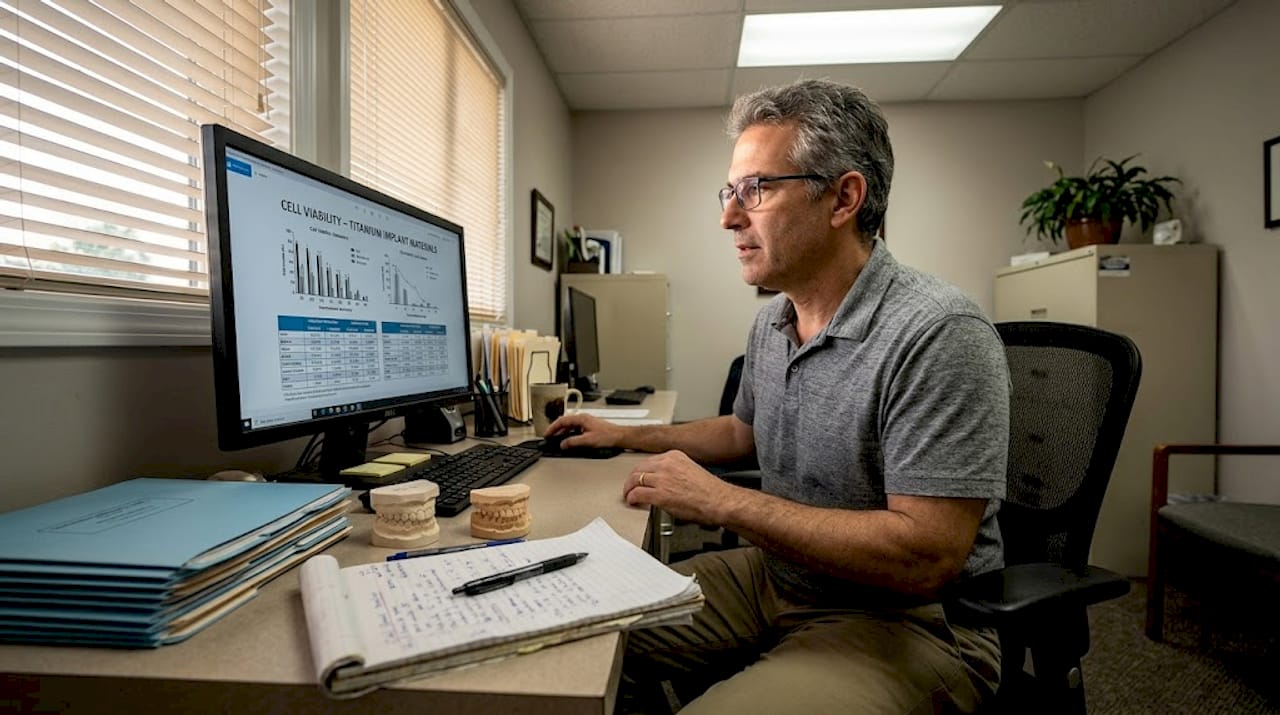
For implant materials, a recent in vitro study reported no cytotoxic effects for specific titanium alloys, with cell viability and migration rates comparable to controls. This supports the continued use of titanium-based implants but also highlights that alloy composition, surface topography, and processing conditions are not interchangeable variables. Small changes in alloy formulation can produce measurable differences in biological response.
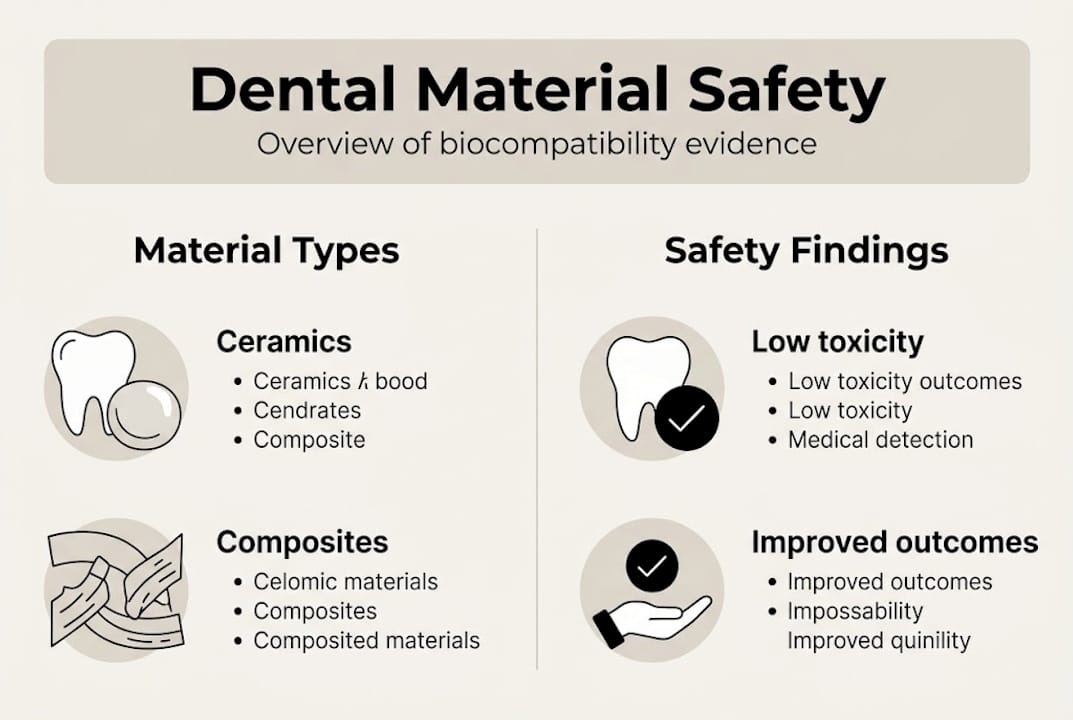
The aggregate takeaway is that modern dental materials have generally improved in their safety profiles, but the evidence base is uneven. Researchers and clinicians working on implant material evaluation need to account for material-specific variables rather than applying category-level conclusions to individual products.
Clinical and regulatory realities: Factors that affect real-world biocompatibility
While lab results matter, translating evidence to the dental chair means grappling with clinical complexity and regulatory requirements. A material that performs well in a controlled in vitro environment may behave differently once it is placed in a patient’s mouth, where temperature fluctuates, pH shifts, and microbial biofilms form.
Factors that influence real-world biocompatibility outcomes include:
- Patient biology: Immune status, genetic polymorphisms, and existing sensitivities affect how individuals respond to the same material
- Oral hygiene: Biofilm accumulation and pH changes from diet accelerate material degradation and ion release
- Restoration context: Proximity to pulp tissue, contact with gingival margins, and occlusal load all affect material behavior
- Clinical technique: Mixing ratios, curing times, and surface finishing directly influence the final material properties
- Local regulation: Different jurisdictions impose different requirements for pre-market biocompatibility data
Material choice, operator technique, and patient context interact in ways that make direct comparison of clinical outcomes challenging, even when the same material is used across different settings.
“Restorative outcomes are multifactorial. A material’s in vitro profile is one input among many, not a guarantee of clinical performance.”
This is particularly relevant for regulatory submissions. Agencies require evidence that is robust, reproducible, and relevant to the intended clinical use. A study conducted under idealized laboratory conditions may not satisfy reviewers if it fails to address clinically plausible exposure scenarios. Our medical compliance guide outlines how to structure evidence packages that meet these expectations, and our extractables and leachables studies provide the chemical characterization data that regulators increasingly require alongside biological testing.
The core takeaway here is that biocompatibility is not a property that a material possesses in isolation. It is a relationship between the material, the patient, and the clinical environment.
Why the conventional understanding of dental material biocompatibility falls short
Ultimately, what does all this mean for you as a clinician or researcher? Our view is that the field has developed a false sense of security around the term “biocompatible.” When a product carries that label, it is tempting to treat the question as settled. It rarely is.
Standard testing regimes are designed for efficiency and regulatory throughput, not for capturing patient-specific nuances. A material tested on a single fibroblast cell line under standardized extraction conditions tells you something useful, but it does not tell you how that material will behave in a patient with a compromised immune system, a history of metal sensitivity, or aggressive bruxism.
Real-world outcomes depend on many external factors not always controlled in studies. Marketing language often amplifies the positive findings while minimizing the methodological limitations. As researchers and clinicians, the responsibility falls on us to interrogate the evidence rather than accept it at face value.
“Robust clinical outcomes come from more than materials. They require technique, context, and ongoing research.”
We advocate for integrating patient history, clinical conditions, and material science into every selection decision. The most defensible choices are those grounded in case-specific evaluation, not category-level assumptions. Our advanced dental testing capabilities are built to support exactly this kind of rigorous, individualized approach.
Pro Tip: Treat biocompatibility data as a starting point for material selection, not an endpoint. Layer it with clinical experience, patient history, and regulatory context before making a final decision.
How Materials Metric supports dental material biocompatibility and compliance
To translate insights into action, here’s how Materials Metric can support your biocompatibility workflow.
We provide specialized analytical and testing services designed for dental material developers, researchers, and regulatory teams who need precise, reproducible, and defensible data. From cytotoxicity screening to extractables characterization and regulatory package preparation, our capabilities are aligned with ISO 10993 and GLP standards. Our biocompatibility compliance guide is a practical resource for teams building submission-ready evidence. For a broader view of how analytical data supports compliance decisions, our analytical testing overview covers method selection and validation strategy. We also offer advanced material characterization to support product development at every stage. Contact us to discuss a testing plan tailored to your materials and regulatory pathway.
Frequently asked questions
What is the difference between bioactivity and biocompatibility in dental materials?
Bioactive is distinct from biocompatible, and the definitions are still debated. Bioactivity refers to a material’s ability to interact beneficially with biological tissues, while biocompatibility means the material does not harm tissues; the two terms are not interchangeable.
Why do biocompatibility test results vary between studies?
Variability comes from differences in cell lines, extraction conditions, assay types, and exposure durations, making direct comparisons unreliable. In vitro test heterogeneity makes between-study comparison difficult, which is why protocol standardization is essential.
Are CAD/CAM dental materials safer than conventional alternatives?
Most modern CAD/CAM dental restorative materials show equal or lower in vitro toxicity compared to conventionally fabricated materials, based on systematic reviews. The majority of reviewed studies indicated CAD/CAM milled materials generally exhibited lower toxicity, though methodological variation limits definitive conclusions.
What factors in the clinic affect material biocompatibility outcomes?
Material choice interacts with technique and patient factors in ways that in vitro studies cannot fully capture. Patient-specific biology, clinical technique, oral environment, and material handling all play crucial roles in real-world outcomes.