Key Takeaways
- An FDA chemical characterization review evaluates the chemical identity, purity, and safety of materials used in medical devices and pharmaceutical products.
- Regulatory frameworks — including ISO 10993-18 Chemical Characterization and FDA guidance — define clear requirements for manufacturers.
- Extractables and leachables (E&L) studies are a core component of FDA submissions for drug-contact and device materials.
- Elemental impurity testing under USP General Chapter <232> Elemental Impurities is mandatory for many pharmaceutical products.
- Early-stage chemical characterization reduces late-cycle regulatory risk and accelerates time to market.
- Partnering with an accredited laboratory ensures data quality, method validity, and FDA submission readiness.
What Is an FDA Chemical Characterization Review?
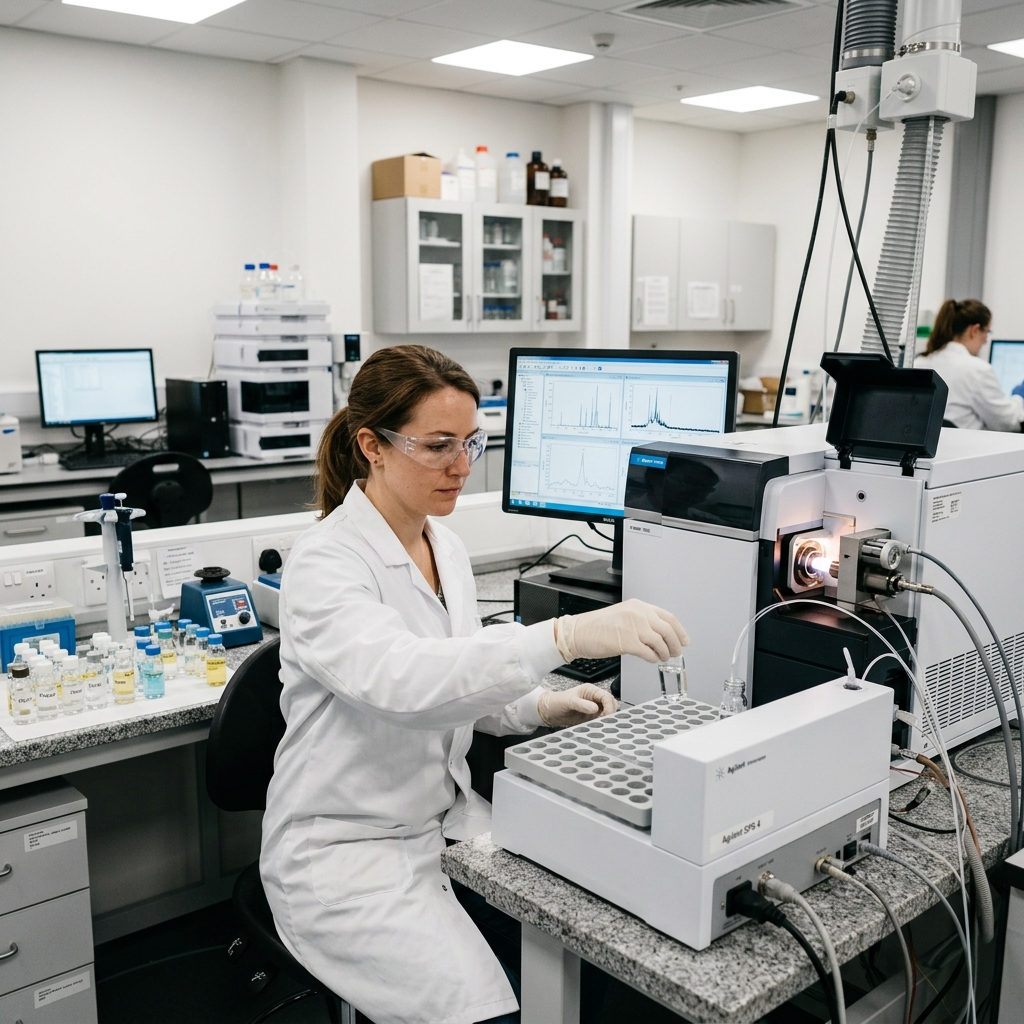
A FDA chemical characterization review is the formal regulatory process by which the U.S. Food and Drug Administration evaluates chemical data submitted by manufacturers of medical devices, pharmaceutical products, and combination products. At Materials Metric, we help companies build and defend these data packages every day. Ultimately, understanding what the FDA expects — and why — is the first step toward a successful submission.
Chemical characterization means systematically identifying and quantifying the chemical entities present in a material or product. Specifically, these entities include raw material constituents, processing aids, degradation products, and potential extractables. Consequently, the FDA uses this data to assess patient safety risk before granting market authorization.
Furthermore, the scope of an FDA chemical characterization review extends across product categories. Medical devices, drug-device combination products, pharmaceutical packaging, and biologics container-closure systems all fall under characterization requirements. Therefore, manufacturers across multiple industries must understand and apply these principles.
Why the FDA Prioritizes Chemical Characterization
Patient safety is the FDA’s primary mandate. Chemical substances that migrate from device materials or pharmaceutical packaging into the body can cause toxicological harm. As a result, the agency requires robust chemical data before approving any product with patient-contact materials.
Moreover, regulatory submissions that lack rigorous chemical characterization face deficiency letters, clinical holds, or outright rejection. These outcomes cost manufacturers time and money. In addition, they delay patient access to potentially life-saving products. Proactive characterization prevents these outcomes.
Key Regulatory Frameworks Governing FDA Review
Several overlapping frameworks govern what the FDA expects in a chemical characterization submission. The most critical include:
- ISO 10993-18: Defines the chemical characterization process for medical device materials, including risk-based analytical approaches.
- FDA Guidance on Use of International Standard ISO 10993-1: Clarifies how the FDA interprets and applies ISO standards during device review.
- ICH Q3C, Q3D: Cover residual solvents and elemental impurities in pharmaceutical products, respectively.
- USP <232> / <233>: Provide limits and test methods for elemental impurities in drug products.
- FDA Guidance on Extractables and Leachables: Outlines E&L study expectations for drug containers and delivery systems.
Understanding which framework applies to your product category is essential. However, most submissions require elements from more than one guideline. Therefore, an integrated analytical strategy is always more effective than a siloed approach.
The FDA Chemical Characterization Review Process: Step by Step
The FDA chemical characterization review follows a structured, risk-based workflow. Manufacturers must plan this workflow carefully from the earliest design stage. Skipping steps or providing incomplete data are the most common causes of FDA deficiency letters in this area.
Step 1 — Material Identification and Risk Assessment
Every characterization study begins with a full inventory of materials used in the product. Notably, this includes polymers, metals, adhesives, coatings, lubricants, and colorants. Each material carries a unique chemical profile and a unique risk level based on patient contact duration and contact area.
Specifically, the FDA and ISO 10993-18 classify patient contact into three categories: limited (under 24 hours), prolonged (24 hours to 30 days), and permanent (over 30 days). Higher contact duration demands more exhaustive characterization. As a result, implantable devices require far more rigorous analysis than short-term external contact products.
Risk assessment at this stage also considers the biological endpoints of concern. These include cytotoxicity, sensitization, irritation, systemic toxicity, and carcinogenicity. Identifying relevant endpoints early helps analysts select the right analytical methods. Our Biocompatibility & Toxicity Testing service integrates seamlessly with chemical characterization at this stage.
Step 2 — Analytical Testing and Chemical Identification
After completing the risk assessment, laboratories perform the actual chemical testing. This phase involves identifying all chemical entities present above analytically relevant thresholds. Analysts use a suite of complementary techniques to achieve comprehensive coverage.
Common analytical techniques include:
- GC-MS (Gas Chromatography-Mass Spectrometry): Identifies volatile and semi-volatile organic compounds.
- LC-MS/MS (Liquid Chromatography-Tandem Mass Spectrometry): Detects non-volatile and polar extractables.
- ICP-MS (Inductively Coupled Plasma-Mass Spectrometry): Quantifies elemental impurities with parts-per-billion sensitivity.
- FTIR Spectroscopy: Confirms polymer identity and detects surface contaminants. See our FTIR Analysis service for details.
- XRD Analysis: Characterizes crystalline phases and inorganic compounds. Our XRD Analysis service supports this need.
- NMR (Nuclear Magnetic Resonance): Provides structural confirmation for unknown organic compounds.
Furthermore, extraction conditions must simulate real-world use. Analysts select solvents, temperatures, and contact times that reflect the worst-case clinical scenario. This approach ensures that the study captures all chemicals a patient could realistically encounter.
Step 3 — Quantification and Threshold Evaluation
Identifying a chemical is only half the task. Quantification determines whether detected substances exceed safety-based thresholds. The FDA and supporting guidance documents define several key thresholds:
| Threshold Type | Definition | Action Required |
|---|---|---|
| Analytical Evaluation Threshold (AET) | Minimum level requiring chemical identification | Identify all compounds above AET |
| Qualification Threshold (QT) | Level above which toxicological qualification is needed | Conduct toxicological risk assessment |
| Reporting Threshold (RT) | Level above which reporting in submission is required | Report in regulatory dossier |
| Toxicological Concern Threshold (TTC) | Exposure level below which toxicological risk is negligible | May not require full toxicological assessment |
Substances detected above the Qualification Threshold require a formal toxicological risk assessment. Consequently, this assessment becomes a key document in the FDA chemical characterization review submission. Our Chemical & Elemental Characterization service supports full quantification workflows aligned with these thresholds.
The Core of FDA Chemical Characterization Review: Extractables and Leachables
Extractables and leachables (E&L) studies represent the most technically demanding aspect of any FDA chemical characterization review. These extractables are chemicals that migrate from a material under controlled, often aggressive, laboratory conditions. By comparison, leachables are the subset of extractables that actually migrate into a drug product or patient under normal use conditions.
The distinction matters enormously. Extractables studies identify the universe of possible migrants. Leachables studies confirm which of those migrants actually appear in the final product or clinical environment. Therefore, both study types are typically required for a complete FDA submission.
Designing a Compliant E&L Study
Designing an E&L study requires careful selection of extraction solvents. Analysts typically use a polarity range — from aqueous to non-polar organic solvents — to capture chemicals with diverse solubility profiles. For example, common solvents include water, ethanol, isopropanol, and hexane.
In addition, extraction temperature and time must reflect worst-case clinical use. For example, a device used at body temperature for 30 days requires extraction conditions that simulate or exceed those parameters. Accelerated extraction protocols use elevated temperatures to condense long-duration exposure into shorter study timelines.
Moreover, analysts must validate the extraction method before relying on it for regulatory submission. Method validation confirms that the procedure is accurate, precise, specific, and reproducible. Our Method Development & Validation service provides fully documented validation packages that meet FDA and ICH expectations.
Analytical Techniques for E&L Studies
Comprehensive E&L studies use multiple orthogonal analytical techniques. No single method covers all chemical classes. Therefore, laboratories combine volatile organic analysis (GC-MS), non-volatile organic analysis (LC-MS), and elemental analysis (ICP-MS) to achieve full chemical coverage.
For polymer-based materials, FTIR Analysis confirms base polymer identity. This step ensures that no material substitution has occurred and that the correct chemical profile is being assessed. Furthermore, SEM Analysis can reveal surface morphology and particulate contamination that may not appear in solution-based studies.
Additionally, DSC Testing characterizes thermal transitions in polymer materials. These transitions can indicate the presence of plasticizers, additives, or processing residues that may subsequently leach. Combining thermal and chemical analysis gives a fuller picture of material behavior.
Quick Note: The FDA increasingly expects E&L data to be generated using methods validated under internationally recognized analytical standards. Unvalidated or legacy methods often trigger FDA information requests (IRs) during review. Always confirm method validation status before finalizing your study plan.
Leachables Confirmation and Safety Qualification
Once extractables are identified and quantified, scientists design a leachables confirmation study. Specifically, this study analyzes actual drug product or device eluates under simulated use conditions. Results confirm which extractables become real-world leachables.
Each identified leachable above the Qualification Threshold then undergoes a toxicological safety assessment. Toxicologists assign a Permitted Daily Exposure (PDE) or apply a Tolerable Intake (TI) value from established databases. Consequently, this process determines whether the detected leachable poses an unacceptable patient risk.
For complex or novel chemicals without established safety data, manufacturers may need to commission targeted toxicology studies. Research from PubMed Central – Trace Metals Review and peer-reviewed toxicology databases supports these assessments. Our Scientific & Technical Consulting team can guide manufacturers through this process efficiently.
Elemental Impurity Testing in FDA Chemical Characterization Review
Elemental impurity testing is a mandatory pillar of the FDA chemical characterization review for pharmaceutical products. Heavy metals and other elemental contaminants can accumulate in the body and cause serious harm, even at low concentrations. Therefore, regulators enforce strict limits on their presence in drug products and packaging.
ICH Q3D and USP <232>/<233> Requirements
ICH Q3D categorizes elemental impurities into three classes based on toxicity and likelihood of occurrence. Class 1 elements — arsenic, cadmium, lead, and mercury — pose the highest risk. Meanwhile, the Class 2 group covers cobalt, nickel, vanadium, and similar metals of moderate concern. By contrast, Class 3 elements carry relatively low toxicity but still warrant monitoring.
Furthermore, USP General Chapter <232> Elemental Impurities defines the permissible daily exposure (PDE) limits for each element by route of administration. These limits differ for oral, parenteral, and inhalation routes. Therefore, manufacturers must determine the correct PDE values for their specific product and route before designing their testing program.
ICP-MS as the Gold Standard Technique
ICP-MS is the preferred technique for elemental impurity quantification in regulatory submissions. It offers detection limits in the parts-per-trillion range, covering all ICH Q3D elements in a single analytical run. As a result, ICP-MS delivers comprehensive elemental data efficiently.
Our Chemical & Elemental Characterization service uses ICP-MS alongside ICP-OES for matrices that benefit from higher dynamic range. Together, these techniques cover all ICH Q3D elements with the sensitivity and accuracy regulators expect. In addition, our Chemical Purity & Contaminant Screening service adds a broader screening layer to catch unexpected impurities.
Pharmaceutical Packaging and Container-Closure Systems
Container-closure systems — including glass vials, rubber stoppers, plastic bottles, and prefilled syringes — are major potential sources of elemental contamination. Moreover, the FDA expects manufacturers to evaluate every patient-contact component for elemental migration potential.
Studies typically involve preparing aqueous and non-aqueous extracts of the packaging materials. Analysts then subject these extracts to ICP-MS analysis. Detected elements are compared against ICH Q3D PDE limits, adjusted for the daily dose of the drug product. Our Wet Chemistry & Classical Analytical Methods service supports sample preparation and digestion workflows for these matrices.
For solid dosage forms, analysts digest the drug product itself and analyze the digest for elemental content. This approach captures contributions from active pharmaceutical ingredients, excipients, and packaging alike. Consequently, the final risk assessment reflects the total elemental burden reaching the patient.
Analytical data quality is equally critical. Published research in Nature Reviews Methods Primers highlights how method performance directly affects the reliability of regulatory submissions. Therefore, all elemental methods used for FDA submissions must undergo full ICH Q2(R1) validation or at minimum a rigorous method qualification.
Our Chemical & Analytical Testing team routinely supports pharmaceutical clients through full elemental impurity testing programs, from study design through final report preparation for FDA submission.
Advanced Analytical Techniques Supporting FDA Chemical Characterization Review
Modern laboratories deploy a wide range of analytical techniques to meet FDA chemical characterization review expectations. Each technique targets a specific chemical class or concentration range. Consequently, combining multiple methods is always necessary for a complete regulatory dataset.
Atomic Spectroscopy: ICP-MS, ICP-OES, and AAS Compared
Three primary atomic spectroscopy methods support elemental analysis in regulatory submissions. In addition, understanding their strengths and limitations helps manufacturers select the right approach for each matrix.
| Technique | Detection Range | Best Use Case | Regulatory Acceptance |
|---|---|---|---|
| ICP-MS | Parts-per-trillion (ppt) | Multi-element trace analysis; ICH Q3D compliance | Gold standard; fully accepted by FDA and USP |
| ICP-OES | Parts-per-billion (ppb) | Higher-concentration matrices; macro-element analysis | Widely accepted; often paired with ICP-MS |
| AAS (Atomic Absorption Spectroscopy) | Parts-per-billion (ppb) | Single-element focused studies; heritage methods | Accepted; less preferred for multi-element submissions |
| XRF (X-Ray Fluorescence) | Parts-per-million (ppm) | Rapid screening; solid materials and coatings | Screening only; requires ICP-MS confirmation |
ICP-MS remains the dominant technique for FDA submissions because it measures all ICH Q3D target elements in a single run. However, ICP-OES complements ICP-MS when sample matrices contain high dissolved solids. Together, these techniques provide complete elemental coverage with confidence.
Chromatographic Methods for Organic Chemical Identification
Organic chemical characterization relies heavily on chromatography paired with mass spectrometry. GC-MS excels at detecting volatile and semi-volatile compounds, including residual solvents, plasticizers, and antioxidant degradation products. LC-MS/MS, meanwhile, handles non-volatile, polar, and thermally labile compounds that GC cannot resolve.
Furthermore, headspace GC-MS is particularly valuable for detecting trapped residual solvents in polymer materials. This technique analyzes vapors above a heated sample without solvent extraction. As a result, it avoids introducing new chemical interferences into the analysis.
High-resolution mass spectrometry (HRMS), including Orbitrap and Q-TOF platforms, adds another layer of power. HRMS enables accurate mass measurement and confident structure elucidation of unknown compounds. Consequently, HRMS is increasingly preferred for E&L studies where unknown leachables must be positively identified. Research published through ScienceDirect consistently highlights HRMS as a leading tool for trace-level organic characterization.
Microscopy and Surface Analysis Techniques
Chemical characterization is not limited to solution-based analysis. Surface and microscopy techniques reveal important information about material composition and particulate contamination. These methods often support or confirm findings from bulk chemical analysis.
Specifically, our SEM Analysis service uses scanning electron microscopy with energy-dispersive X-ray spectroscopy (SEM-EDX). This combination images surface features while simultaneously mapping elemental composition. Moreover, our TEM Analysis service provides nanoscale resolution for particle characterization in injectable drug products and biologics.
Together, these surface techniques create a comprehensive analytical picture. As a result, manufacturers submitting data for nanoparticle-containing products or complex implantable devices particularly benefit from this multi-technique approach.
Industry-Specific Applications of FDA Chemical Characterization Review
The FDA chemical characterization review applies across multiple regulated industries. However, each sector brings unique material types, patient contact scenarios, and regulatory pathways. Understanding industry-specific expectations helps manufacturers design efficient, targeted studies.
Medical Devices and Implantable Materials
Medical device manufacturers face some of the most demanding chemical characterization requirements. Implantable devices — such as orthopedic implants, cardiovascular stents, and neural stimulators — remain in patient contact permanently. Therefore, their chemical characterization must be exhaustive.
The ISO 10993-18 framework provides the primary roadmap for device chemical characterization. It mandates a risk-based analytical evaluation covering all device materials. Moreover, it requires manufacturers to justify the completeness of their analytical approach through a documented chemical characterization report (CCR).
Our Biocompatibility & Toxicity Testing service integrates directly with chemical characterization for device submissions. Biological endpoints — including cytotoxicity, genotoxicity, and carcinogenicity — are evaluated in the context of the identified chemical profile. This integrated approach satisfies FDA expectations under both ISO 10993-1 and ISO 10993-18.
Pharmaceutical Products and Drug Packaging
Pharmaceutical manufacturers must address chemical characterization at multiple levels. Active ingredients, excipients, manufacturing equipment, and primary packaging all require evaluation. Furthermore, the interaction between drug product and container-closure system is a critical area of FDA scrutiny.
Elemental impurity programs under USP Elemental Impurities guidance require risk assessments covering all potential elemental sources. These sources include water, raw materials, process equipment, and packaging components. Consequently, a comprehensive pharmaceutical program is a multi-step, cross-functional effort.
Our Chemical & Analytical Testing service supports pharmaceutical clients from early development through commercial manufacturing. We provide study design, method development, testing, and report writing — all aligned with FDA and ICH expectations.
Combination Products, Biologics, and Emerging Technologies
Combination products — such as prefilled syringes, drug-eluting stents, and autoinjectors — combine drug and device components in a single product. As a result, they fall under both pharmaceutical and device characterization requirements simultaneously. This dual applicability significantly increases the complexity of the chemical characterization program.
Biologics and biosimilars face additional challenges. Protein-based drugs are highly sensitive to leachables from container-closure systems. Even trace levels of extractables can cause protein aggregation or immunogenic responses. Therefore, the FDA demands especially rigorous E&L data for biologics submissions.
Our Scientific & Technical Consulting team helps manufacturers navigate these complex, multi-framework environments. We provide strategic regulatory consulting alongside analytical execution, ensuring that study designs address all applicable FDA expectations from the outset.
Quality Assurance Best Practices for FDA Chemical Characterization Review
Data quality is the foundation of a successful FDA chemical characterization review. Poorly executed studies — even with the right techniques — produce data that regulators cannot rely on. Therefore, rigorous quality assurance practices are non-negotiable in regulated analytical work.
Laboratory Accreditation and Good Laboratory Practice
Laboratories performing regulated analytical testing should hold ISO/IEC 17025 accreditation. Importantly, this accreditation confirms technical competence and management system compliance. Consequently, FDA reviewers can have confidence in data generated by accredited facilities.
Good Laboratory Practice (GLP) compliance is additionally required for certain non-clinical safety studies. GLP regulations govern study conduct, data integrity, and archiving. Furthermore, electronic data integrity — including audit trails and raw data preservation — is an increasing area of FDA inspection focus.
Quick Note: Laboratories that cannot demonstrate data integrity controls face significant regulatory risk. The FDA’s data integrity guidance requires that all analytical records be attributable, legible, contemporaneous, original, and accurate — known as the ALCOA principles. Always verify that your testing partner applies these principles before awarding work.
Method Validation and System Suitability
Every analytical method used in an FDA submission must be validated according to ICH Q2(R1) guidelines. Validation demonstrates that the method is accurate, precise, specific, linear, and robust. Unvalidated or partially validated methods are a leading cause of FDA information requests during review.
System suitability testing confirms that analytical instruments perform correctly on the day of analysis. Analysts run reference standards and acceptance criteria checks before every analytical sequence. As a result, any instrument drift or malfunction is caught before it affects sample data.
Our Method Development & Validation service delivers fully documented validation packages. These packages meet ICH Q2(R1), USP, and FDA expectations. Moreover, our validation reports include all raw data, statistical summaries, and acceptance criteria evaluations required for regulatory submission.
Documentation, Traceability, and Report Quality
Regulatory submissions live or die on documentation quality. Every analytical result must trace back to a calibrated instrument, a validated method, certified reference standards, and a qualified analyst. Consequently, this chain of traceability gives FDA reviewers the confidence to accept the data without further questions.
Chemical characterization reports must follow a logical structure. They should include scope, material descriptions, analytical methods, results, threshold comparisons, and a clear risk-based conclusion. Specifically, the conclusion must state whether each detected substance poses an acceptable or unacceptable risk to patients.
Our Chemical & Elemental Characterization service delivers report packages that meet FDA submission standards. In addition, our scientific team provides expert responses to FDA deficiency letters and information requests when needed.
Frequently Asked Questions About FDA Review of Chemical Characterization
What triggers an FDA chemical characterization review for a medical device?
Any medical device that contacts a patient — directly or indirectly — triggers characterization requirements. The extent of the review depends on contact type, duration, and the biological endpoints of concern. Permanent implants require the most comprehensive chemical characterization data packages.
How long does a complete E&L study typically take?
A complete extractables and leachables study typically takes between 12 and 24 weeks, depending on material complexity and the number of analytical techniques required. Accelerated extraction protocols can compress timelines for some product categories. However, biological endpoint studies and toxicological assessments add additional time on top of the analytical work.
Does the FDA accept ISO 10993-18 as sufficient for device chemical characterization?
The FDA generally accepts ISO 10993-18 as a foundational framework but applies its own additional guidance. Specifically, the FDA’s 2023 guidance on biocompatibility clarifies areas where it expects more detail than the ISO standard alone provides. Therefore, manufacturers should align studies with both ISO 10993-18 and the applicable FDA guidance documents simultaneously.
What is the difference between a screening study and a full characterization study?
A screening study identifies chemicals present above the Analytical Evaluation Threshold (AET) using a broad analytical sweep. A full characterization study goes further — it quantifies all identified substances, compares results against safety thresholds, and includes a formal toxicological risk assessment. Consequently, full characterization studies are required for regulatory submissions, while screening studies support early-stage development decisions.
Can manufacturers use existing literature data instead of generating new test data?
Manufacturers may use existing literature data, supplier data, or historical test results as supporting evidence. However, the FDA requires that any referenced data come from equivalent materials tested under equivalent conditions. Moreover, the agency often scrutinizes the vintage and validation status of legacy data. Therefore, new testing is almost always required for novel materials or new product configurations.
How does Materials Metric ensure its data meets FDA submission standards?
Materials Metric operates under ISO/IEC 17025 accreditation and applies ICH Q2(R1) method validation to all regulated testing. Our team includes analytical chemists, regulatory scientists, and toxicologists who collaborate on every project. Furthermore, we provide fully traceable reports with raw data, calibration records, and formal risk-based conclusions — all formatted for direct inclusion in FDA submissions.
Conclusion
The FDA chemical characterization review is a scientifically rigorous and regulatory-critical process. It demands comprehensive material identification, validated analytical methods, threshold-based risk assessment, and complete documentation. Consequently, manufacturers who invest in thorough chemical characterization early in development consistently experience smoother, faster regulatory submissions.
Moreover, the complexity of modern products — combination devices, biologics, nanoparticle formulations — continues to raise the analytical bar. Staying ahead of FDA expectations requires both technical expertise and regulatory awareness. As a result, partnering with an experienced, accredited laboratory is not a luxury — it is a strategic necessity.
Materials Metric provides end-to-end support for every stage of the FDA chemical characterization review process. From initial material risk assessment through E&L study design, elemental impurity testing, method validation, and final report preparation, our team delivers data that regulators trust. Every project benefits from our multi-technique analytical capabilities, our regulatory consulting expertise, and our commitment to data integrity.
Ready to build a stronger chemical characterization program? Contact Materials Metric today to discuss your specific product, timeline, and regulatory requirements. In addition, visit our service request page to start a project conversation with our analytical and regulatory science team. We are here to help you achieve regulatory confidence — efficiently and completely.
Related Posts from Materials Metric
Explore more insights from our team of materials scientists and analytical experts:
- Biological evaluation plan | Materials Metric | Compliance
- ISO 10993-1:2025 changes | Materials Metric | Compliance
- Trace Metal Analysis Services: Methods, Applications, and Regulatory Considerations
- Top Benefits of Choosing Materials Metric as Your Contract Research Organization