Trace metal analysis services help you find and measure metals that appear in very small amounts inside a sample. At first, these amounts may seem too tiny to matter. However, even a few parts per billion can change safety, quality, and compliance. For this reason, many industries rely on careful trace metal testing every day.
At Materials Metric, we measure these elements with proven tools and clear methods. Moreover, we explain what each result means for your product. As a result, you receive data you can act on, not just numbers on a page.
What Is Trace Metal Analysis?
Trace metal analysis is the process of finding and measuring metal elements at low levels. Usually, these levels sit below 0.1% of the sample. In practice, we report them in parts per million (ppm), parts per billion (ppb), or even parts per trillion (ppt). Because the amounts are so small, sample preparation matters a great deal. Therefore, we control contamination at every step.
Why Trace Metal Analysis Matters
Small traces of metal can carry large effects. Below, we explain the main reasons clients ask for this testing.
Protecting Human Health
Some metals, such as lead, arsenic, cadmium, and mercury, are harmful even at low doses. As a result, regulators limit them in water, food, and medicine. Trace testing confirms that products stay within safe limits.
Ensuring Product Quality
Unwanted metals can also lower product quality. For example, catalyst residues may affect drug stability. Likewise, metal contamination can weaken coatings and electronics. By measuring these traces, we help protect performance.
Meeting Regulatory Limits
Many markets set strict limits for specific elements. Before you ship a product, you often must prove that it meets those limits. Therefore, documented trace results are essential for approval.
Solving Contamination Problems
Sometimes a product fails, and the cause is unclear. In these cases, an elemental analysis can point to the source. For instance, it can reveal corrosion products or stray particles.
Trace Metal Analysis Methods We Use
No single tool fits every job. Instead, we choose the method that matches your element, sample, and required limit. Below, we describe the main techniques.
ICP-MS
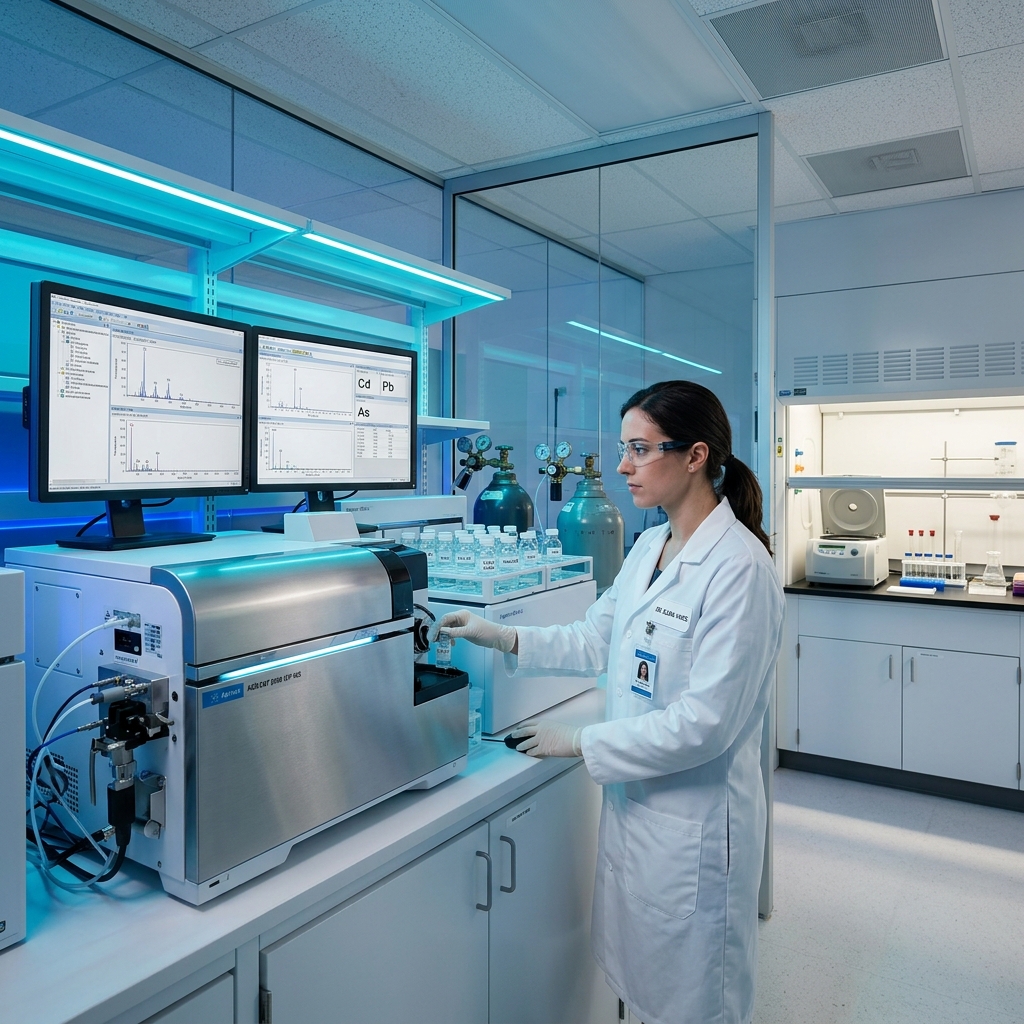
ICP-MS stands for inductively coupled plasma mass spectrometry. First, an argon plasma turns the sample into ions. Then, a mass spectrometer counts those ions by weight. As a result, ICP-MS reaches the lowest limits, often parts per trillion. Moreover, it can measure many elements at once.
ICP-OES
ICP-OES reads the light that excited atoms give off. In general, it works well from parts per billion up to higher levels. Because it is fast and rugged, we often use it for water, soil, and materials.
AAS (Atomic Absorption Spectroscopy)
AAS measures how much light a sample absorbs. Flame AAS suits higher concentrations. By contrast, graphite furnace AAS reaches very low levels for single elements. Therefore, AAS is a strong choice for focused testing.
XRF
XRF uses X-rays to read the elements in a solid. Notably, it does not destroy the sample. For this reason, we use it to screen alloys, coatings, and consumer goods quickly.
SEM-EDS
SEM-EDS pairs high-power imaging with elemental mapping. In other words, it shows not only which metals are present, but also where. Consequently, it helps with particle studies and failure analysis.
Method Comparison at a Glance
| Method | Best for | Typical detection | Sample state |
|---|---|---|---|
| ICP-MS | Ultra-trace, many elements, isotopes | ppt – ppb | Liquid |
| ICP-OES | Trace to major levels, complex matrices | ppb – ppm | Liquid |
| GFAAS | Targeted single-element trace work | sub-ppb | Liquid |
| XRF | Fast, non-destructive screening | ppm – % | Solid |
| SEM-EDS | Particles, mapping, failure analysis | ~0.1% (local) | Solid |
Applications of Trace Metal Analysis
Trace metal testing supports many fields. Each one has its own targets and rules. Below are the most common uses.
Pharmaceuticals and Medical Devices
In medicine, trace metals must stay below safe limits. Accordingly, we test drug substances, products, and device materials. In addition, we support extractables and leachables studies.
Environmental and Water Testing
For the environment, we measure metals in water, soil, and sediment. In particular, drinking water needs tight control of lead and arsenic. Thus, accurate testing helps protect public health.
Food, Supplements, and Consumer Goods
Food and supplements can pick up metals from soil or processing. Therefore, brands test for arsenic, lead, cadmium, and mercury. This step keeps products safe and compliant.
Metals, Alloys, and Electronics
Manufacturers also need to confirm what their materials contain. For example, electronics must meet restricted-substance rules. As a result, we screen for lead, cadmium, mercury, and chromium.
Forensic and Failure Analysis
Finally, trace metals can tell a story. When a part fails, their pattern can reveal the cause. Similarly, elemental clues can trace contamination back to its source.
Regulatory Considerations
A trace result rarely stands alone. Instead, it must meet a clear limit in a specific framework. Below, we cover the rules that shape elemental testing.
Pharmaceutical Limits: USP <232>/<233> and ICH Q3D
For drugs, two frameworks lead the way. First, USP General Chapters set the limits and the approved methods, as the official USP elemental impurities resource explains. In addition, the ICH Q3D(R2) guideline lists 24 elements and sets daily exposure limits by route. Together, they guide most pharmaceutical testing.
Environmental Limits: EPA Methods
For water and waste, the U.S. EPA provides trusted methods. For instance, EPA Method 200.8 measures trace elements by ICP-MS. Because limits keep tightening, low detection power matters more than ever.
Laboratory Quality: ISO/IEC 17025
Beyond the limits, data quality counts too. Notably, ISO/IEC 17025 sets the benchmark for competent testing labs. As a result, results stay traceable and defensible.
| Framework | Scope | Example focus elements |
|---|---|---|
| USP <232>/<233> | Drug elemental impurity limits and methods | As, Cd, Hg, Pb, and more |
| ICH Q3D(R2) | Daily exposure limits for 24 elements | Classes 1, 2A, 2B, 3 |
| EPA 200.8 / 6020 | Metals in water, waste, and soil | Multi-element panels |
| EU RoHS | Restricted metals in electronics | Pb, Cd, Hg, Cr(VI) |
| ISO/IEC 17025 | Lab competence and data quality | All analytes |
Our Trace Metal Analysis Services at Materials Metric
At Materials Metric, our trace metal analysis services cover the full process from start to finish. First, we define your target elements and limits. Next, we choose the right method and prepare your sample with care. Then, we run the analysis with strong quality controls, such as blanks, spikes, and reference materials. Finally, we deliver a clear report that you can use.
Our related services include chemical and elemental characterization, spectroscopic and chemical analysis, and chemical purity and contaminant screening. In addition, our method development and validation team can build a custom method when your project needs one.
Why Choose Materials Metric for Trace Metal Analysis?
Clients choose us for several clear reasons:
- Proven methods: Above all, we follow trusted standards and validated procedures.
- Wide capability: In addition, we handle many elements, matrices, and limits.
- Clear reporting: Furthermore, we explain what each result means for your goals.
- Expert support: Finally, our team guides you from planning through compliance.
Conclusion
In short, trace metal analysis turns tiny amounts of metal into clear, useful answers. Whether you work in medicine, the environment, food, or manufacturing, the right data keeps you safe and compliant. Above all, our trace metal analysis services give you results you can trust. To get started, request a service from Materials Metric today, and our team will help you measure with confidence.