
X-ray Absorption Spectroscopy (XAS)
X-ray Absorption Spectroscopy (XAS) is an advanced, element-specific technique used to probe the local chemical and electronic structure of materials by measuring how X-rays are absorbed as incident energy is varied. XAS provides insight into atomic-scale environments that cannot be resolved by long-range structural methods.
At Materials Metric, XAS is applied through analysis of XANES (X-ray Absorption Near-Edge Structure) and EXAFS (Extended X-ray Absorption Fine Structure). XANES reveals oxidation state, electronic structure, and local bonding, while EXAFS provides quantitative information on coordination numbers, interatomic distances, and structural disorder. These capabilities make XAS essential for studying metals, catalysts, battery materials, biomaterials, and complex systems where short-range order governs performance.
Use of XAS
XAS is used to:
• Determine oxidation states in metals, catalysts, and battery materials
• Analyze the local atomic environment surrounding specific elements
• Identify short-range order in amorphous or nanostructured materials
• Study changes in chemical state during cycling, heating, or chemical reactions
• Characterize composites, coatings, and mixed materials with overlapping phases
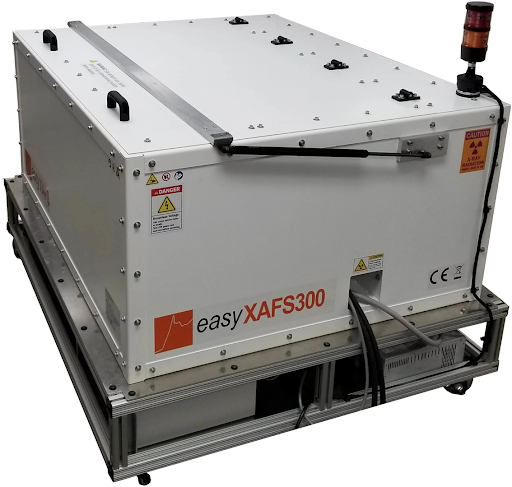
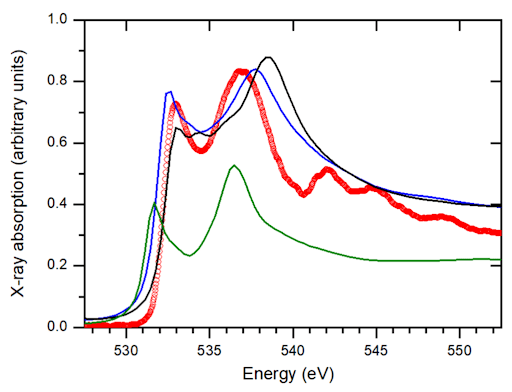
Applications of XAS
• Battery & Energy Materials: cathode/anode oxidation states, cycling behavior
• Catalysts & Nanomaterials: coordination environment, active-site identification
• Metals & Alloys: oxidation, corrosion, and phase transitions
• Ceramics & Composites: dopant states and bond structure
• Polymers & Biomaterials: metal-binding interactions, coordination chemistry
• Environmental & Chemical Materials: trace-metal speciation
Sample Analysis Process
1. Submission & Objective Review
- Identify target element(s) and desired XANES/EXAFS analysis
• Define sample type (powder, pellet, film, slurry, electrode, coating)
• Determine measurement mode (transmission or fluorescence) based on concentration
2. Sample Preparation
XAS is sensitive to sample thickness and homogeneity. Preparation includes:
- Powders: pressed into uniform pellets with appropriate mass loading
• Films/coatings: mounted directly; thickness optimized for absorption edge
• Battery electrodes: tested as-is or dried/processed depending on requirement
• Trace or dilute samples: measured in fluorescence mode
• No dissolution is required, samples remain in solid form
Notes:
• Oxygen- or moisture-sensitive materials may be prepared in inert atmosphere
• Pellets may be prepared with BN or cellulose as diluent
3. XAS Measurement
- X-ray energy scanned across absorption edge of target element
• XANES region analyzed for oxidation state and electronic structure
• EXAFS oscillations analyzed for interatomic distances and coordination
• Data collected in transmission or fluorescence mode depending on concentration
4. Data Processing & Reporting
- Background subtraction and normalization
• XANES fitting and oxidation state assignment
• EXAFS Fourier transform and shell fitting (coordination, bond distances)
• Comparison to reference standards
• Comprehensive, annotated report with structural interpretation
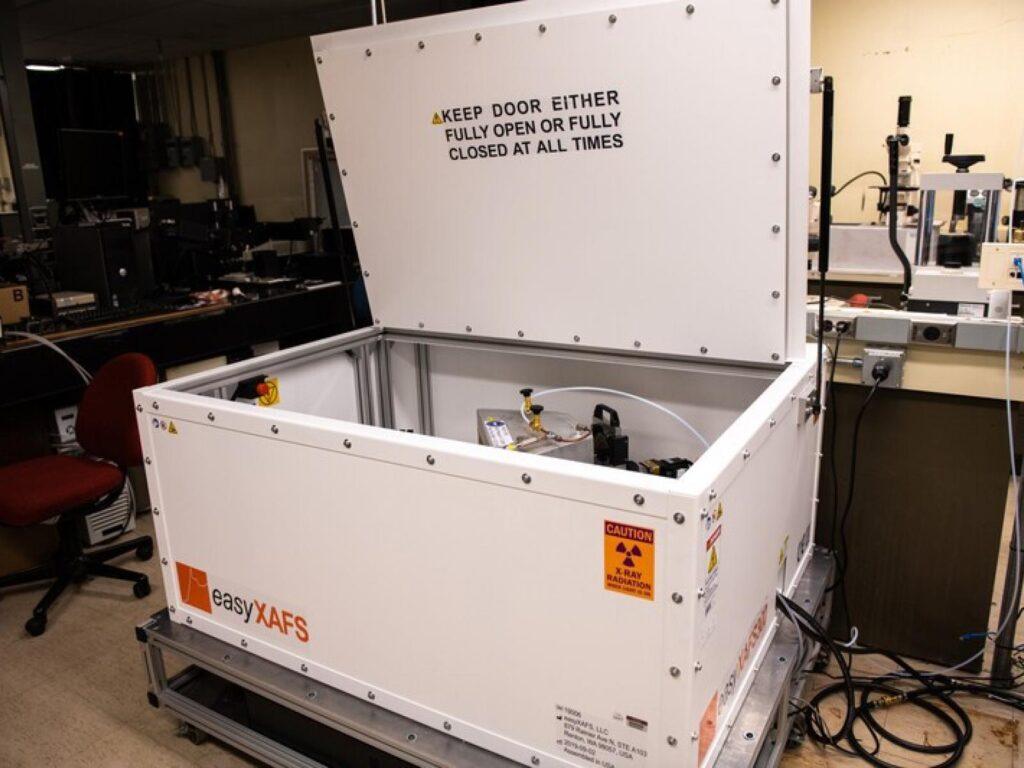
Why Choose Materials Metric for Your XAS Analysis
Materials Metric provides high-resolution XANES and EXAFS analysis with expert structural interpretation tailored to advanced materials research.
Our XAS services offer:
- Element-specific oxidation state and bonding analysis
• Quantitative EXAFS modeling for precise atomic coordination
• Expertise with battery materials, catalysts, nanostructures, and mixed-phase systems
• Support for transmission and fluorescence XAS for low-concentration elements
• Clear, publication-ready reporting with reference comparisons
• Integration with XRD, XPS, SEM/EDS, and ICP data for complete structural–chemical insight
We transform complex XAS signals into actionable structural information that drives R&D, quality control, and materials innovation.