Nanoparticle Tracking Analysis (NTA)
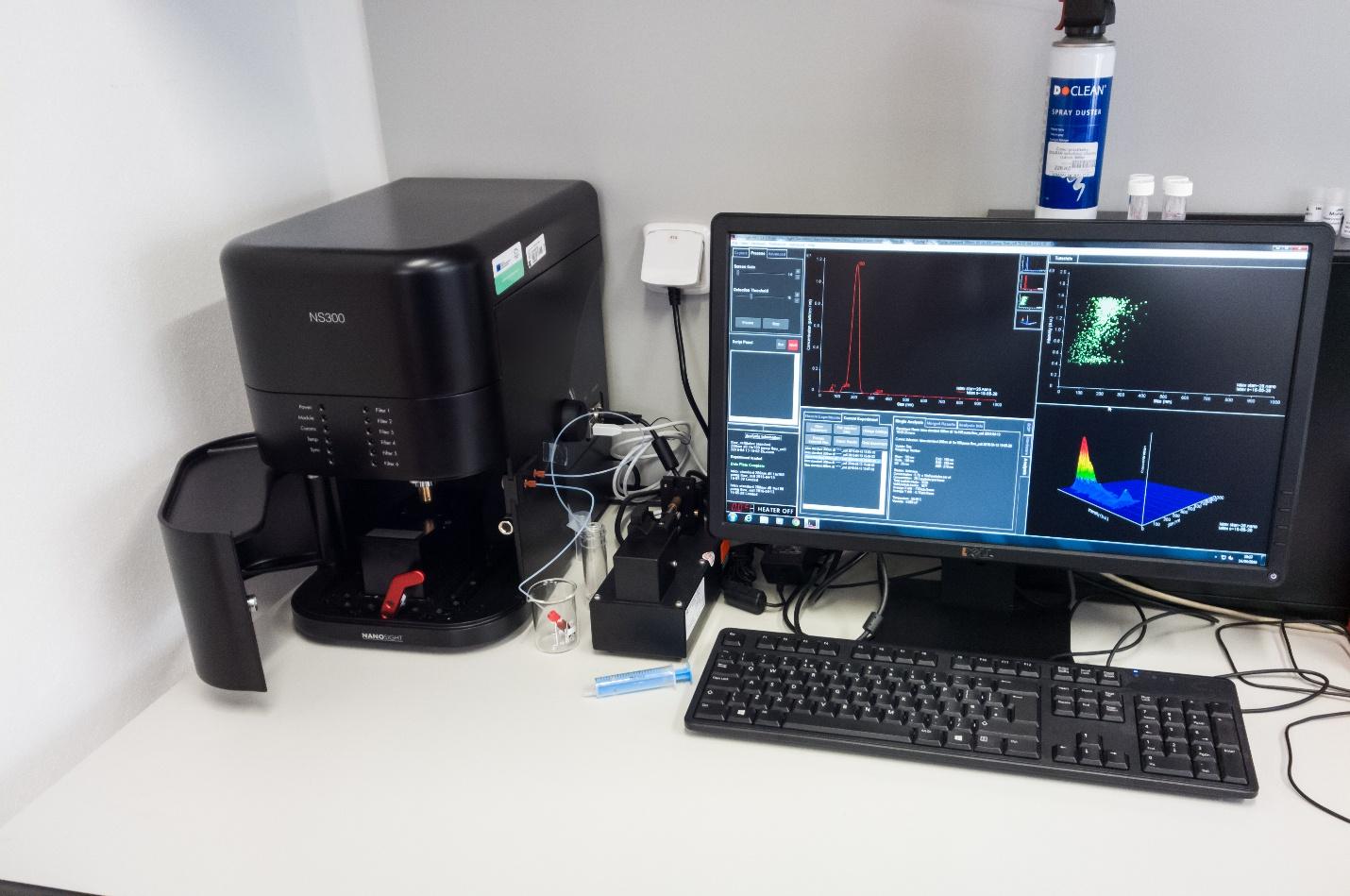
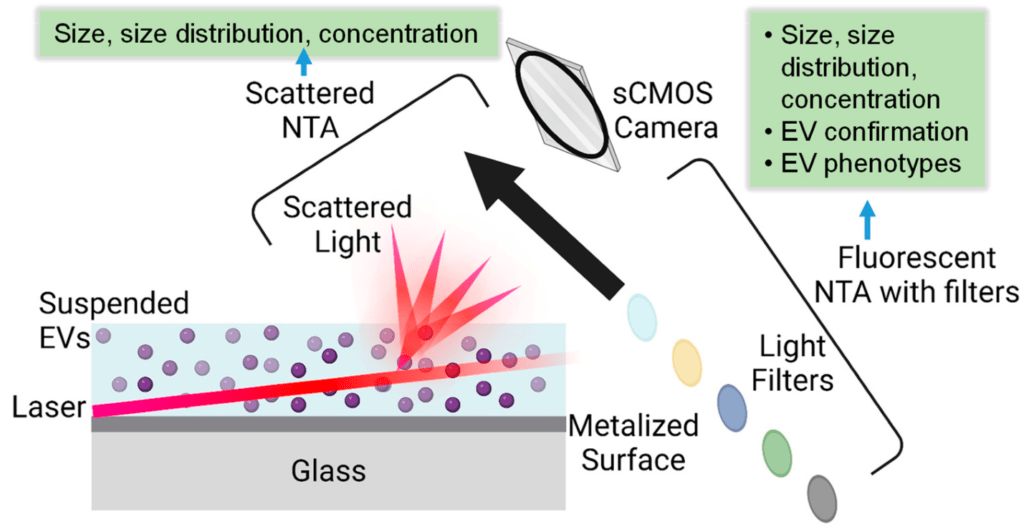
Nanoparticle Tracking Analysis (NTA) is an optical characterization technique used to measure both the size and absolute concentration of nanoparticles in liquid suspension. Unlike ensemble methods such as DLS, NTA directly visualizes individual nanoparticles under laser illumination and tracks their Brownian motion in real time.
At Materials Metric, this single-particle tracking approach provides number-based size distributions, accurate particle concentration (particles/mL), and direct video confirmation of nanoparticle behavior. NTA offers improved resolution for polydisperse systems and is widely applied to biological vesicles, drug delivery nanoparticles, emulsions, polymeric nanoformulations, and environmental nanoparticle analysis.
Use of NTA
- Quantify nanoparticle concentration (particles/mL)
- Measure number-weighted size distributions
- Assess dispersion stability and aggregation
- Characterize extracellular vesicles (EVs/exosomes)
- Compare batch-to-batch nanoparticle uniformity
- Validate nanoformulations during development
- Monitor degradation or aggregation under stress
Applications
- Extracellular Vesicles (EVs) / Exosomes: size & concentration profiling
- Drug Delivery Nanoparticles: polymeric, lipid, metal, or hybrid systems
- Liposomes & Micelles: formulation stability and uniformity
- Polymer Nanoparticles: self-assembled structures and colloids
- Nanotoxicology: environmental nanoparticles, contaminants
- Cosmetics & Personal Care:nanoemulsions, encapsulated actives
- Food & Agriculture: colloidal suspensions, protein aggregates
Sample Analysis Process
1. Submission & Objective Review
- Define expected size range (typically 30–1000 nm)
- Identify whether concentration, size distribution, or stability is the primary goal
- Provide information on sample buffer, viscosity, or surfactants
2. Sample Preparation
- Dilution optimized for ideal particle visibility (avoids overcrowding/underloading)
- Gentle mixing ensures uniform dispersion
- Samples handled under low stress to preserve biological vesicles or sensitive nanomaterials
- Filtration avoided unless specifically required
3. NTA Measurement
- Laser illuminates suspended nanoparticles
- High-speed camera captures their Brownian motion
- Software tracks individual particle trajectories
- Hydrodynamic size and particle concentration calculated from movement and frame density
- Multiple video captures improve statistical reliability
4. Data Processing & Reporting
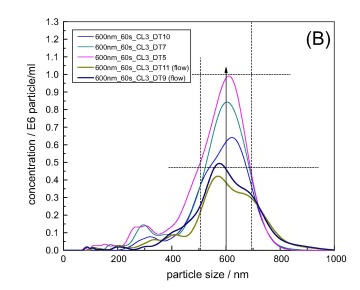
- Number-weighted size distribution
- Particle concentration (particles/mL)
- Distribution histograms and statistical summaries
- Optional stability tracking over time
- Video footage available upon request
- Expert interpretation tied to formulation quality, EV purity, or nanoparticle behavior
Why Choose Materials Metric for NTA Analysis
Materials Metric provides precise NTA characterization with a focus on accurate nanoparticle concentration measurement, making it ideal for biological particles, nanomedicine formulations, and colloidal systems.
Our NTA services offer:
- High-resolution particle tracking for concentration and size
- Improved accuracy for polydisperse or complex nanoparticle mixtures
- Expertise in lipid nanoparticles, polymeric systems, EVs, and protein aggregates
- Careful sample handling to preserve sensitive nano-bio systems
- Integration with DLS, laser diffraction, and chemical analysis for comprehensive nanoparticle profiling
- Clear, publication-quality reporting designed for R&D, regulatory submissions, and quality control
We help you quantify how many nanoparticles are present, how uniformly they are distributed, and how they behave under real conditions.