
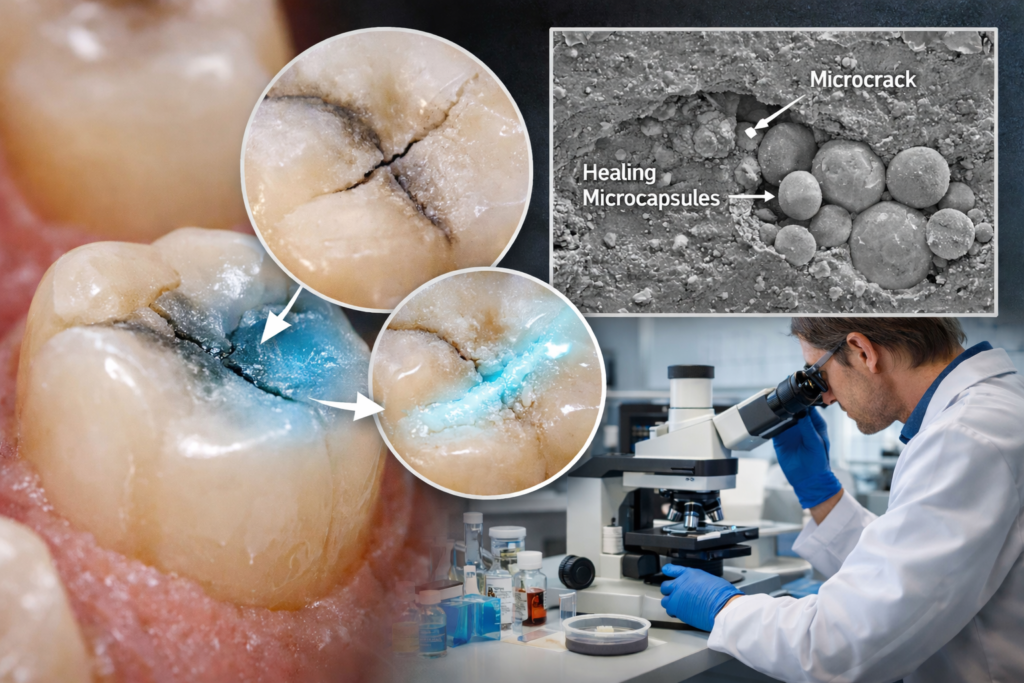
Dental materials are undergoing a major transformation as research shifts toward smarter, longer-lasting solutions. One of the most promising developments is the emergence of self-healing polymers, designed to repair microcracks and damage autonomously, extending the lifetime of dental restorations and reducing secondary failures.
Why Self-Healing Polymers Matter in Dentistry
Dental restorations experience continuous mechanical stress, thermal cycling, moisture exposure, and chemical attack. Over time, microscopic cracks can form, leading to degradation, bacterial infiltration, and restoration failure.
Self-healing polymers address these challenges by:
Repairing microcracks before they propagate
Improving durability and service life of restorations
Reducing the risk of secondary caries and material failure
Lowering the need for frequent replacements
These materials represent a shift from passive restoratives to active, responsive dental materials.
Approaches to Self-Healing in Dental Polymers
Current research explores several mechanisms, including:
Microcapsule-based healing agents released upon damage
Reversible covalent and supramolecular bonding systems
Polymer networks capable of thermal or moisture-activated healing
Each approach introduces new material variables that must be carefully characterized and validated.
How Materials Metric Supports Self-Healing Dental Materials
Materials Metric provides custom testing solutions to support the development and validation of self-healing dental polymers, including:
Chemical and structural characterization to confirm healing chemistry
Thermal and mechanical testing to assess durability before and after healing
Microscopy and surface analysis to visualize crack formation and repair
Custom protocol development to simulate oral conditions
Our testing workflows help researchers quantify healing efficiency, long-term stability, and performance under clinically relevant conditions.
Enabling Smarter, Longer-Lasting Dental Materials
Self-healing polymers are redefining expectations for dental materials performance. By pairing advanced material design with precise, application-specific testing, Materials Metric helps accelerate the transition of these innovations from research to real-world dental applications.